
Picture a neighbor who has gardened the same half-acre plot for 40 years. Her tomatoes go in on a specific Tuesday, her carrots always on a Friday two weeks later. Ask her why, and she won’t say “the calendar told me to.” She’ll lean on her shovel, glance at the sky, and say something like: “I wait for the window.” Most beginners have no idea what she means. By the end of April, they usually find out the hard way.
The 5-day sowing window that experienced gardeners watch for in April is not a marketing gimmick or a gardening myth. It is the convergence of three independent factors: soil temperature reaching a reliable threshold, the last frost date for your specific zone passing with high probability, and a stable weather pattern that won’t wash your seeds out or freeze them back into dormancy. Miss it, and you’re either sowing into cold mud that rots your seeds before they sprout, or you’re scrambling in May to replant what didn’t take. Catch it, and the whole season snaps into alignment.
Key takeaways
- There’s a hidden convergence of three factors that creates the perfect sowing window most gardeners overlook
- Soil temperature readings beat the calendar and air temperature every single time—here’s what pros measure
- Why frost dates are averages, not guarantees, and how to predict your actual window with precision
Why Soil Temperature Beats the Calendar Every Time
Most beginners make the same mistake. They check the date, see “mid-April,” and throw seeds in the ground. Experienced gardeners check the soil. A consistent soil temperature is a much better indicator of when to plant seed than air temperature or the calendar. The air might feel warm on a sunny afternoon, but two inches underground, where germination actually happens, conditions can be completely different.
Most seeds for warm-season edibles prefer soil temperatures between 70 and 80 degrees Fahrenheit, and when the soil temperature is too cool, seeds may take longer than expected to germinate or will never germinate at all. Cool-season crops are more forgiving, but only to a point. Lettuce seeds and pea seeds can germinate when the soil is in the 30s, but it takes them longer, and a seed that might sprout in a week when the soil is in the 60s could take three weeks or longer if it’s in the 40s, leaving plenty of time for rot or other problems to set in.
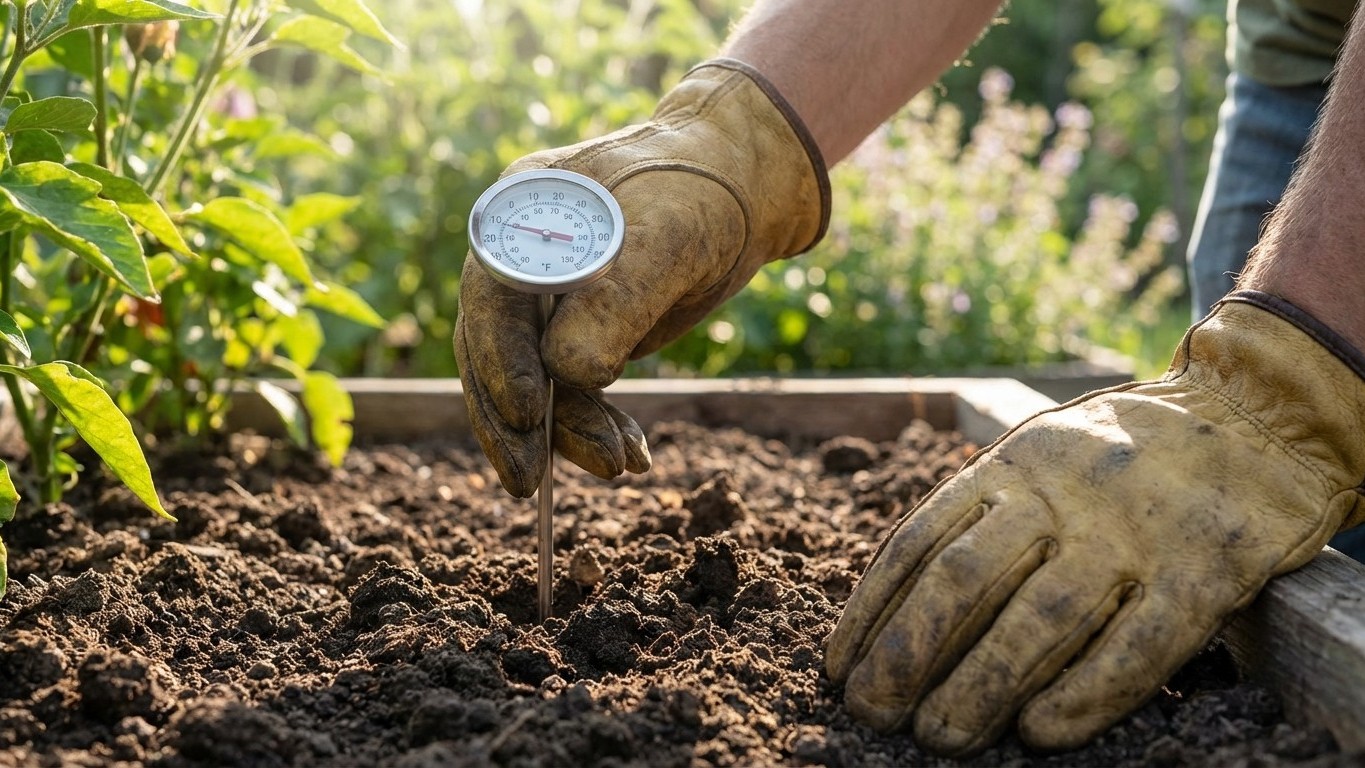
The fix is simple and costs almost nothing. A soil thermometer is an easy-to-use, indispensable tool that can make gardening from seed more successful, helping you achieve a great germination rate. Stick the probe two inches deep in the morning, then again in the evening. Taking and recording readings twice a day for a couple of days will give you an even more accurate average of your current soil temperature. That average, not the date on your phone, tells you whether your 5-day window has arrived.
The Frost Date Factor: Averages Are Not Guarantees
Your last spring frost is the average final date when temperatures may dip to 32°F. After this point, the risk of frost decreases, but frost is still possible, so you should always monitor your local weather forecast. That word “average” is doing a lot of heavy lifting. Old gardeners know this intuitively. Beginners tend to treat the published last frost date like a hard deadline, as if nature runs on a schedule.
While it’s important to know your frost dates, it’s equally important to understand these dates are only estimates and do not account for unusual weather events, such as abnormally warm spells or sudden cold snaps. They also don’t take into account your particular microclimate, which can affect your frost date by as much as a few weeks. A garden in a low-lying spot might frost two full weeks after a neighbor’s on a gentle slope above it. Temperatures can be highly variable within small distances due to topography; minimum temperatures can vary as much as 10°F from the bottom of a valley to a nearby hilltop, because cool air, being more dense than warm air, moves down slopes and accumulates in valleys.
The practical move is to treat frost dates as a probability, not a certainty. There is no way to forecast the exact last freeze months in advance, so climatologists use past observations to calculate the probability of freezing temperatures after certain dates. Your 5-day window opens when the 5-day forecast shows no night below 35°F and you’re comfortably past your zone’s last frost date. Both conditions, together, not just one.
What the Old Farmers’ Almanac Tradition Gets Right
There is a third layer to this, one that divides rational gardeners into two camps: lunar timing. For over 200 years, the Farmer’s Almanac has included a Planting Calendar that uses phases and position of the Moon to predict the best times to perform specific gardening tasks. Skeptics (reasonable ones) point out that science hasn’t confirmed a dramatic effect. Controlled scientific studies have found no measurable difference in germination rates, growth patterns, or yields between lunar-timed and conventional planting schedules. Fair enough.
But here’s what the tradition actually does well, independent of whether the moon affects sap flow: it creates a disciplined rhythm. Even if you stay cautious about the science, the routine can help you stay organized, observe your plants more closely, and keep a steady flow of tasks through the month. Moon gardening starts with two things: the lunar cycle and your usual regional planting calendar, and you still respect frost dates, soil temperature, and daylight hours. The moon calendar forces you to plan ahead. And in April, planning ahead is exactly what separates a gardener who catches the window from one who misses it.
From the New Moon to the First Quarter, moisture is said to rise, encouraging leaf and stem growth, making this the period considered best for planting above-ground crops like lettuce, tomatoes, beans, and squash. Whether or not you subscribe to the gravitational theory, aligning your sowing with a 5-day stretch that also happens to coincide with stable, frost-free weather is just sound planning.
How to Identify Your Personal Window This April
April is a transition month in most zones. Early April still carries the risk of late frosts in many areas, while late April often feels like true spring has arrived. The window, for most gardeners in USDA Zones 5 through 7, typically falls between April 10 and April 25. It shifts earlier if you’re in warmer zones, later if you’re farther north.
Concretely, here’s what to watch for simultaneously. Check your 7-day forecast and identify a stretch of at least 5 days without predicted frost. Take your soil temperature readings and confirm the soil is holding above 50°F for cool-season crops (spinach, peas, carrots, lettuce) or above 60°F for slightly warmer-season starts. During a cold spring, it’s better to delay sowing to ensure the soil temperature is warm enough than to be hasty and get disappointing results. That advice, from The Old Farmer’s Almanac, sounds simple. Applied in April, it’s the single difference between germination and rot.
Experienced gardeners often prepare their beds ahead of time so they can plant quickly when the conditions arrive with good weather. That’s the real secret. The window itself is not the hard part. The hard part is having your beds ready, your seeds on hand, and your soil pre-amended so you can move in 24 hours when conditions align. Beginners aren’t late because they don’t know the window. They’re late because they weren’t ready when it opened.
This April, before you reach for a seed packet, reach for a soil thermometer. Watch the 5-day forecast the way you watch a weather window before a camping trip. And consider which crops go in first: you can direct-sow cold-hardy crops as soon as the soil can be worked, including peas, spinach, lettuce, radishes, carrots, and beets. The rest, including tomatoes and basil, are waiting for a warmer window you’ll catch in May. The question worth sitting with is this: if a single week in April can define the shape of your entire growing season, what else in life deserves that same kind of attention to timing?
Sources : gardeningknowhow.com | gardeners.com