
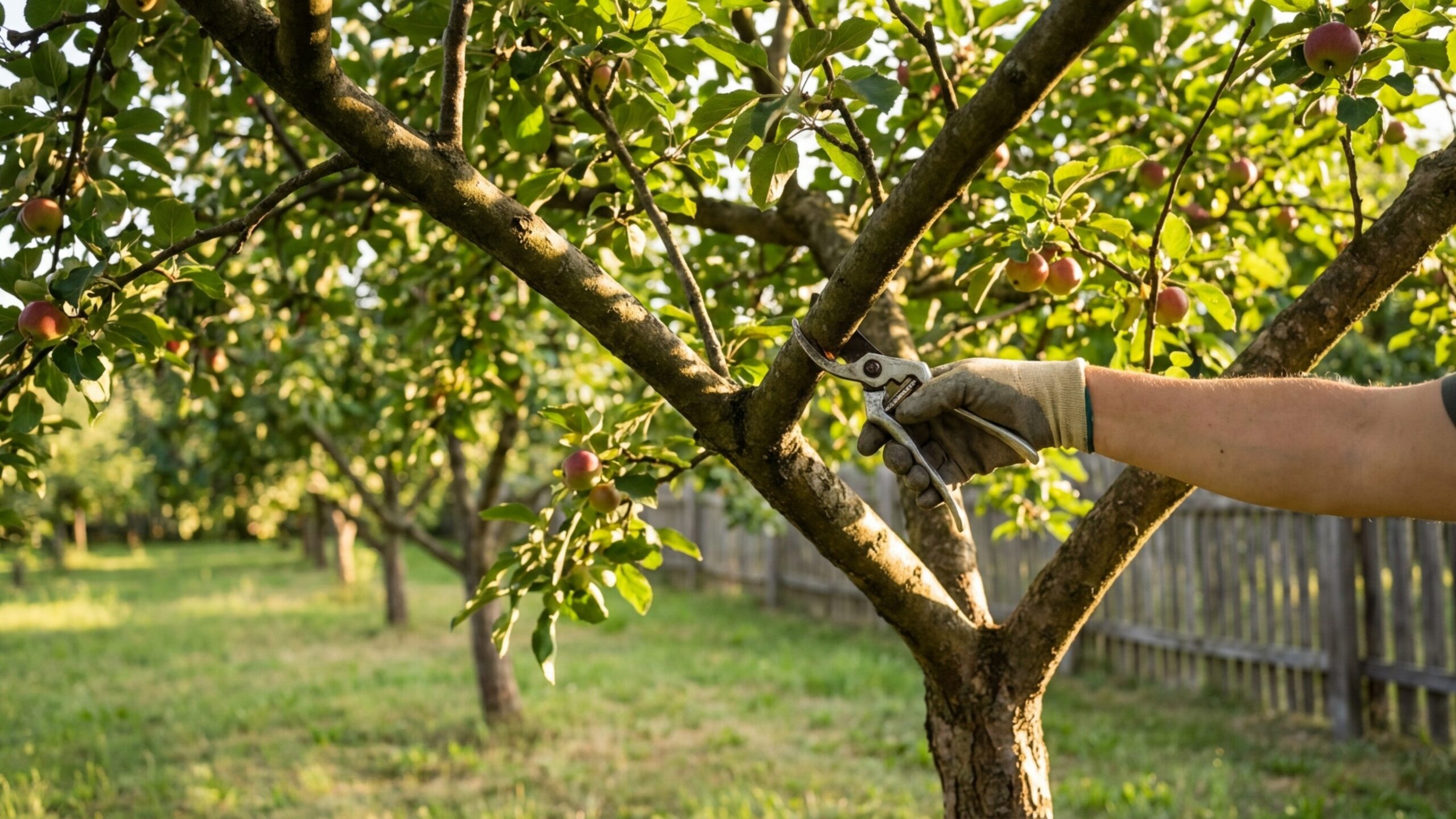
Your fruit tree is loaded with lush green growth right now, branches stretching in every direction, leaves catching every bit of summer light. It looks like abundance. So the idea of reaching in with your pruning shears and cutting large sections of it away, while fruit is actively forming, feels almost criminal. But that instinct to protect is exactly what’s keeping your harvest mediocre.
The counterintuitive move professional orchardists have used for decades? Pruning in summer, not just in winter. And more specifically, removing growth that your tree has already invested energy in producing. Summer pruning may seem counterintuitive, because removing branches and leaves reduces the total amount of photosynthesis that the plant can perform, which slows plant growth during the remainder of the growing season. And yet, that’s precisely the point.
Key takeaways
- What looks like destruction in July transforms into an extraordinary harvest by August
- The mysterious reason fruit trees refuse to produce heavily—and the single cut that changes everything
- A forgotten orchardist’s rule reveals why most home gardeners never see their trees’ full potential
Why Cutting Back a Thriving Tree Actually Makes Sense
Think of your fruit tree as an overambitious project manager, it wants to grow taller, push new shoots, expand its canopy, and do all of this simultaneously. If you’ve ever wondered why your tree fails to produce a heavy fruit set even though it’s lush, green, and large, it’s because the tree has no reason to fruit. Life is good, there are no threats, plenty of fertilizer, daily irrigation — why should it waste energy making fruit? Pruning changes that calculus entirely.
Fruit is a way for trees to spread their seed. When a tree is put in a survival mode via pruning, it gives the command to push out fruits to propagate itself into the landscape. You’re not damaging the tree. You’re redirecting it. There’s a real difference between those two things, and understanding it changes everything about how you approach the garden.
Summer pruning improves fruit yield by inducing rapid formation of fruiting buds and spurs below the cuts, spurs being short, stubby branches, often no longer than two inches, on which some fruit trees grow their fruit. That’s the mechanism. Cut a shoot off above a cluster of growth, and the tree responds by forming the very structures it needs to carry fruit next season and this one.
The Key Move: Opening the Canopy
The single most productive cut you can make right now is removing growth from the center of the tree. Dense, crossing, inward-facing branches are energy thieves. The interior of unpruned trees tends to be too shady for good production. Fruit needs sun, obvious in theory, yet constantly overlooked in practice because we hesitate to remove anything that looks healthy.
Remove any branches that grow towards the center (these reduce air flow), downward (too weak to support fruit), or that cross other branches. Circulation and allowing light into the center of the tree is the goal. The old orchardist’s rule of thumb is blunt and memorable: you should be able to throw your hat through the middle of the tree. If you can’t, you’ve got work to do.
Summer pruning allows more sunlight to reach developing fruit, improving both size and sugar content. The apples (or plums, or pears) develop that deep, rich color that only comes from adequate sun exposure. This isn’t a marginal gain, better light penetration is the difference between grocery-store fruit and something you’d Actually brag about.
Water sprouts deserve special attention here. These are the vertical, whip-like shoots that shoot straight up from branches and seem to multiply overnight. Pruning maximizes fruit production and health by controlling vegetative growth. Shoots, water sprouts, and vertical branches drain a tree’s energy. Cut them out at the base. No hesitation needed.
Timing Is Everything (And Most People Get It Wrong)
The shift to summer pruning, specifically during mid to late July, aligns perfectly with the apple tree’s natural growth cycle. By midsummer, the tree has completed its major spring growth phase and is beginning to redirect energy toward fruit development and root growth. You’re working with the tree’s biology, not fighting it.
Apple and pear trees should be pruned primarily during the summer, from late June to early September. For stone fruits like cherries, plums, apricots, and peaches, the window is ideally between June and August, to minimize the risk of diseases like bacterial canker and silver leaf. These aren’t arbitrary dates, they reflect when wounds heal fastest and when disease pressure is lowest.
One practical warning worth noting: avoid pruning if rain is in the immediate forecast. Rain can stir up disease elements, like fungal spores, that may take advantage of fresh pruning cuts. Pick a dry stretch of weather, make your cuts clean, and don’t go overboard in a single session.
The Second Counterintuitive Move: Thinning the Fruit Itself
There’s a companion technique that amplifies everything above, and it’s even harder to bring yourself to do. If you want to get the most from a bumper crop of forming fruit, you’ll need to remove some of those fruits now. It sounds counterintuitive, but there’s logic behind this apparent madness.
Selectively removing young fruits is called thinning. Many tree fruits, including apples and pears, naturally thin their fruits in early summer during the so-called June drop. But thinning further can help trees stay in good shape and produce a more useful crop. The fruit you leave behind will be genuinely larger, sweeter, and better colored than anything a crowded, unthinned tree could produce.
Thinning also stops trees from cropping heavily one year, only to produce very few fruits the next, a phenomenon known as biennial bearing. If your tree seemed to “skip” a year recently, that’s probably what happened. For eating apple varieties, aim to leave about 4 to 6 inches between individual fruits. For larger cooking apples, look for around 6 to 9 inches between fruits.
The psychological barrier here is real. Pulling young fruit off a tree that you’ve spent months nurturing feels like failure. But consider what you’re actually doing: choosing quality over quantity, forcing the tree to concentrate its energy into fewer, better fruits. Summer pruning helps balance fruit load and vegetative growth, ensuring trees do not become overburdened with fruit, allowing the tree to allocate more resources to developing larger, higher-quality fruits.
The gardener who can override the instinct to leave every branch intact, every shoot growing, every tiny fruit on the cluster, that’s the gardener who walks away with an extraordinary harvest. The trees that look a little severe in July are the ones that make you stop in your tracks come August. Pruning shears in hand, ask yourself: are you managing a tree, or just watching one grow?