
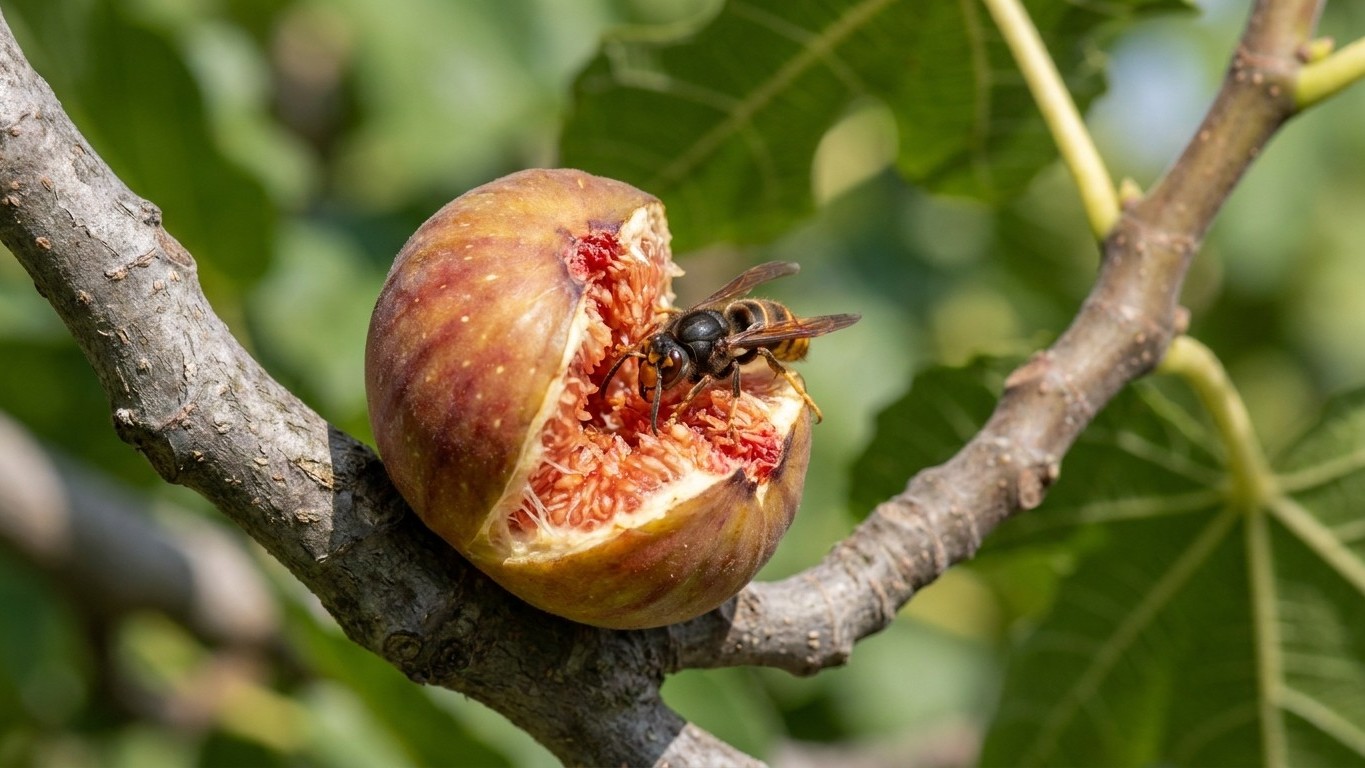
Every spring, well-meaning gardeners hang plastic bottles filled with beer, wine and sugary syrup from tree branches, hoping to stop the Asian hornet invasion before it starts. The problem: spring trapping is discouraged without a highly selective trap, since 99% of insects caught in a non-selective trap are not Asian hornets. A far more useful moment to act arrives later in the season, when ripening fruit on your apple, pear, fig or plum trees turns into a natural hornet magnet, and a much better early-warning system than any bottle trap.
Key takeaways
- Spring traps are a ecological trap—99% of caught insects aren’t the target species
- Hornet behavior completely changes in August when they hunt sugar instead of protein
- A single overripe fig or bruised pear reveals more in minutes than weeks of spring trapping
The spring trap problem nobody wants to admit
The math behind spring trapping looks appealing on paper. Each fertilized queen destroyed means one less hornet nest and 11 kg of insects, honeybees and wild pollinators, saved. But peer-reviewed field data tell a messier story. A study published in Apidologie found that even the best-performing traps and baits, tested across both seasons, caught only 3.65% of the target species in spring and 1.35% in autumn out of all trapped insects. The rest was bycatch: bees, hoverflies, butterflies, beetles, the pollinators your garden actually needs.
France took notice. Since a law passed on March 14, 2025, homemade bottle traps are banned in France, with three approved models now recommended nationally. Belgian researchers reached a similar conclusion from the other direction: nest control remains the only effective population-level management method, even as selective spring trapping for queens grows more popular among beekeepers. A four-year monitoring project in Brittany measured the trade-off directly and found total bycatch weighing 200 to 300 grams per year, compared with a single secondary nest that can collect 11.32 kg of insect biomass across 159 species. Trapping isn’t worthless, but it’s a blunt instrument used at the wrong scale by most home gardeners.
Why August fruit tells you more than any trap ever will
Hornet behavior flips completely once summer peaks. In spring, foundress queens hunt sugar to restart their metabolism after hibernation; by midsummer, workers switch to hunting protein to feed larvae. Then, in August, their dietary needs change again: the adults turn toward sugary sources. Their activity peaks between July and October, and it’s specifically during fruit ripening that hornets become genuinely visible in a garden.
Figs are the classic giveaway. Ripe, sweet fruit like figs attracts hornets particularly, and overripe or slightly split figs release a powerful sweet scent that draws them in, whether they feed directly on the fruit or on those fallen to the ground. Figs aren’t alone on the menu. The attraction isn’t limited to fig trees: apple trees, with their fallen fruit, pear trees and plum trees also rank among the favored trees. Damaged fruit is the real trigger, not the tree itself. In August and September, overripe pears, apples, figs and plums attract hornets massively; they cut into the fruit’s flesh and extract sugars to feed the colony’s adults.
That’s the trick worth remembering. A single split fig or a bruised pear left on the ground does more to reveal hornet presence in ten minutes than a week of checking a spring trap. And unlike a trap, which only tells you a hornet existed once it’s dead inside, live fruit-feeding hornets give you something spring trapping never can: a flight path.
Turn a fruit tree into a hornet tracker
Once hornets settle into a feeding rhythm on a ripe fruit tree, they fly the same route back and forth, over and over, toward their nest. Entomologists and pest-control guides agree this repetitive traffic is the single best clue for locating a nest before autumn leaf-fall makes it obvious. If you see several hornets always passing in the same direction, observe their path from a safe spot; the back-and-forth trips can reveal the nest entrance or a hunting zone, especially near a beehive, ripe fruit or a water source. The rule that follows matters just as much: don’t try to follow the insects through a hedge or under a roof, since that’s often when people end up too close; caution beats an overly persistent check.
This is where checking your fruit trees in August beats spring trapping on every practical level. You’re not guessing whether a bottle of fermented syrup happened to lure in a queen among hundreds of drowned bees. You’re watching real, current activity, tracing it to its source, and reporting a located nest to your town hall or a licensed pest-control operator instead of intervening yourself. A nest can become dangerous very quickly, so it’s wiser to report its presence to qualified people or your municipality’s relevant services.
Simple garden habits reinforce the method. A plum tree left unpicked in August is an open invitation, and a fig tree whose fruit bursts in the heat is even worse. Collecting fallen fruit daily during ripening season removes the buffet that draws hornets close to your terrace in the first place, while leaving a few marked, uncollected fruits under close watch turns your orchard into exactly the kind of monitoring post that scientists set up on purpose, minus the paperwork.
None of this replaces professional nest destruction, which remains the only method that actually dents a local hornet population rather than just counting it. But treating your pear tree as a listening post in August, rather than treating your garden fence as a trapping range every March, costs nothing, kills no bees by accident, and gives you the one thing a trap never will: an address.
Sources : link.springer.com | pureportal.inbo.be