
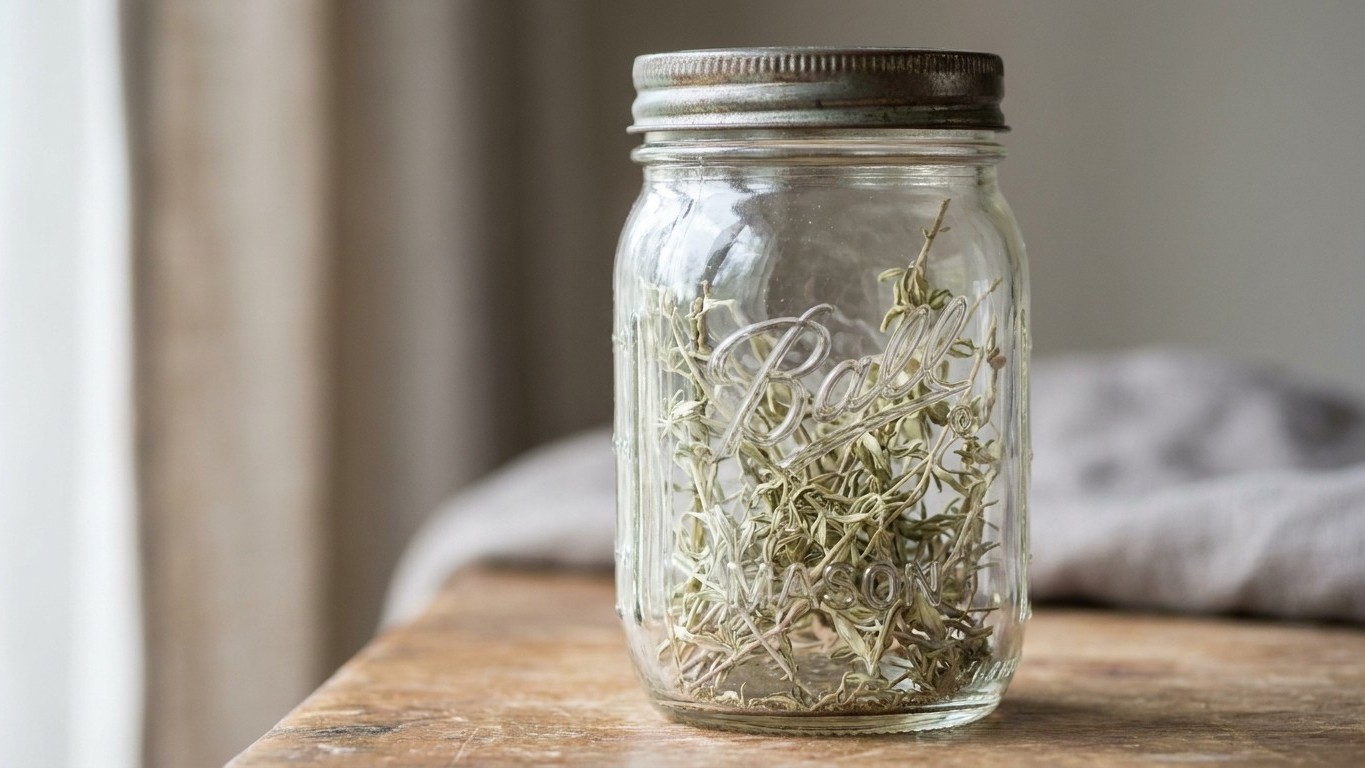
That jar smelled like nothing. Not dust, not must, just a faint whisper of what used to be thyme and savory, as if someone had opened the window and let the scent slip out weeks before you noticed. The heat you thought would speed things along had actually stolen the one thing you were trying to save.
Here’s what actually happened on that sunny windowsill or patio table: the essential oils inside those leaves, the tiny reservoirs that give thyme its sharp, peppery bite and savory its warm, slightly bitter edge, cooked off before the water even finished evaporating. Every culinary herb stores its flavor in microscopic oil glands embedded in the leaves and stems, and those glands are remarkably heat-sensitive. Direct sun doesn’t just dry herbs faster. It dries them recklessly.
Key takeaways
- The one thing that seems perfect for drying herbs is actually their greatest enemy
- Heat and light trigger a chemical reaction that erases 30-60% of what makes herbs taste good
- The jar you open a month later will barely smell like anything—and there’s a reason for that
Why the sun betrays you
Sunlight does two things at once, and both work against you. First, there’s the heat itself. To dry herbs effectively, you need a consistent temperature between roughly 90°F and 110°F, a range that’s ideal for preserving the essential oils and flavors within the herbs. A jar left in full August sun can easily blow past that ceiling, sometimes climbing well above what any recipe or extension guide recommends.
Then there’s the light itself, independent of temperature. Researchers who study essential oil degradation point to something called autoxidation. The presence of light, either ultraviolet or visible, accelerates the autoxidation process by triggering hydrogen abstraction, which leads to the formation of lipid alkyl radicals during sun-drying, when herbs are exposed to direct sunlight. Translation: the sun doesn’t just evaporate water, it chemically breaks down the very molecules responsible for thyme’s thymol and savory’s carvacrol, the compounds that give these two herbs their punch in the first place.
This isn’t a niche opinion from one gardening blog. The University of Georgia’s National Center for Home Food Preservation is blunt about it: sun drying is not recommended because the herbs can lose flavor and color. Penn State Extension lists sun drying right alongside oven drying as a method with real limitations. Heat, low humidity, and air movement are needed to dry herbs, but sun drying and oven drying have limitations.
The 30 to 60 percent you never see coming
The numbers here are more dramatic than most home cooks expect. One culinary guide puts it plainly: most cooks lose 30 to 60 percent of their herb’s essential oil content before the jar even reaches the spice rack, simply because they chose speed over temperature control. That’s not a rounding error. That’s the difference between a pinch of dried thyme that perfumes a whole pot of soup and one that might as well be green sawdust.
Savory suffers the same fate, maybe worse, because its flavor compounds sit close to the leaf surface, ready to volatilize the moment temperatures spike. Open any dried thyme jar that’s been sitting in a cabinet for months and rub a pinch between your fingers. If you smell almost nothing, the thyme was not the problem, the drying method was. That’s precisely the sensation described here: opening the jar a month later and finding almost nothing left to smell.
There’s a second, quieter loss too: color. Sun-baked herbs tend to fade toward a dull olive or grayish brown instead of holding onto that deep green. Direct sunlight and hot temperatures can damage or reduce the volatile essential oils found in herbs, negatively impacting their flavor, potency, and color. A jar of pale, faded thyme isn’t just less flavorful, it looks tired sitting on a spice rack next to herbs that were dried properly.
What actually works, and why it’s slower on purpose
The fix isn’t complicated, but it does require giving up the instinct that heat equals speed equals efficiency. Air drying is perfect for herbs like rosemary, thyme, and sage, which have sturdy leaves. Tie herbs into small bundles using string or twine, then hang them upside down in a cool, dry place away from direct sunlight. A pantry shelf, a closet, even a shaded corner of a garage all work better than a sunny counter. Expect the process to take longer. Allow herbs to dry for 1 to 3 weeks depending on humidity, which sounds glacial compared to a single hot afternoon, but that patience is exactly what protects the oils.
For anyone who wants speed without sacrificing flavor, a food dehydrator is the closest thing to a shortcut that doesn’t cheat. Dehydrator drying is a fast and easy way to dry high quality herbs because temperature and air circulation can be controlled, with the thermostat set to 95°F to 115°F. Some models even let you dial in humidity settings for particularly damp climates, which matters because herbs should be dried where humidity is under 60%.
Once the herbs are actually dry, the storage habits matter almost as much as the drying method. Preserving the essential oils in herbs is important for the best flavor, and this requires keeping herbs away from sunlight and using low heat to dry them. That means the jar’s final resting place shouldn’t be a sunny windowsill either, no matter how pretty it looks catching the afternoon light. It’s best to dry and store herbs in a cool, dark place, though complete darkness isn’t required. A cabinet away from the stove, tightly sealed, does more for flavor than any amount of decorative display ever will.
Thyme and savory are famously forgiving plants, the kind that survive drought, poor soil, and neglect without complaint. It’s almost ironic that the one thing they can’t survive is a well-meaning gardener trying to help them along a little too fast, under a sun that was never invited to the drying process in the first place.
Sources : gardeningdream.com | pindersnursery.com