
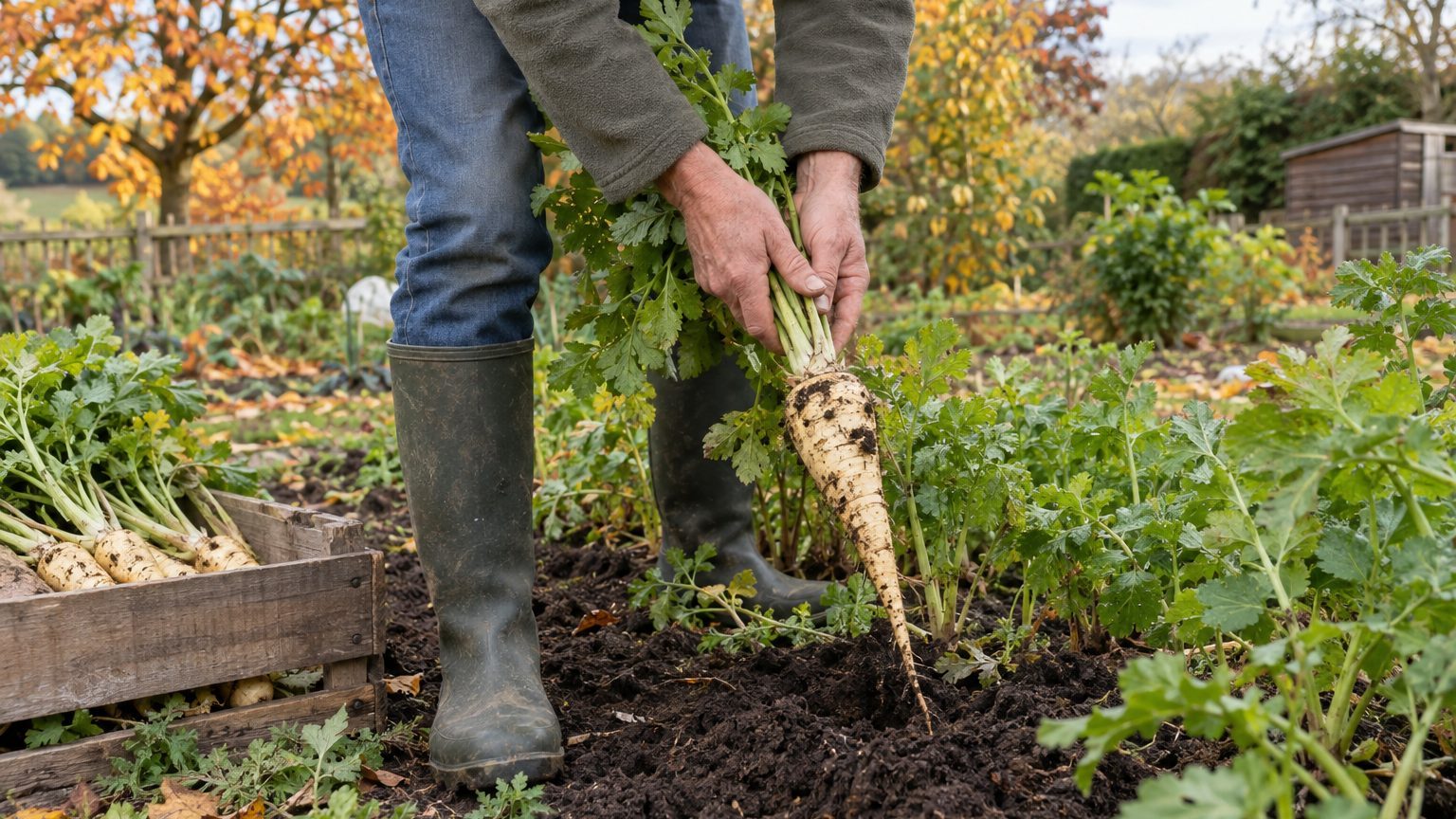
A forked parsnip is almost never a seed problem. The root split because something stopped its growing tip, or because the soil swung from bone dry to soaked, and the plant improvised.
Three culprits account for most of the twisted, legged, multi-pronged roots that turn up at harvest: obstructions in the soil, fresh manure, and uneven watering. Fix those and the parsnips come out straight.
- Stones, compacted clay and buried debris make the taproot branch around the obstacle.
- Fresh, undecomposed manure damages the root tip and leaves pockets that split the root.
- Uneven watering, with long dry spells followed by heavy soaks, causes splitting and forking.
The taproot has one job, and anything in the way ruins it
A parsnip is a taproot. It sends one growing point straight down, and the fat, tapering root we eat is the swollen result of that single descent.
Hit a stone, a lump of compacted clay or a buried chunk of brick, and that tip either dies or turns aside. The root then sprouts new tips around the obstacle, which is how you end up with a parsnip that looks like it has trousers on.
Soil depth matters more than most gardeners expect. Mature roots commonly reach 12 inches or more, and some varieties go well past that, so loosened soil needs to go down at least that far. A shovel-width of tilled topsoil sitting on hard subsoil is a trap.
Sifting is tedious but worth it.
Many experienced growers dig the bed in autumn or winter, pull out every stone larger than a marble, and break up clods by hand. Frost does some of the work for you, crumbling heavy lumps over the cold months. If your ground is stony beyond hope (think glacial till in New England, or rocky clay in parts of the Midwest), raised beds at least 12 to 15 inches deep filled with loose, sandy loam sidestep the whole problem.
Fresh manure: the mistake that feels like generosity
Gardeners love to feed vegetables, and parsnips seem hungry, since they sit in the ground for months. But fresh manure is one of the surest ways to get forked roots.
Rich, nitrogen-heavy material encourages leafy growth and, more to the point, it can burn or damage the young root tip. Fresh manure also leaves pockets of undecomposed material in the soil. The root meets these pockets, branches, and you get hairy, split results.
The same logic applies to the bed’s recent history. Manure applied the previous autumn and well worked in is usually fine, while manure forked in a few weeks before sowing is not. Compost that is fully broken down, dark and crumbly, is a safer way to improve the bed.
Plan ahead. Put the manure on whatever crop precedes the parsnips, such as squash or potatoes, and let the parsnips inherit the leftover fertility without the raw material.
Too much nitrogen overall also pushes top growth at the expense of root shape, so a light hand pays off. A modest dose of a balanced fertilizer before sowing is enough for most soils, and a soil test will tell you if even that is needed.
The watering mistake that splits the root
Here is the one that surprises people, because it happens in perfect soil. Parsnips seeded in spring spend a long, slow summer sizing up, and during that stretch the soil moisture rarely stays steady.
A dry spell lets the root skin toughen and slow down. Then a heavy rain or a long, deep soak arrives, and the interior swells faster than the outer layer can stretch. The result is cracking or splitting along the length of the root, the same mechanism that splits carrots and tomatoes after a storm.
Splitting and forking are cousins but not twins. A split root has cracked open, while a forked root has branched. Both come from stress, and uneven moisture contributes to each.
Consistency beats quantity.
A reasonable target is about an inch of water per week, delivered in one or two deep sessions rather than daily sprinkles, which encourage shallow roots and a crusted surface. A 2- to 3-inch mulch of straw or shredded leaves slows evaporation and smooths out the swings between wet and dry. In a hot, dry summer, check the soil a few inches down; if it is dusty, water.
Germination is its own watering puzzle. Parsnip seed is notoriously slow, often taking two to four weeks to sprout, and a bed that dries out in that window gives patchy stands. Gardeners keep the surface damp by laying a board or a strip of burlap over the row until seedlings show, checking daily and removing the cover at the first green.
Small decisions at sowing that prevent crooked roots
Seed freshness is a quiet factor. Parsnip seed loses viability fast, so buying new packets each year beats saving last season’s leftovers. Poor germination leads to gaps, and gaps lead to roots with room to sprawl in odd directions.
Thinning also counts. Seedlings crowded together compete and distort one another, so aim for roughly 3 to 4 inches between plants once they are established. Thin by snipping with scissors instead of pulling, which disturbs neighbors’ roots.
Direct sowing is the rule. Parsnips resent transplanting because any damage to the taproot at that early stage almost guarantees a fork. Skip the starter pots, and sow where the plants will finish, usually in mid-spring once the soil has warmed a little.
Then there is a trick some gardeners swear by for tough ground: making planting holes with a dowel or crowbar, filling them with fine sifted compost or sand, and sowing into each. The root follows the easy path down. It takes an afternoon, and it can rescue a bed that would otherwise grow nothing but stubby, tangled roots.
Are forked parsnips still worth eating?
Yes. A forked parsnip tastes the same as a straight one; only peeling gets fiddly. Roast them, mash them, or simmer them into soup, and nobody at the table will ever know.
Parsnips also sweeten after cold weather, as starches convert to sugars once the soil chills, so leaving them in the ground through the first few frosts improves the flavor. Just lift them before the ground freezes solid or the spring regrowth begins, when the roots turn woody.
Next season, dig deep, skip the fresh manure, and keep the moisture even. If one row still comes up crooked, check what was buried under it before you blame the seed.