
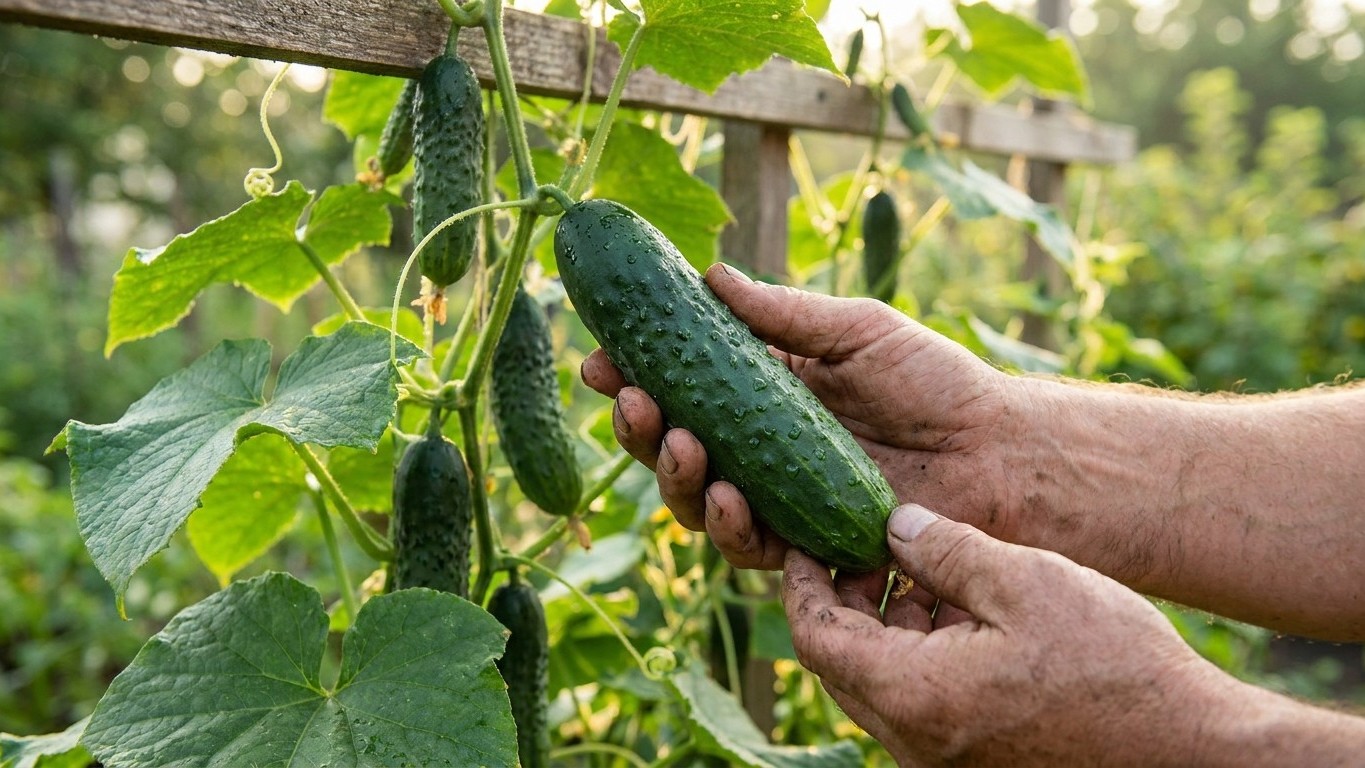
Bitter cucumbers are one of the most common, and most misunderstood, vegetable garden failures. Not a disease. Not a pest. Just a cucumber doing exactly what its biology tells it to do when pushed past its limits. Last summer, after years of blaming my soil, my seeds, even the variety I chose, a neighbor two houses down changed my entire approach in about fifteen minutes.
He had been growing cucumbers for thirty years. His plants looked almost offensively healthy, deep green, sprawling, loaded with fruit that stayed crisp even through a stretch of days that hit 97°F. Mine, four blocks away in what I assumed was comparable soil, were producing cucumbers that tasted like they’d been soaked in dish soap. Something was clearly different, and it wasn’t luck.
Key takeaways
- A cucumber plant’s bitterness is triggered by heat combined with inconsistent watering, not bad luck or poor soil
- One simple morning watering ritual and a 4-inch mulch layer can eliminate the stress response that makes cucumbers taste like soap
- Harvesting frequently and trellising your plants creates conditions where bitter compounds never concentrate in the fruit
The chemistry behind bitter cucumbers, and why heat triggers it
Cucumbers produce a group of compounds called cucurbitacins, which are responsible for that sharp, throat-catching bitterness. These compounds exist in all cucumbers at low levels, they’re the plant’s natural defense against insects and herbivores. Under normal conditions, a healthy cucumber dilutes them enough that you never notice. Under stress, the plant ramps up production dramatically.
Heat is one of the primary triggers, but the mechanism isn’t simply “hot weather equals bitter fruit.” The real culprit is irregular watering during heat spikes. When a cucumber plant goes through cycles of drought stress followed by sudden water availability, it cannot regulate cucurbitacin distribution properly. The compounds concentrate in the skin and the stem end of the fruit first, which is why many gardeners notice bitterness is strongest near the stem and in the peel. The University of Illinois Extension has documented this stress response extensively in its cucumber cultivation guides.
Temperature swings above 90°F combined with inconsistent moisture create exactly the conditions where cucurbitacin production surges. My watering schedule, whenever I remembered, roughly every two or three days, was practically a recipe for it.
What my neighbor does differently, and why it works
He waters every single morning, before 8 a.m., and he waters deeply. Not a light sprinkle, but a slow, thorough soak that reaches 6 to 8 inches into the soil. His logic: the plant needs to arrive at the hottest part of the day with a full reservoir, not playing catch-up at 2 p.m. when surface soil is already at 110°F.
The second thing he showed me was his mulch layer, a good 4 inches of straw packed around the base of every plant. Mulch does two things simultaneously: it slows evaporation, so the soil stays consistently moist between waterings, and it buffers soil temperature fluctuations. Bare soil in full sun can swing 40°F between morning and afternoon. Under a thick straw mulch, that swing drops to around 10 to 15°F. For a plant that responds to stress by producing bitter compounds, that thermal stability is the difference between edible and unpleasant.
He also grows his cucumbers on a trellis, vertical against a fence that faces east. They get morning sun, which is gentler, and partial shade in the harshest afternoon hours. Mine were sprawled on the ground, soaking up full southern exposure from 10 a.m. to 7 p.m. Trellising also improves air circulation, which reduces the humidity-related diseases that further stress the plant.
Small adjustments that compound into real results
Beyond watering rhythm and mulch, he made two other changes I hadn’t considered. First, he never lets a cucumber stay on the vine past its prime. Overripe cucumbers send a hormonal signal that slows the whole plant’s production and increases stress markers throughout, including cucurbitacin levels in younger fruit still developing. Harvesting every two to three days, even if the cucumbers look like they could go a little longer, keeps the plant in a productive, lower-stress state.
Second, he amended his soil with aged compost before planting, specifically to improve water retention. Sandy or loose soils drain too fast, creating moisture deficits between waterings even when you’re watering consistently. Clay-heavy soils hold water but can become waterlogged, which introduces a different kind of stress. Compost acts as a buffer, it improves drainage in clay soils and water retention in sandy ones. His beds had been amended for years and held moisture noticeably better than mine.
There’s also a varietal dimension worth mentioning. Gynoecious cucumber varieties, those that produce predominantly female flowers, tend to fruit faster and are bred for more consistent production under stress. Some modern varieties have also been selected for lower cucurbitacin content, so bitterness is structurally reduced even when conditions aren’t perfect. If you’re starting seeds for next season, looking for “bitter-free” or “burpless” labeling on the seed packet is a real advantage, not just marketing language.
One practical detail that surprises most people: when you do get a bitter cucumber, peeling it and cutting off the stem end removes the majority of the cucurbitacin, since the compounds concentrate there. Rubbing the cut end of the cucumber against the sliced stem end, an old technique that draws out the bitter white foam, actually has some scientific basis. It won’t save a severely bitter fruit, but it genuinely improves a mildly bitter one.
This season, with consistent morning watering, a straw mulch layer, and the cucumbers trained upward on a simple wire frame, the difference has been stark. The plants went through the same 10-day heat stretch that wrecked last year’s crop. The cucumbers came out clean, crisp, and completely without that soapy aftertaste. Thirty years of accumulated gardening knowledge, passed along in fifteen minutes over a fence, sometimes that’s all it takes.