
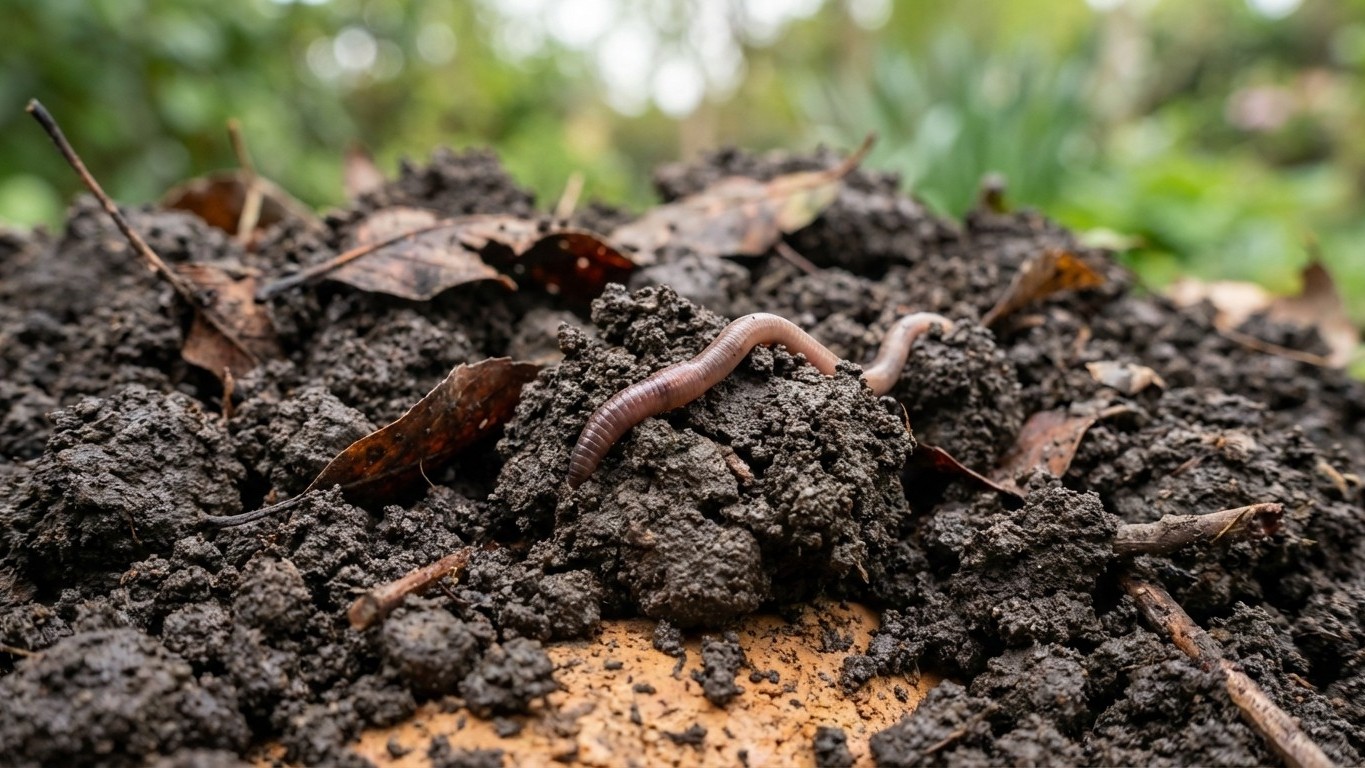
Clay soil has a reputation, and it’s well-earned. It compacts like concrete in summer, turns into a sticky swamp after rain, and seems almost personally hostile to anything you try to grow in it. Carrots fork and twist. Tomatoes drown. You push a shovel in and it comes back out looking like a shovel-shaped brick. If you’ve been there, you know the particular frustration of watching a garden that should thrive just… struggle.
The fix, as it turns out, was sitting in a pile at the end of my driveway every fall. Free, abundant, and mostly ignored: leaves.
Key takeaways
- A simple yard material was causing the biggest soil problem—and most gardeners were throwing it away
- The transformation happened gradually, but by season two the results were undeniable
- The real cost? A few hours of work in November and a willingness to stop fighting nature
Why clay soil is so difficult to work with
Clay particles are extraordinarily fine, much smaller than sand or silt. That’s what makes clay so dense, those tiny particles pack together tightly, leaving almost no room for air or water to move through. Roots suffocate. Drainage stalls. After a hard rain, water sits on the surface like a shallow pond. In a drought, the ground cracks into a jigsaw puzzle. There’s no middle ground with clay. It’s either too wet or too hard, and the window where it’s actually workable feels about three hours long in mid-April.
The core problem is organic matter. Clay soil typically has very little of it, and organic matter is the thing that gives soil structure, creating the tiny spaces (called pores) that roots need to breathe and water needs to drain. Add organic matter back in sufficient quantities, and clay transforms. Not overnight. But it transforms.
Leaves: the free amendment most gardeners overlook
Every autumn, neighborhoods produce an almost comical surplus of fallen leaves. Most people bag them for curbside pickup or burn them in a pile. Municipalities spend real money collecting and processing them. Meanwhile, gardeners are paying for bags of compost at the hardware store and wondering why their soil never improves.
Leaves are essentially a slow-release package of carbon, minerals, and organic material. When they break down, they feed the soil food web, the bacteria, fungi, earthworms, and microorganisms that are responsible for creating healthy, structured soil. Earthworms in particular are drawn to decomposing leaves like they’ve been invited to a dinner party. And as earthworms move through clay, they physically open up channels that help with drainage and aeration. The effect is measurable within a single growing season if you apply enough material.
The key word is “enough.” A thin scattering of leaves won’t do much. What works is volume. A layer of shredded leaves, six to eight inches deep, applied in fall and left to decompose over winter — will begin breaking down by spring, leaving behind a soft, workable top layer that looks nothing like the clay you started with underneath. Year two looks better. Year three, you’ll be giving other people gardening advice.
How to actually use leaves in a clay garden
Whole leaves can mat together and actually repel water, so shredding them first makes a significant difference. Running a lawn mower over a pile a couple of times is enough. You don’t need a wood chipper or any special equipment. Shredded leaves break down faster, integrate better into the soil, and don’t form that impermeable layer that whole leaves sometimes create.
The two main approaches are sheet mulching and direct incorporation. Sheet mulching means laying the shredded leaves directly on top of your beds, which works especially well when combined with a layer of cardboard underneath (this suppresses weeds while the whole system decomposes together). Direct incorporation means mixing shredded leaves into the top several inches of soil in fall, giving them the winter to start breaking down before you plant in spring. Both methods work. Many serious vegetable gardeners use both at the same time, mulching pathways and incorporating into beds.
One thing worth knowing: fresh, undecomposed leaves temporarily tie up nitrogen as they break down. The microbes doing the work of decomposition consume nitrogen in the process. So if you’re planting immediately after adding leaves, mixing in a nitrogen source, compost, blood meal, or even grass clippings, helps keep plants from yellowing while the soil adjusts. If you’re adding leaves in fall for spring planting, this usually isn’t an issue, because the decomposition process completes over the winter months.
What changed in my garden after two seasons
After the first winter with a heavy leaf application, the soil surface by spring was darker, looser, and smelled alive in a way clay doesn’t usually smell. The earthworm population was visibly larger. Planting was easier. Carrots, which had been practically impossible in the hard clay before, grew straight that summer for the first time. That alone felt like a small miracle.
By the end of the second season, the soil twelve inches down had noticeably improved structure. Not perfect. Clay takes years to fully transform, and expecting it to become loamy overnight is unrealistic. But the difference in how plants responded was dramatic enough that I stopped buying bagged soil amendments entirely. The leaves from two oak trees and a maple were producing more organic material than I could use.
The cost was zero. The labor was a few hours in November. The only thing I changed was stopping the habit of throwing away material that the soil actually needed.
There’s something worth sitting with in all of this. The solution to one of gardening’s most stubborn problems was free, seasonal, and literally falling into the yard. Which raises an honest question about how many other “gardening problems” are really just cases of working against the natural cycle instead of with it. Clay soil is difficult, but maybe the real difficulty was ignoring the leaves all along.