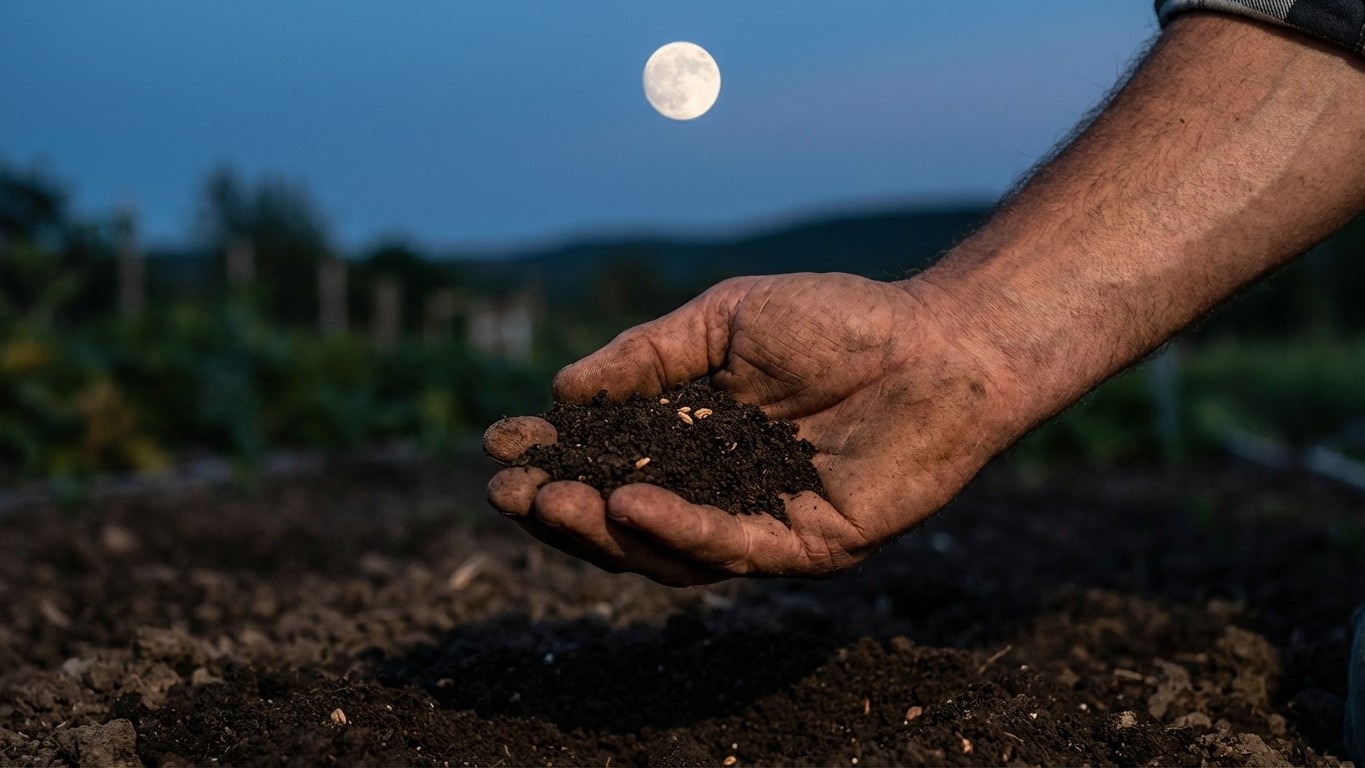
Before a single seed hit the ground, grandma checked the moon. Not the weather forecast, not the soil thermometer, the moon. She wasn’t alone. Across generations of American farmers and backyard gardeners alike, the lunar planting calendar was as standard a tool as a trowel or a watering can. Today, that tradition is making a real comeback, and for good reason: the science behind it is more interesting than most people expect.
Key takeaways
- A German scientist in 1930 proved seeds germinate faster at the full moon—now nearly a century of data confirms it
- The moon’s gravitational pull draws moisture to soil surface during waxing phases, making seeds swell and sprout stronger
- There’s a counter-intuitive rule for what to plant when, and it’s so simple you only need a calendar to apply it
A Practice Older Than Any Almanac
Planting by the moon is an age-old practice that gardeners and farmers have used for hundreds of years. Gardening by the moon is a fundamental part of the Farmers’ Almanac philosophy, and for over 200 years, its print editions have included a planting calendar that uses the phases and position of the moon to predict the best times to perform specific gardening tasks. That’s not a quirky footnote, it’s a two-century institutional commitment to a method that millions of readers swore by season after season.
The core idea is simpler than it sounds. Moon phase gardening considers two periods of the lunar cycle: the time between the new moon and the full moon (the waxing phase) and the time between the full moon and the new moon (the waning phase). Each window, roughly two weeks long, creates different conditions in the soil, and those differences matter more than you’d think when you’re trying to coax a tomato seedling into something worth harvesting.
What the Moon Actually Does to Your Soil
Skeptics tend to dismiss lunar gardening as folklore. But the mechanism behind it is grounded in the same physics that governs ocean tides. The moon’s gravitational pull causes sea levels to rise, but it also causes moisture levels to rise in the soil, and when that moisture rises, plants can access it more readily and remain hydrated longer. Think about that for a moment: the force powerful enough to move entire oceans is also, quietly, moving the water table beneath your raised beds.
Seeds absorb more water between the new moon and the full moon because moisture is increasingly drawn to the soil’s surface during this period. This extra moisture causes seeds to swell, promoting stronger germination and better-established plants. Early research backs this up too. The effect of moon phases on seed germination was first studied by L. Kolisko in 1930. Using wheat, Kolisko found that seeds germinated faster and more prolifically when sown at the full moon, while the new moon gave the most unsuccessful results. Nearly a century of observation, confirmed and reconfirmed, starting with a German scientist and a field of wheat.
The light angle matters as well. The moon also reflects light down onto plants, and in some cases, brighter moonlight can help certain plants. At full moon, that reflected light is at its peak, a subtle but real boost to overnight photosynthesis activity in some species.
The Waxing vs. Waning Rule: What to Plant When
The most practical takeaway from all of this is surprisingly easy to apply. Plant annual flowers and vegetables that bear their harvest above ground, corn, tomatoes, watermelon, zucchini, during the waxing moon, from the day the moon is new to the day it is full. As moonlight increases night by night, plants are encouraged to grow leaves and stems. Your summer garden lineup, goes in during the build-up phase.
Root crops follow a different rhythm entirely. After the full moon, during the waning phase, moisture slowly recedes downward. This period is traditionally favored for root crops, pruning, harvesting, and soil work. Carrots, beets, potatoes, turnips, these go in when the moon is pulling energy downward into the earth. The logic tracks intuitively: the energy follows the direction of growth.
Harvest timing, too, deserves attention. Over centuries, farmers found that apples, cabbages, potatoes, and onions store better if harvested during the waning moon, when water content is decreased. Fruits or vegetables meant to be eaten immediately are at their best when gathered during the waxing moon. Tomatoes, specifically, have been found to ripen most satisfactorily when harvested at the full moon, when water content is highest. The difference isn’t just cosmetic, it affects shelf life, texture, and flavor.
Beyond Phases: The Biodynamic Layer
For gardeners who want to go deeper, there’s an entire parallel system called biodynamic gardening, developed in the 1920s by Rudolf Steiner and expanded through decades of field research by German farmer Maria Thun. Maria Thun was a German biodynamic researcher best known for developing the biodynamic sowing calendar through decades of practical field trials. Her work explored how lunar and planetary rhythms influence plant growth and continues to shape biodynamic agriculture worldwide, and she experimented for 60 years with lunar and planetary rhythms.
The central principle of her calendar is the sidereal rhythm of the moon, meaning the moon’s position in front of the constellations of the zodiac — rather than simply its visible phases. Through systematic sowing trials, Thun observed that when the moon passes through certain zodiac constellations, different parts of the plant are stimulated. The biodynamic calendar breaks each month into “root days,” “leaf days,” “flower days,” and “fruit days” based on those constellations. By following monthly charts that highlight flower days, fruit days, leaf days, and root days, you can cultivate crops in harmony with lunar cycles, ensuring a more fruitful harvest.
Is the zodiac aspect necessary for a home gardener? Probably not as a starting point. But the phase-based system, waxing for above-ground crops, waning for below-ground and harvest — is accessible to anyone with a $10 calendar and a free weekend.
While modern science hasn’t definitively proven lunar gardening effects in controlled studies, many gardeners swear by it, pointing to stronger seedlings, improved yields, and healthier plants over decades of observation. Moon gardening doesn’t replace good soil, proper timing, or climate awareness, but instead acts as a natural rhythm, helping gardeners decide when to plant, not what to plant. That distinction matters. This isn’t a silver bullet, it’s a layer of intelligence added on top of everything you already know about your garden.
What strikes me most about this whole tradition is that it survived industrialization, the Green Revolution, and the age of synthetic fertilizers without disappearing. Generation after generation kept checking the moon, quietly, stubbornly, because the results spoke for themselves in their harvest baskets. As we enter a spring season where so many gardeners are turning back toward slower, more observant methods of growing, maybe the most rebellious thing you can do is put your phone down, step outside on a clear night, and simply look up before you decide when to plant your tomatoes.