
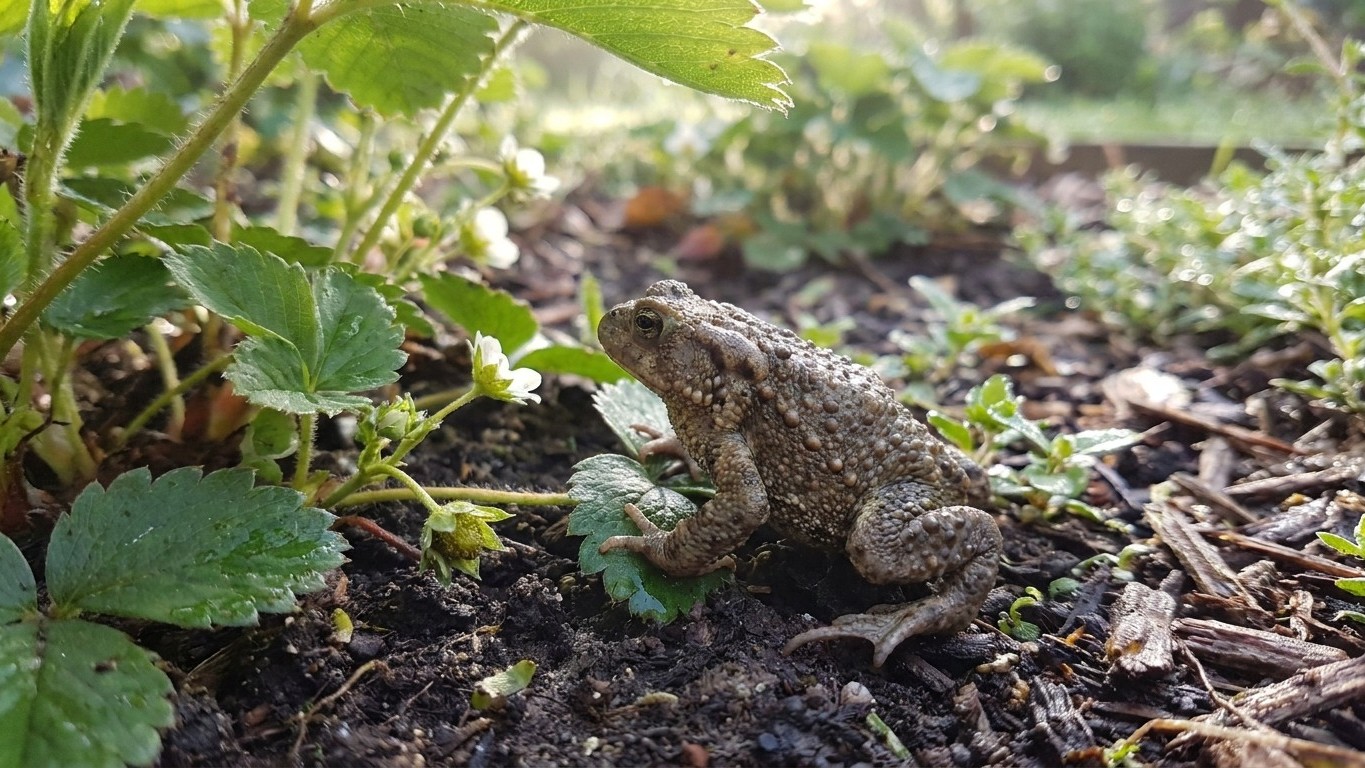
A single sheet of strawberry netting, laid flat on the ground in mid-May, turned into a death trap. Not for birds, not for beetles, but for something far smaller and, to many gardeners, completely unexpected: the fine mesh had snared a dozen toad froglets, each with legs no wider than a matchstick, struggling silently in the weave. The netting had done exactly what it was designed to do. The problem is, it doesn’t discriminate.
Key takeaways
- Tiny toad froglets are getting fatally trapped in strawberry netting during peak migration season
- Garden netting kills one of nature’s most effective slug hunters, with measurable consequences for summer pest populations
- A simple fix using raised hoops costs less than replacing netting all season and solves a problem most gardeners don’t know exists
The hidden danger of flat-laid garden netting
Most gardeners think of bird netting as a passive tool. You lay it down, the birds stay away, the strawberries survive. What the seed packet doesn’t mention is that fine-gauge mesh, placed directly on or close to the ground, becomes an entanglement hazard for any small vertebrate moving through low vegetation. Toads, frogs, slow worms, grass snakes, hedgehogs, all of them navigate garden beds at ground level, and all of them can become fatally caught in netting that offers no clearance beneath it.
The specific culprit is usually diamond-mesh netting with openings between 1 and 2 centimeters. Juvenile amphibians, whose legs are extraordinarily thin relative to their body size, push a limb through one opening and then move, which pulls the mesh tighter around the joint. The more they struggle, the more entangled they become. A toad froglet found in May is almost certainly a common toad (Bufo bufo) just weeks out of the water, making its first terrestrial migration. These animals are disoriented, determined, and entirely unable to back out of mesh once trapped.
According to the UK’s Royal Society for the Protection of Birds and multiple wildlife rehabilitation charities, garden netting is one of the leading causes of preventable wildlife injury in domestic gardens each spring and early summer. The timing matters: May is peak migration season for juvenile amphibians in the Northern Hemisphere, and it coincides almost exactly with the window when strawberry growers are most aggressively protecting their fruit from blackbirds and pigeons.
Why strawberry beds are a particular hotspot
Strawberry beds create ideal amphibian habitat almost by accident. The dense, low canopy of leaves holds moisture, the mulch or straw underneath shelters invertebrates, and the beds are often positioned near water sources, a garden pond, a damp border, a shaded wall. Toads and frogs are actively seeking exactly this kind of microclimate in May, either to hunt slugs or to shelter from daytime heat. Laying a flat sheet of netting over these beds is, from a toad’s perspective, like draping a net across a corridor it uses every night.
There’s a secondary issue that gardeners rarely consider: the netting also traps prey animals. A slug moves under the mesh, a toad follows, and suddenly you have a scenario where the very pest-control service your garden provides naturally is being dismantled by the tool you used to protect your fruit. One adult common toad consumes an estimated 100 slugs per month during active season. Losing even two or three toads to netting over a single spring has measurable consequences for pest populations later in summer.
Alternatives that protect strawberries without the collateral damage
The fix is simpler than most people expect. Raising the netting on hoops, even basic wire hoops pushed 15 to 20 centimeters above the soil surface — creates a gap that birds cannot access but that ground-level animals can move through freely. Amphibians, hedgehogs, and slow worms all travel horizontally and low; they are not going to climb up and over a suspended barrier. The netting becomes a ceiling rather than a snare.
Larger mesh sizes also reduce risk significantly. A 5-centimeter square mesh is still effective against birds, and it is large enough that most vertebrate limbs won’t become trapped. The trade-off is slightly reduced protection against determined smaller birds, but the practical difference in strawberry loss is minimal for most home growers. Rigid fruit cages, sold in flat-pack form by most garden centers, eliminate the issue entirely, they are fully enclosed structures that require no ground contact at all.
For gardeners who already have fine-mesh netting on hand, a temporary solution is to check the perimeter and surface of flat-laid netting every morning during May and June. Entanglement injuries progress quickly in warm weather, and an animal found within a few hours can often be freed without lasting harm. Carrying a pair of scissors to cut the mesh rather than trying to untangle the legs is the fastest and least traumatic method of release. Wildlife rehabilitators consistently advise cutting the netting away from the animal, never pulling.
What to do if you find an animal trapped in netting
Stay calm, work slowly, and cut. Scissors or small craft snips are ideal. Hold the animal gently in one cupped hand to reduce its movement while you cut each strand of mesh individually, rushing causes the animal to thrash, which tightens existing loops. Once free, place the toad or frog in a shaded, damp spot near where you found it and leave it alone. Most juveniles recover within minutes if the entanglement was recent.
If the legs show obvious swelling, discoloration, or the animal cannot right itself after five minutes, contact a local wildlife rehabilitator. In the US, the National Wildlife Rehabilitators Association maintains a directory at nwrawildlife.org. In the UK, the RSPCA operates a 24-hour helpline. Amphibian injuries to limbs are often treatable, but only when the animal reaches a rehabilitator within a reasonable window.
Common toads have declined by roughly 68% in the UK over the past 30 years, according to the Amphibian and Reptile Conservation Trust, a figure that sits uncomfortably alongside the knowledge that garden netting is a contributing factor. The strawberries are worth protecting. So is the animal eating the slugs that would otherwise eat your plants. Raised hoops cost about the same as a season’s worth of replacement netting, and they solve a problem most gardeners don’t even know they have until they find those tiny legs.