
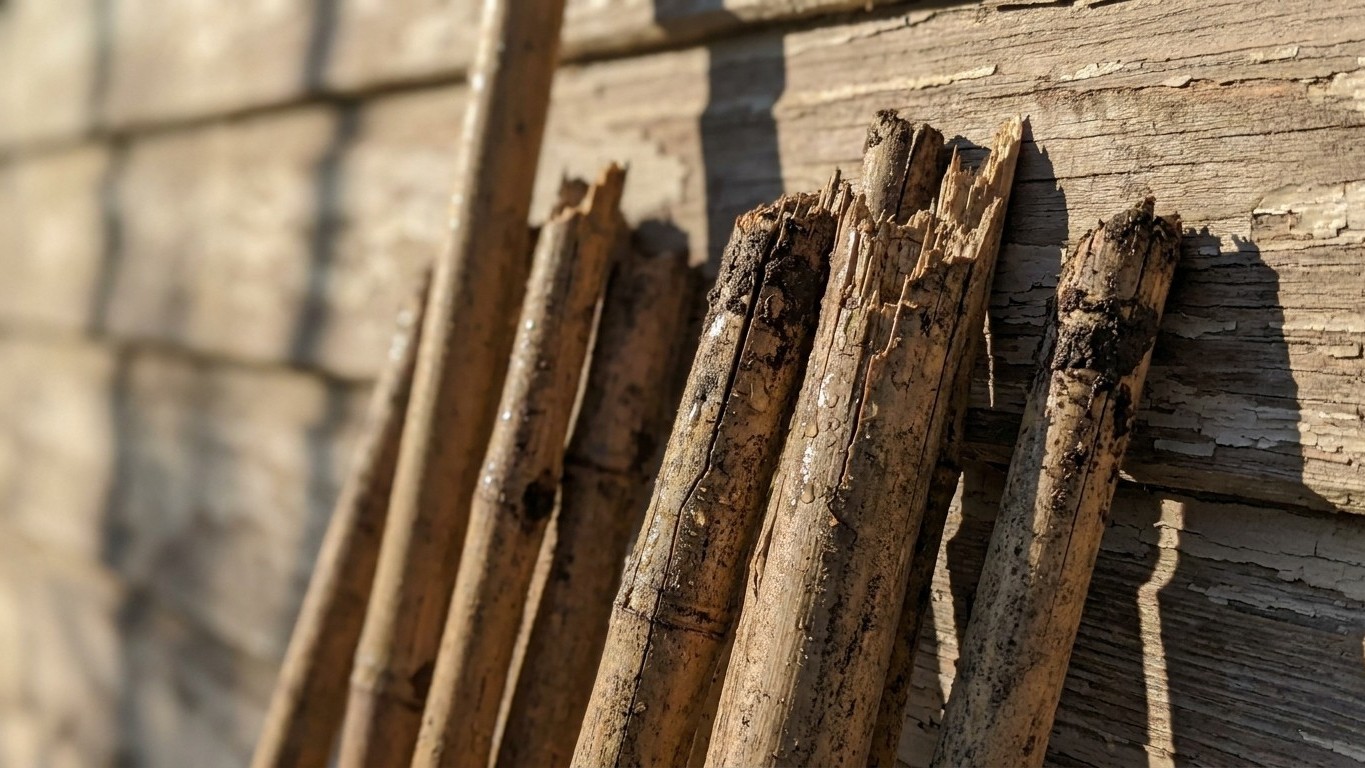
Bamboo stakes look clean enough at the end of the season. A quick wipe, a stack in the corner of the garage, and they’re ready for next year, that’s the logic most gardeners follow. The problem is that “clean enough” and “safe to reuse” are two very different things, and the gap between them is exactly where plant diseases live.
Key takeaways
- A simple surface wipe leaves dangerous pathogens embedded deep in bamboo’s porous fibers
- Vulnerable new transplants absorb contamination directly from stakes during their most critical week
- Proper sanitization exists, but some stakes are too compromised to save—and that’s okay
What hides on last year’s stakes
Bamboo is porous. That’s part of what makes it such a satisfying material, lightweight, flexible, strong. But those same microscopic channels that give bamboo its structural properties also trap organic matter: bits of stem tissue, dried sap, soil particles. A wipe-down removes the surface debris. It does nothing to what’s embedded deeper in the fiber.
The pathogen most commonly carried over on tomato stakes is Cladosporium fulvum, the fungus behind leaf mold, but it’s not alone. Botrytis cinerea — gray mold, survives on plant debris and tool surfaces for months. Bacterial canker, caused by Clavibacter michiganensis, has been documented surviving on contaminated wooden stakes long enough to infect the following season’s crop. A 2019 study from Cornell’s plant pathology department confirmed that wooden and bamboo support materials can act as vectors for soilborne and foliar pathogens when reused without proper treatment.
That curling of the first leaves, the slight downward cupping along the margins, that’s often one of the earliest visible signs that something systemic is happening. By the time you see it, the plant has likely already been compromised at the root or stem level, absorbing whatever was leaching off the stake as it got wet with watering.
The timeline most gardeners miss
A week after planting is a deceptively short window. New transplants are at their most vulnerable during that period: roots are establishing, the plant hasn’t yet built up the secondary metabolites it uses as natural defenses, and it’s absorbing everything from its immediate environment. Contact with a contaminated stake during this window is about as poorly timed as it gets.
Most gardeners assume disease comes in from the outside, a new pest, bad weather, a neighboring plant. The idea that you carried the problem in yourself, stored it all winter, and then set it right next to your new seedlings is harder to accept. But it’s surprisingly common. Vertical surfaces in the garden, cages, stakes, trellises, clips, rarely get the same sanitation attention that soil amendments and seed selection receive, and they should.
The stakes also go right into the soil, which means anything on their surface gets introduced directly to the root zone. A pathogen sitting on the top six inches of a stake might wash down with the first rain, right to where feeder roots are actively developing. There’s no barrier, no filter. Just direct contact.
How to actually sanitize bamboo stakes (and when to give up on them)
Bleach is the most accessible option. A 10% bleach solution, roughly one part household bleach to nine parts water, is sufficient to surface-disinfect bamboo. Soak for at least 30 minutes, not just a dip. After soaking, rinse and allow to dry completely before storage, because damp bamboo left in a pile will develop its own mold problems in storage.
Hydrogen peroxide at 3% concentration works as an alternative if you’re concerned about residual bleach affecting soil biology, it breaks down into water and oxygen without leaving persistent compounds. Some growers use a 70% isopropyl alcohol wipe as a quick field solution between handling plants, though that’s more relevant for pruning shears than for stakes with embedded debris.
Here’s the honest part: if your stakes hosted a plant that showed confirmed disease symptoms last season, sanitizing may not be enough. Porous materials with heavy pathogen loads are genuinely difficult to fully decontaminate. Commercial greenhouse operations often treat bamboo stakes as single-season materials and compost or incinerate them after each crop, not because they’re wasteful, but because the cost of a crop failure outweighs the cost of new stakes. For a home gardener, that math is worth running.
Fiberglass or coated metal stakes sidestep this problem almost entirely. They’re non-porous, easy to wipe down, and can be sanitized in seconds. They cost more upfront, but a set of quality metal stakes can last a decade without becoming a disease reservoir. The environmental calculus isn’t straightforward either, bamboo is renewable, but a bamboo stake replaced every year generates more material waste than a metal one used for ten.
Building a sanitation habit that actually sticks
The most effective moment to treat garden hardgoods isn’t spring planting time, it’s immediately after you pull them from the garden in fall. Pathogens are easier to kill on fresh debris than after they’ve had months to colonize deeper into the material. Cleaning stakes while they’re still dirty from the season, before storage, resets the contamination clock.
Designate a bucket and keep a premixed bleach solution ready during harvest and cleanup. It takes about four minutes per batch of stakes. Mark any stakes that came from a diseased plant, a rubber band, a piece of tape, whatever works, and set them aside for disposal rather than the sanitize-and-reuse pile. That simple sorting habit is what separates a garden cleanup from an actual sanitation protocol.
One detail worth keeping in mind: the soil around last year’s diseased plants can harbor the same pathogens as the stakes themselves. Rotating your tomatoes to a different bed each season, ideally a three-year rotation, cuts pathogen carryover from the soil side of the equation. Pair that with sanitized stakes and you’ve addressed both vectors. Most leaf curl problems that show up in week one are the result of getting only one of those two things right.