
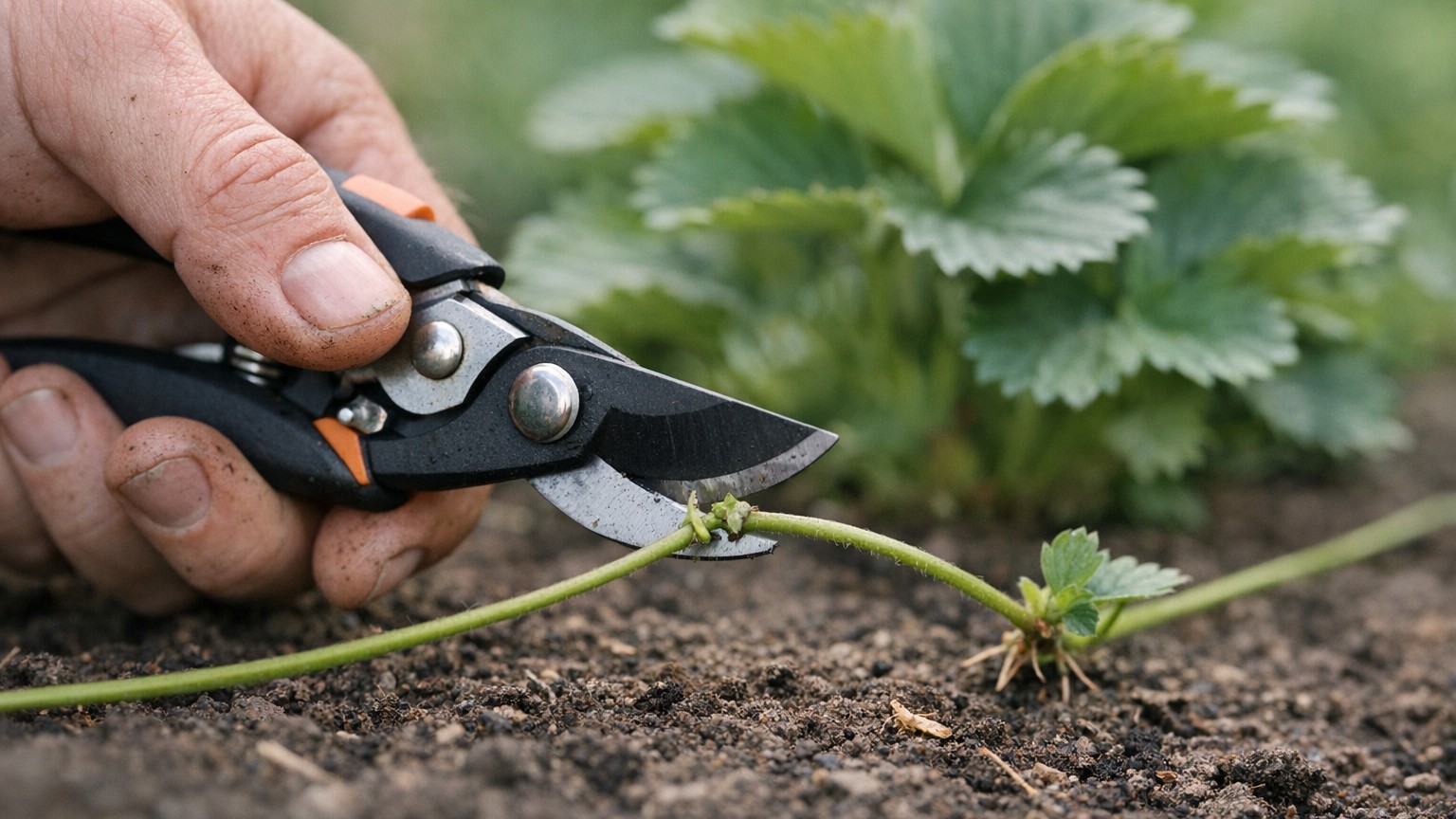
For three summers, my strawberry harvest was a disappointment. A handful of berries per plant, small, underflavored, barely worth the trip outside. The plants looked healthy enough, green, spreading, cheerful, so I assumed the soil was the problem, or the weather, or some vague notion of bad luck. Then a neighbor who has been growing strawberries for over two decades walked through my garden, picked up a long, wiry stem trailing across the soil, and cut it off without asking permission. “You’ll thank me next July,” she said.
She was talking about runners, those horizontal stems, technically called stolons, that strawberry plants send out aggressively in June and July. Each runner extends outward from the mother plant, sometimes reaching 12 to 18 inches, and sprouts a small plantlet at its tip that roots itself into the soil. Left unchecked, a single plant can send out six to twelve runners in a season. The garden looks lush, almost wild. The harvest, though, is the price you pay for that abundance.
Key takeaways
- A neighbor’s single snip revealed a three-year mystery about mysteriously tiny strawberry harvests
- Runners steal the exact nutrients meant for fruit development, forcing plants to choose between spreading and bearing
- One garden management change increased harvests more than tripling the number of plants
Why Runners Are Robbing Your Harvest
A strawberry plant has a fixed amount of energy. That sounds obvious, but the implications are easy to miss when you’re standing in a garden in June watching something that looks like healthy growth. Every runner the plant produces draws carbohydrates and nutrients directly from the crown, the same reserves that should be going into flower development, fruit set, and root strength. The plant isn’t expanding its capacity; it’s dividing it.
Research from university extension programs consistently shows that plants allowed to runner freely produce significantly fewer and smaller fruits than those where runners are managed. Cornell’s cooperative extension, for instance, has long recommended removing runners weekly during the growing season for June-bearing varieties to maintain production quality. The energy redirection isn’t subtle. Plants that have their runners removed regularly often produce 20 to 50 percent more fruit by weight than unmanaged ones in the same bed.
There’s also a spatial issue. When plantlets root themselves freely around the mother plant, they compete for the same water, nutrients, and light. What looks like a thriving colony is actually a crowd of plants quietly undercutting each other. Strawberries need airflow between plants to reduce fungal disease, and a bed choked with runners becomes the perfect humid environment for botrytis, gray mold, to take hold.
The Difference Between June-Bearing and Everbearing Varieties
Not all Strawberry plants respond to runner management the same way, and this distinction matters before you go scissors-happy through your bed. June-bearing varieties, the classic type that delivers one large, concentrated harvest in early summer — are the most sensitive to runner load. These plants put their reproductive energy into a single annual push, so anything that dilutes that energy has a disproportionate impact on yield.
Everbearing and day-neutral varieties behave differently. They produce fruit in flushes throughout the season rather than in one concentrated burst. For these types, some growers allow a limited number of runners to root, typically no more than one or two per mother plant, to renew the bed without sacrificing too much fruit production. The general rule most experienced growers follow: keep runners on everbearing types only when you’re deliberately trying to propagate new plants, and even then, select the strongest runner and remove the rest.
The timing of removal is also worth noting. June is when the plants shift from fruiting mode into runner production mode, it’s the natural biological transition after the first harvest on June-bearing types. Catching runners early, before they’ve had a chance to root and start drawing energy, is far more effective than removing established plantlets later in the season. A weekly walk through the strawberry bed with a clean pair of snips takes about ten minutes and pays back in spades.
How to Actually Manage Runners Without Destroying Your Future Plants
Removing runners doesn’t mean abandoning propagation entirely. Strawberry plants have a productive lifespan of roughly three to four years before their yields decline sharply, so keeping a rotation going matters. The practical approach most serious home growers use is to select one or two runners per mother plant each season, guide them into small pots filled with compost-rich soil placed right next to the parent plant, and let those specific plantlets root over three to four weeks. Once rooted, the connecting stem is cut and the new plant is either potted up or transplanted to a fresh bed.
This way you’re deliberately propagating replacements without letting the plant hemorrhage energy into a dozen unmanaged offshoots. The runners you keep are working for your garden’s future. The ones you remove are protecting this year’s fruit.
One detail that often gets skipped: after removing runners, it helps to give the bed a light feed with a potassium-rich fertilizer. Potassium supports fruit development and helps plants recover from the metabolic effort of producing all those stolons in the first place. Tomato fertilizers work well for this, they’re formulated with exactly that balance in mind.
My neighbor’s logic was straightforward: a strawberry plant that isn’t trying to colonize your garden is a strawberry plant that’s trying to fruit. The year after she snipped those runners, I got more berries from six plants than I’d gotten from twelve the year before. The plants were the same variety, the same soil, the same spot in the garden. The only variable was whether I let June do whatever it wanted, or whether I made a decision about where that plant’s energy was actually going.