
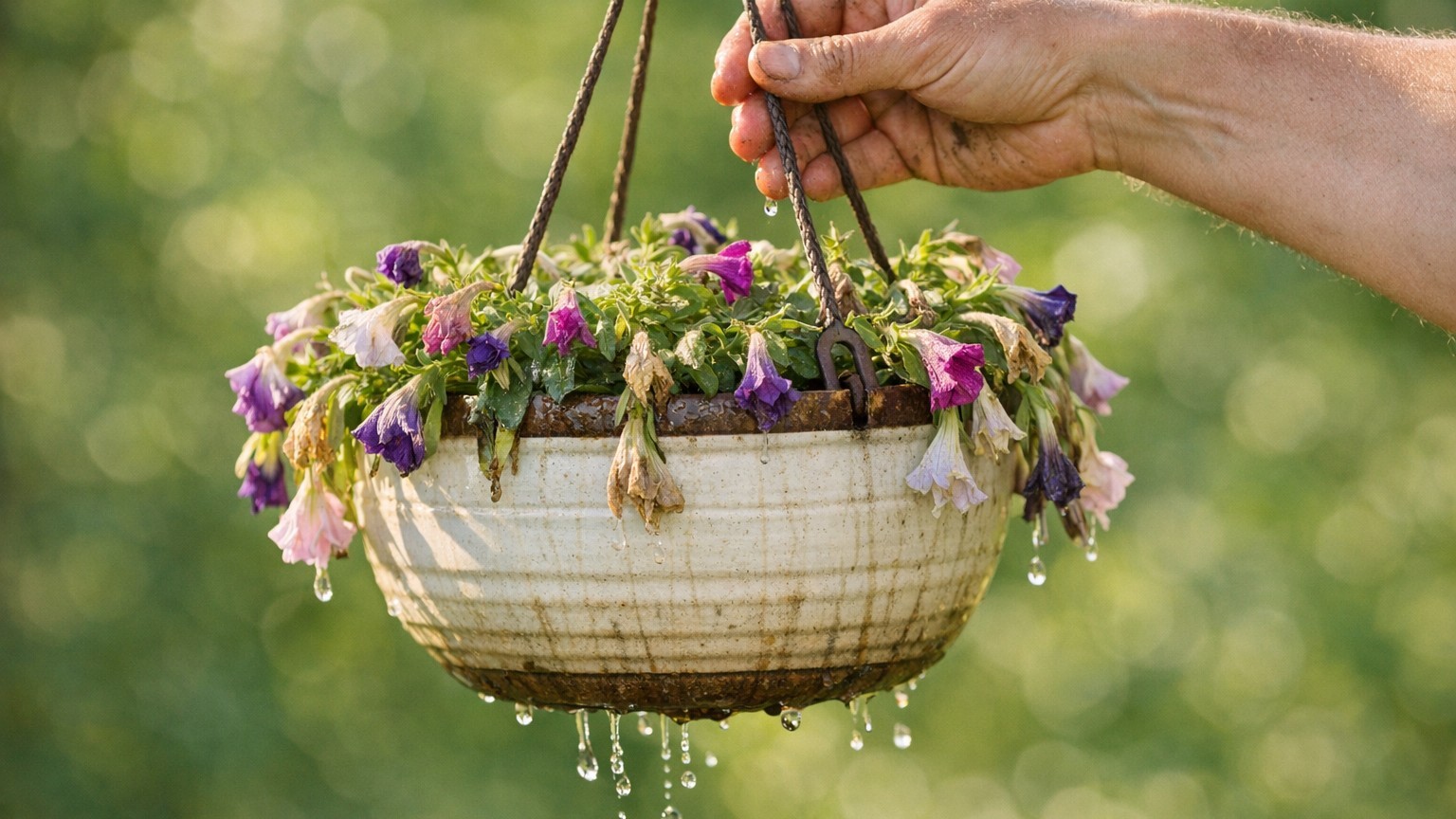
Hanging baskets are designed to kill plants slowly. Not out of malice, but by physics: a dense root ball packed into a small container, suspended in open air, exposed to wind on all sides, draining faster than any border plant could dream of. Water in the morning, and by noon the petunias are drooping again. Most gardeners blame themselves, not enough watering, wrong schedule, wrong plants. The real culprit is usually what’s already in the basket before the first seed goes in.
Key takeaways
- A single diagnostic test using nothing but your hands can pinpoint exactly why your baskets keep failing
- Standard peat compost undergoes a transformation in hanging baskets that makes it actively reject water, not absorb it
- One tablespoon of the right additive at planting time can change your entire summer of gardening
The weight test that changed everything
There’s a diagnostic trick that no gardening book seems to put front and center: lift the basket. Not to check the hook, not to move it, just to feel how heavy it is. Do it right after watering, then again three hours later. The difference in weight tells you exactly how fast water is leaving the root zone. A basket that loses half its weight in under two hours isn’t just drying out. It’s rejecting water, running it straight through the compost and out the drainage holes before roots can absorb a single drop.
That was the moment of recognition for a lot of gardeners who’ve been through this cycle: the basket felt almost light again by mid-morning, despite a thorough watering. The compost, standard multipurpose, the kind sold in massive bags at every garden center — had become hydrophobic. Once peat-based compost dries out past a certain threshold, it actually repels water rather than absorbing it. You can pour a full watering can over it and watch the water channel around the root ball like rain off a waxed car hood, straight out the bottom, never touching the dry core where it’s actually needed.
What the compost was actually doing
Standard peat-based multipurpose compost has a moisture retention window. Fresh from the bag, it holds water reasonably well. But leave it to dry out in a hanging basket, exposed to sun, wind, and the natural transpiration of thirsty plants — and it crosses a threshold from which it doesn’t easily recover. The peat particles contract and become hydrophobic, a process that’s been documented in horticultural research for decades but still catches most home gardeners completely off guard.
The solution isn’t to water more often. That’s the frustrating part. Pouring more water onto hydrophobic compost before addressing the underlying structure just accelerates the drainage problem. What the compost needs is a wetting agent, or, better yet, a structural intervention before the basket is planted. Mixing in water-retaining granules (sodium polyacrylate crystals or similar) at the planting stage can hold several hundred times their weight in water and release it gradually as roots demand it. A single tablespoon of granules in a standard 14-inch basket can genuinely change the moisture retention curve across an entire summer.
Coir fiber, shredded coconut husk, is another option that’s gained traction as peat alternatives become mainstream. Unlike peat, coir doesn’t become hydrophobic when it dries. It re-wets easily, holds structure across the season, and has the added advantage of being a genuine byproduct rather than a harvested resource. Many gardeners who’ve switched to coir-based compost for their hanging baskets report that the twice-daily watering routine drops to once a day, even in a hot June.
Fixing a basket mid-season without starting over
Replanting in late June feels like defeat, and it mostly is, the plants are established, the roots have settled, and disturbing them now risks more stress than the drought cycle you’re trying to fix. There are two practical mid-season interventions worth knowing.
The first is a submersion soak. Lower the entire basket into a bucket of water deep enough to submerge the root ball completely. Hold it down for thirty seconds, minimum, you’ll see air bubbles escaping as the compost finally takes on water. This forces re-wetting of the hydrophobic core and can reset the absorption capacity for a week or more, depending on conditions. Repeat whenever the lift-test tells you the basket has dried out again.
The second intervention is a liquid wetting agent applied through a watering can. Products designed for lawn care, surfactants that break the surface tension of water, work on container compost as well. A dilute solution applied once a week can keep the compost surface from becoming repellent again. The effect isn’t permanent, but it’s enough to carry a basket through the rest of the season without the daily despair of watching petunias collapse by noon.
One overlooked variable: the liner. Solid plastic baskets with no side drainage hold moisture longer than wire baskets lined with coir or moss, but they also suffocate roots in wet conditions. Wire baskets with coir liners lose moisture faster from the sides, which creates the drought problem, but they allow for the kind of air pruning that produces healthier, denser root systems over time. Coconut fiber liners specifically have a slight moisture-wicking quality that slows evaporation compared to open moss. For gardeners in warm climates or exposed, windy positions, this detail alone can make a meaningful difference in summer survival rates.
A study published by the Royal Horticultural Society found that adding water-retaining gel to container compost at the correct rate reduced watering frequency by up to 50% in trials during dry summers. The catch: most gardeners use two to three times the recommended dose, assuming more is better, which actually creates a waterlogged environment that rots roots. The instructions on the packet, in this case, are worth reading.