
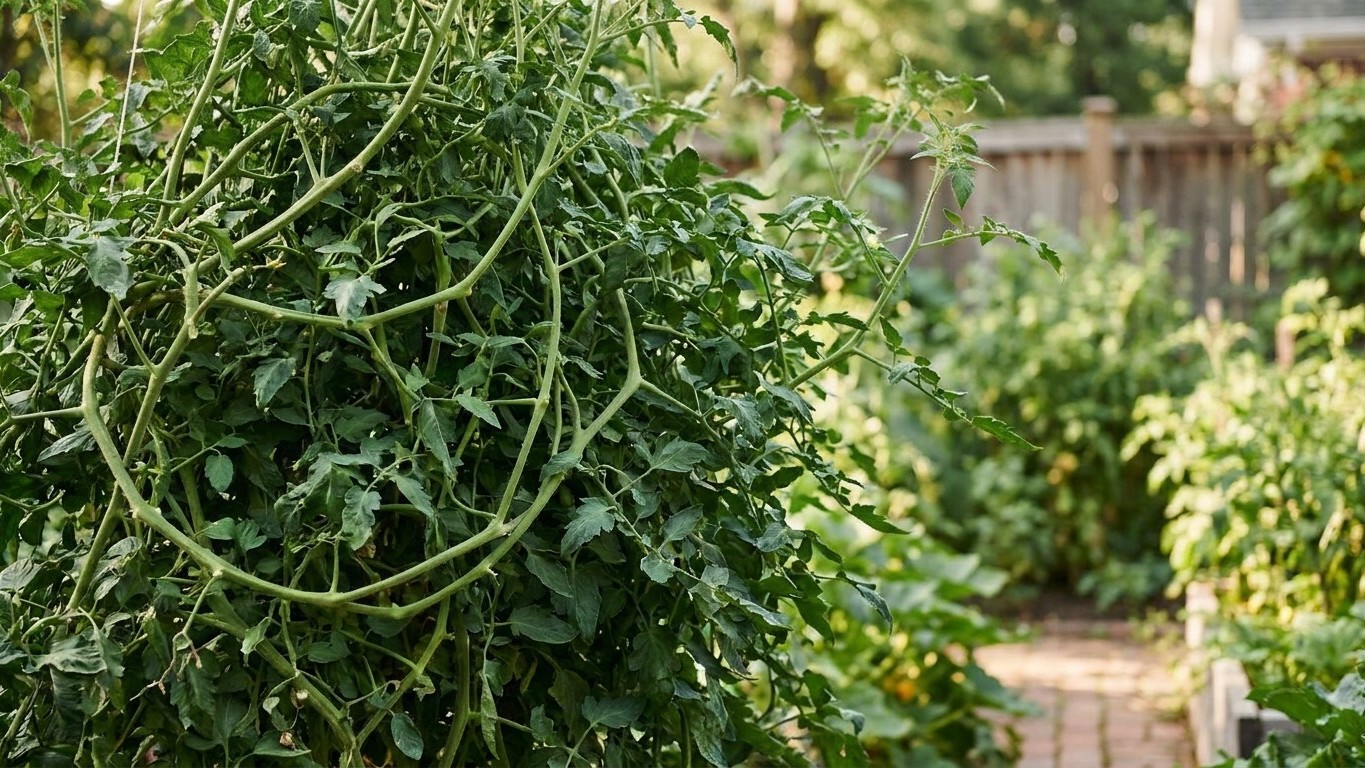
By mid-July, the tomato plants looked spectacular. Dense, knee-high, exploding with green, the kind of lush growth that makes you feel like a competent gardener. Then a neighbor who’s been growing tomatoes for thirty years walked through the gate, looked at the tangled wall of leaves, and said seven words that stung: “You’re not going to get much fruit.”
She was right. The harvest that summer was embarrassing. A dozen tomatoes, maybe fifteen, from four plants. The problem wasn’t a pest, a drought, or bad seeds. The culprit was hiding in plain sight, or rather, growing out of plain sight in every direction.
Key takeaways
- A gardener’s lush tomato plants produced only a dozen fruits all summer—here’s why the neighbor’s comment stung
- Tomato plants operate on a fixed energy budget; every leaf grown is fruit not produced
- Pruning advice that works perfectly for one tomato variety can completely ruin another
When a Plant Mistakes Itself for a Jungle
Tomato plants are tender perennials and will continue producing stems and leaves instead of flowers and fruits until frost forces their life cycle to an end. Left completely unchecked, an indeterminate variety, the kind most home gardeners grow, doesn’t stop. It just keeps going, adding stem after stem, leaf after leaf, in a biological drive that has nothing to do with your salad ambitions.
If you let the plant grow on its own, it may just keep producing more stems and leaves instead of flowering or fruiting until the season has nearly come to an end. Pruning is your way of telling the plant you want less of that (leaves) and more of this (flowers and fruit). The plant isn’t being difficult. It simply doesn’t share your priorities.
The structures responsible for this leafy chaos are called suckers. Tomato suckers are the extra stem that grows at a 45-degree angle between a vertical stem and a horizontal leafy stem. They look innocent at first, a tiny shoot barely an inch long. Ignore them for a few weeks, and your indeterminate tomato suckers can become 8 feet long. If your plant grows 10 suckers, each 8 feet long, you can imagine the mess you’d have. That’s not a garden. That’s a situation.
The Energy Budget Nobody Told You About
A tomato plant runs on a fixed budget of energy. Every calorie it puts into growing a new leaf is a calorie it’s not putting into swelling a fruit. Pruning indeterminate tomatoes improves fruit production by removing extra growth that diverts energy away from developing fruits. Removing extra growth redirects energy back to the fruits and reduces fruit shading, both of which help fruits mature more quickly.
There’s also a disease angle that most people miss. Pruning allows for more airflow within a plant, which reduces humidity and speeds the drying of any remaining leaves. This drier environment is less favorable for fungal and bacterial disease development. An overgrown plant that traps moisture isn’t just unproductive, it’s a petri dish. It’s next to impossible to prune tomato plants that aren’t supported. They form a dense mound of foliage which doesn’t encourage good air circulation and fosters the spread of diseases.
And then there’s the fertilizer trap. Many gardeners, trying to do right by their plants, over-apply nitrogen-rich feeds. The result looks great, big, dark green, vigorous. Nitrogen fuels leafy growth, and tomato plants respond enthusiastically when they receive large amounts of it. The result often looks impressive because the plants become large, dark green, and vigorous. Many gardeners assume these signs indicate perfect health. Unfortunately, the plant may direct most of its energy toward producing foliage instead of tomatoes. A lush plant can be a failing plant. The garden equivalent of a beautiful résumé with no actual job experience.
The Sucker Debate (It’s More Nuanced Than You Think)
Here’s where it gets interesting: pruning advice for tomatoes isn’t one-size-fits-all, and following the wrong advice can actually hurt your harvest. The key is knowing exactly what type of tomato you’re growing.
Determinate tomatoes grow to a predetermined height and produce all their fruits at once. Removing suckers from determinate plants will ruin your harvest rather than help it. But if you’re growing an indeterminate tomato variety, pruning not only promotes plant health, it keeps your plant from becoming too unruly. Two plants, two completely opposite strategies. Getting them confused is one of the most common and costly mistakes in the home vegetable garden.
For indeterminate varieties, the University of Wisconsin Extension recommends a clear approach: remove suckers from indeterminate tomato plants except for the sucker below the lowest flower or fruit cluster. Remove every sucker from the plant except for the first one below the lowest flower or fruit cluster, that sucker is the strongest on the plant and should be left to grow and bear fruit as a second stem. Two stems, managed well, will outperform ten stems left to riot.
If you prune the suckers, you’ll get bigger fruits. If you keep the suckers, you’ll get more fruits, because each sucker turns into a fruit-producing vine. Both paths lead to tomatoes, but only if the plant is actually managed. The third path, which is doing nothing at all, leads to a spectacular-looking plant that delivers a disappointing handful of fruit by September.
How to Actually Fix It : Starting Now
The good news: even a severely overgrown plant can be rescued, just carefully. If your tomato plant is overgrown and full of big, grown suckers, don’t remove more than 30% of the plant’s greenery in one shot. It will shock the plant. Do a bit, then come back a few days later and do more. Aggressive pruning in one session can set the plant back weeks, patience here pays off in fruit, not speed.
For a healthy tomato plant, also remove the leaves on the lower third of the plant. Any leaves that sit below the lowest cluster of flowers or fruit on the tomato should be removed. These leaves aren’t doing anything to help support the plant or the tomatoes it’s growing. They’re just sucking energy and increasing the chance of disease.
Temperature matters too, and it’s a factor even perfectly pruned plants can’t escape. When daytime temperatures climb above 90°F or nighttime temperatures drop below 55°F, plants pause flower production. Leaves continue growing because the plant still focuses on survival, not reproduction. This survival mode delays fruiting and frustrates even experienced gardeners. On a brutal summer stretch, no amount of pruning will force a tomato to set fruit, sometimes the plant just needs the heat to back off.
Going forward, the best time to prune suckers is when they’re small. Check the plants every few days. As soon as you see them start to grow, pinch them off. It takes thirty seconds per plant, twice a week. That’s the entire cost of a decent harvest. The neighbor knew it all along.
One final detail worth keeping in mind: at the tail end of summer, roughly two to three weeks before your first expected frost, your final goal should be to prune to encourage your plant to stop producing new fruit and to start ripening the fruit already on the vine. This process is called “topping.” Through topping, you tell the plant to slow the energy placed on creating more vines and leaves and accelerate the energy for ripening the fruits. The season doesn’t end when growth stops, it ends when the last tomato finally turns red on the vine.
Sources : gardenbetty.com | ruralsprout.com