
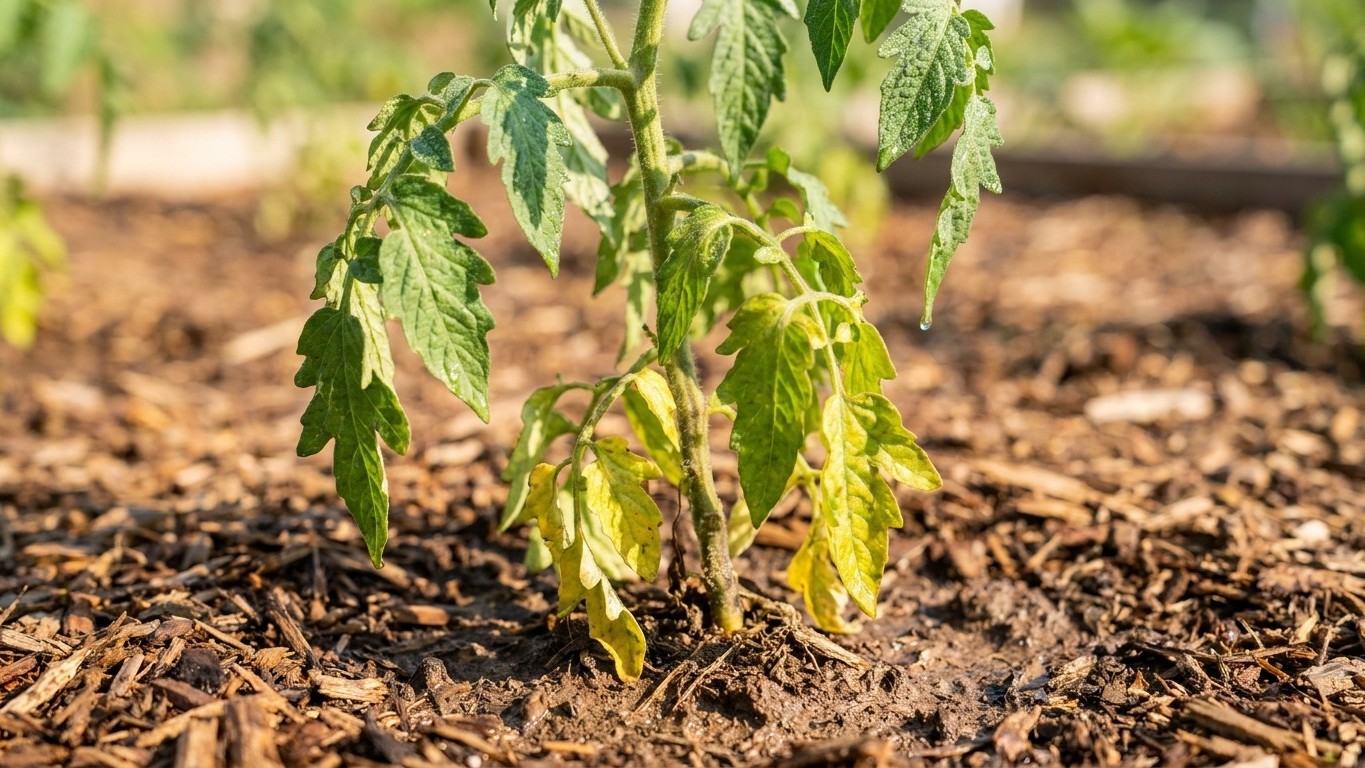
Ninety-five degrees. That’s what the thermometer read the afternoon my tomato plants collapsed like they’d given up entirely, leaves drooping so low they nearly touched the soil. I’d watered them the night before, like I did every single evening that summer. So why were they wilting as if I’d never given them a drop?
The answer had nothing to do with how much water I was giving my plants. It had everything to do with when.
Key takeaways
- Evening watering keeps soil soggy all night, starving roots of oxygen and breeding fungal diseases that weakened plants can’t survive
- During a brutal heatwave, the gardener’s instinct to water more actually accelerated the collapse of already-damaged root systems
- Extension services recommend early morning watering with deep, infrequent soaking and mulch—a combination that rewires how tomato roots grow
The Evening Watering Trap
Watering at dusk feels intuitive. The sun’s down, temperatures drop, and it seems like the perfect moment to let moisture soak in without evaporating instantly. For years, that’s exactly what I believed. But here’s what actually happens underground when you water in the evening: the soil stays damp all night long, creating a cool, saturated environment that tomato roots don’t handle well over time.
Tomato roots need oxygen just as much as they need water. When soil remains soggy for eight or ten hours straight, the air pockets between soil particles fill with water instead of oxygen. Roots essentially suffocate. Add warm nighttime temperatures, common during a heatwave, and you’ve created a breeding ground for root rot and fungal issues like Phytophthora, a pathogen that thrives in wet, warm conditions and attacks weakened root systems.
My plants weren’t dehydrated that scorching afternoon. They were suffering from roots that had been slowly compromised for weeks, unable to pull up water efficiently even though the soil around them was moist. Wilting under heat stress usually signals a plant working hard to cool itself through transpiration. But when roots are damaged, that cooling mechanism breaks down. The plant wilts not from lack of water in the soil, but from an inability to move that water where it’s needed.
What Extension Services Actually Recommend
According to horticulture guidance from land-grant universities, morning watering is consistently recommended over evening watering for exactly this reason. The Utah State University Extension notes that watering in early morning allows plants to absorb moisture throughout the day while giving excess water time to evaporate before nightfall, reducing the risk of fungal disease and root suffocation.
That timing difference Matters More Than most home gardeners realize. Morning watering, ideally between 6 and 8 a.m., lets soil dry out slightly by evening. Roots get their drink, plants photosynthesize with adequate hydration during peak sunlight hours, and by the time temperatures drop at night, the soil isn’t sitting in a saturated state for twelve hours straight.
There’s also a temperature dynamic most people never consider. Cold water hitting warm soil in the evening, or warm hose water hitting cool morning soil, creates a thermal shock that stresses root tissue. Morning watering tends to align water temperature and soil temperature more closely, since both have had all night to equalize.
The Heatwave Made Everything Worse
Here’s the part that really got me. During that 95-degree stretch, I doubled down. I figured if my tomatoes were wilting, they needed more water, so I started watering both morning and evening. Classic overcorrection. Instead of helping, I turned already-stressed roots into a swamp.
Excess watering during extreme heat doesn’t cool plants down the way people assume. Tomatoes regulate their internal temperature primarily through transpiration, releasing water vapor through leaf pores called stomata. When roots are already compromised from chronic overwatering, that regulation system falters regardless of how much water sits in the soil. I was pouring water onto a problem that water couldn’t fix anymore.
The visible symptoms took me too long to read correctly. Yellowing lower leaves, a slight sour smell near the base of the stem, and blossom drop, all of it pointed to root stress, not thirst. I’d been treating the symptoms of overwatering as if they were symptoms of underwatering, which is probably the single most common mistake I’ve seen in community garden plots too. Neighbors dumping water on stressed plants, convinced more is always better.
What I Do Differently Now
The fix wasn’t complicated once I understood the actual problem. I switched to watering exclusively in early morning, before 8 a.m., and I started checking soil moisture two inches down with a finger before watering at all, rather than watering on a fixed schedule regardless of need.
Deep, infrequent watering replaced my nightly ritual. Instead of a light sprinkle every evening, tomatoes do better with a thorough soak two to three times a week, encouraging roots to grow deeper into the soil in search of moisture rather than staying shallow and dependent on daily surface watering. Shallow roots are exactly the kind that struggle most when a heatwave hits, since they have no reserve to draw from.
Mulching turned out to be the piece I’d been ignoring the whole time. A two-to-three-inch layer of straw or shredded bark around the base of each plant keeps soil temperature more stable and slows evaporation dramatically, which means less frequent watering is needed even during heat spikes. It’s a small addition that does more heavy lifting than most people expect from something so simple.
My tomatoes recovered, though it took nearly three weeks for new, healthy root growth to show up in the plant’s vigor. The heatwave that exposed the problem wasn’t really the villain in this story. It just revealed damage that had been building quietly, one well-intentioned evening watering at a time.