
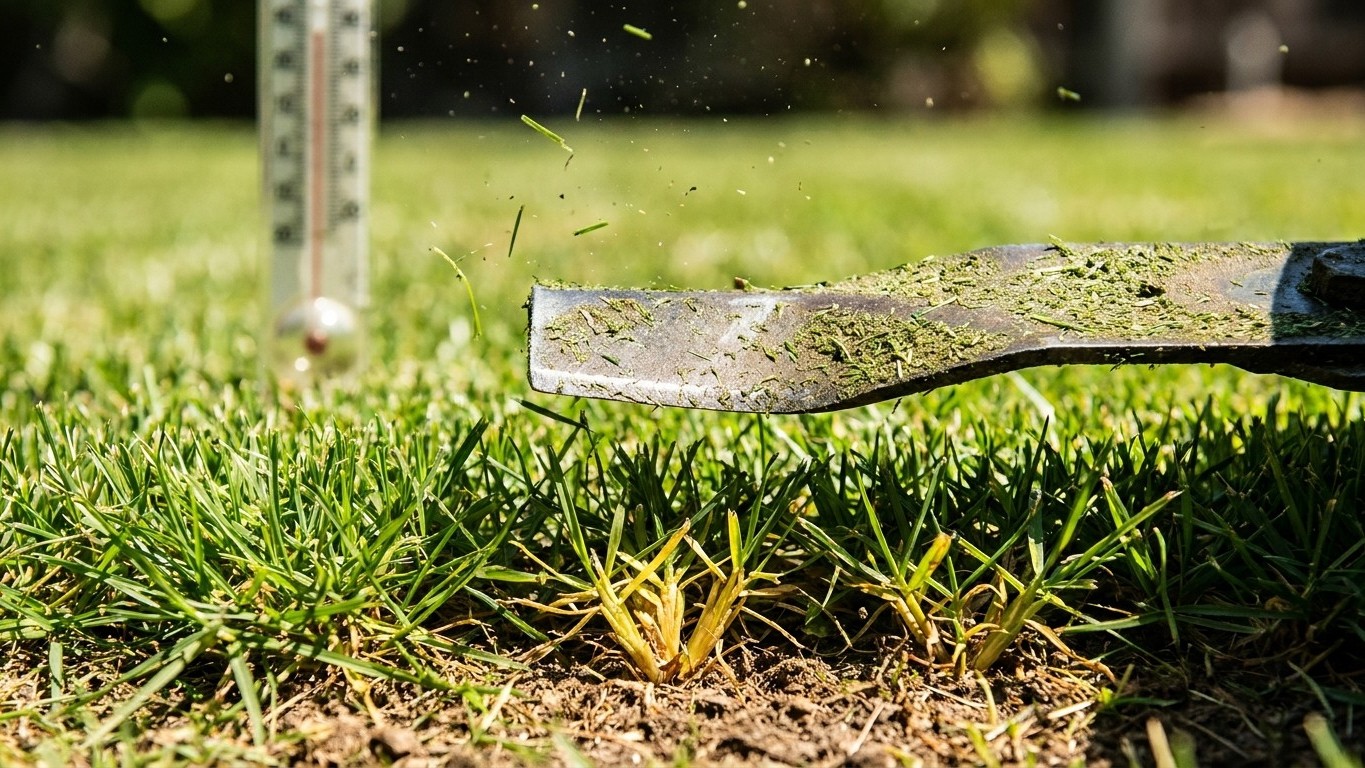
Cutting grass down to two inches on a scorching afternoon feels responsible. It looks clean, it looks intentional, and most homeowners assume shorter grass means less mowing later. But that single pass with the mower blade set too low does something specific and damaging: it exposes the crown of the grass plant, the tiny growing point sitting just above the soil, to direct sunlight and heat it was never built to withstand.
Key takeaways
- The grass crown, sitting just above soil, was never designed to handle direct summer sun exposure
- Mowing short during peak heat can trigger dormancy lasting weeks or kill patches outright, especially cool-season grasses
- Higher mower decks and adjusted timing during summer can reduce water loss and keep roots cooler by several degrees
The crown is not just another part of the blade
Every grass plant has a crown, the junction where roots, stems, and leaves all originate. Think of it as the plant’s control center. Unlike the blade tips, which are designed to take sun exposure and even sacrifice themselves during drought, the crown stays low and shaded under normal grass height, protected by the canopy of leaves above it. When you scalp the lawn, that natural shade disappears in seconds.
At 95°F (35°C), soil surface temperatures in direct sun can climb past 140°F. That’s hot enough to damage or kill exposed plant tissue within hours, according to turfgrass research from land-grant universities like Penn State and the University of Nebraska-Lincoln, both of which study heat stress thresholds in cool-season and warm-season turf. A crown that’s been cooked doesn’t just turn brown, it stops producing new shoots. The plant effectively loses its ability to regenerate from that point.
Why the timing makes it worse
Mowing short in cooler months carries some risk, but the lawn has moisture reserves and lower ambient heat working in its favor. Summer changes the equation completely. Grass under heat stress already closes its stomata to conserve water, slowing photosynthesis and weakening the whole plant. Removing the leaf canopy at that exact moment doesn’t just remove excess growth, it strips away the plant’s sunscreen while its defenses are already down.
Cool-season species like Kentucky bluegrass and tall fescue are especially vulnerable. These grasses naturally slow their growth once temperatures pass 85°F, entering a kind of self-preservation mode. Scalping them during this period can trigger dormancy that lasts weeks longer than necessary, or in patches with compacted soil and poor drainage, it can kill the grass outright. Warm-season varieties such as Bermuda or Zoysia tolerate heat better, but even they show thinning and increased weed encroachment when mowed too aggressively during peak summer.
The visual result is familiar to a lot of homeowners: a lawn that looked fine on Sunday and shows yellow-brown patches by Wednesday. Most people blame drought or bugs. Often, the real cause was the mower deck set two notches too low three days earlier.
The one-third rule, and why it exists
Turfgrass agronomists have long recommended never removing more than one-third of the grass blade’s height in a single mow. For a lawn maintained at 3 inches, that means mowing before it reaches 4.5 inches, not letting it grow to 6 inches and then chopping it back down in one aggressive session. The rule isn’t arbitrary. It’s calibrated to keep enough leaf surface intact to shade the crown and continue photosynthesis without shocking the plant.
During heat waves, many extension services actually recommend raising the mower deck even higher than usual, sometimes to 3.5 or 4 inches for cool-season lawns. Longer grass blades create a canopy that shades the soil, reduces surface evaporation, and keeps root zones several degrees cooler. It’s a small adjustment with an outsized effect: lawns mowed higher during summer routinely need less irrigation to stay green, simply because less water evaporates from shaded soil.
There’s also a timing factor most people overlook. Mowing at midday, when the sun is directly overhead and temperatures peak, adds stress on top of the height problem. Grass mowed in the early morning or early evening, when temperatures are lower and the plant isn’t already under heat stress, recovers faster even if the cut itself is imperfect.
What to actually do differently
Fixing this doesn’t require new equipment, just a change in habit. Raise the mower deck before the first heat wave of the season, not after the lawn already shows stress. Keep mower blades sharp, since a dull blade tears grass tips rather than cutting them cleanly, creating ragged wounds that lose more moisture and heal more slowly, on top of a crown already exposed to heat. Water deeply but infrequently, encouraging roots to grow downward rather than staying shallow near a surface that heats up fastest.
A rotation worth adopting: mow every 5 to 7 days rather than on a fixed weekly schedule, adjusting based on actual growth rather than the calendar. During slow growth periods in peak summer heat, that might mean stretching to 10 days between cuts. Letting the grass dictate the schedule, rather than forcing it into a routine built for spring conditions, keeps the crown consistently shaded.
None of this means lawns can’t be mowed at all during a heat wave. It means the cutting height matters more in July than in April, and that a mower deck set for a tidy spring lawn can quietly work against a lawn trying to survive August. The grass that looks the neatest right after mowing on a 95°F afternoon is often the same grass showing bare patches by the following weekend, not because of drought or disease, but because its growing point spent three days with nothing standing between it and direct sun.