
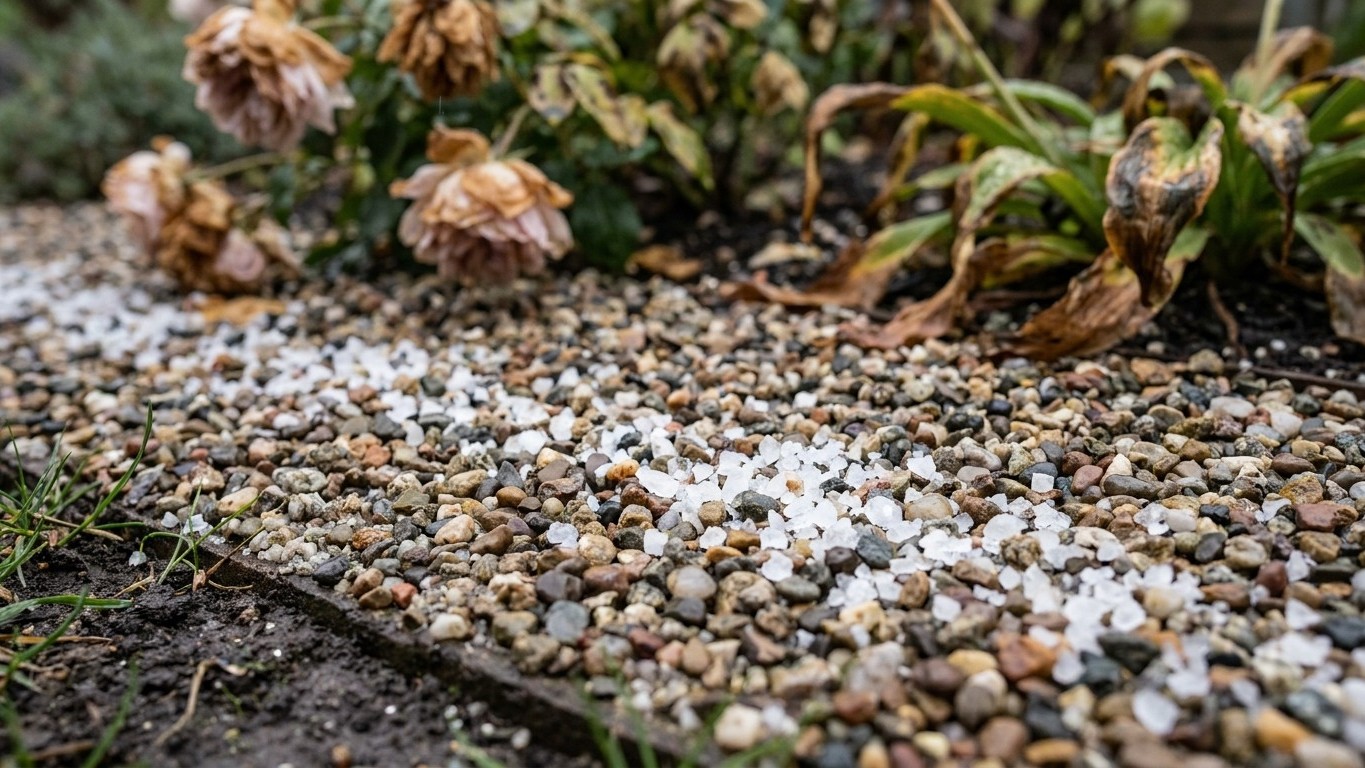
Coarse salt kills weeds in gravel within 24 to 48 hours. That part of the plan worked exactly as advertised. What nobody warns you about on the seed packet or the gardening forum is what happens the moment a good rainstorm rolls through and turns that same salt into a slow-moving poison heading straight for your flower beds.
The logic behind pouring salt on gravel weeds is simple enough: it’s cheap, it’s already in your kitchen cabinet, and it works fast. Rock salt kills weeds by impairing their ability to process the water they need to live, acting as a desiccant that breaks down plant walls on a cellular level, permanently killing the plant. Salt begins working the moment it’s applied, though visible signs typically show up 24 to 48 hours later, and over the next two weeks most of the weeds should be dead or dying. For anyone tired of pulling the same dandelions out of the same cracks every June, that kind of speed feels like a miracle.
Key takeaways
- Salt works fast on weeds, but one rainstorm turns it into a runaway toxin heading straight for your garden
- The damage appears days after the rain, making it nearly impossible to connect cause to effect
- Salt poisoning can make soil unusable for multiple growing seasons—it’s not a quick fix
The Part Nobody Mentions Until It’s Too Late
Rock salt is considered a non-selective herbicide, and that’s the major catch. Salt has no concept of a property line. Rock salt, sodium chloride, kills weeds and other green plants by impairing their ability to process the water they need to live. A rose bush ten feet away is just as vulnerable as the crabgrass you were targeting.
Once rain arrives, the salt doesn’t stay put. Runoff from rain or watering will carry the salt into garden beds and kill flowers, vegetables, and shrubs. Salt can be carried with rainwater runoff and end up in places you don’t want it, like your lawn, a flower bed, or nearby streams and ponds. A single downpour is often all it takes to move a season’s worth of applied salt from the path where you wanted it into the soil where you absolutely didn’t.
What makes this especially frustrating is the delay. You don’t see the damage the day it rains. Chloride ions are transported to the leaves where they interfere with photosynthesis and chlorophyll production, and chloride accumulation can reach toxic levels, causing leaf burn and die-back. By the time your tulips or hydrangeas show scorched, browning edges, the salt has already been sitting in the root zone for days, quietly displacing the nutrients your plants actually need.
Why the Soil Itself Takes the Real Hit
The visible wilting is only half the story. Dissolved sodium and chloride ions, in high concentrations, can displace other mineral nutrients in the soil, so plants absorb the chlorine and sodium instead of needed plant nutrients such as potassium and phosphorus, leading to deficiencies. Your flower bed doesn’t just lose the plants you see, it loses part of its capacity to feed whatever you try to plant there next.
There’s also a physical drought effect layered on top of the chemical one. Salts in the soil can absorb water, resulting in less water being available for uptake by the plants, increasing water stress and root dehydration. Gardening extension researchers call this “physiological drought”, your bed can look perfectly watered and your plants will still act thirsty, because the salt is hoarding the moisture before roots ever get a chance at it.
None of this fades quickly, either. Sodium chloride does not simply vanish after application; it persists in the soil, potentially poisoning the ground for years. The process of leaching salt contamination down to normal levels can take years. One impulsive afternoon with a salt shaker on your gravel path can echo through that flower bed for multiple growing seasons.
Damage Control (and What Actually Works Instead)
If you’ve already made this mistake, the first move is flushing, not waiting. Heavy, repeated watering helps push residual salt further down through the soil profile and away from the root zone, since the volume of fresh water applied to soils impacts the amount of salt leached away, while rainfall can wash salt from leaves. This won’t undo damage already done to affected plants, but it limits how much salt lingers for the next planting cycle. A soil test afterward isn’t overkill, either. A soil testing lab can test the soluble salt level of soil samples, and you request this by checking “soluble salts” under the optional tests box.
Going forward, the fix isn’t abandoning salt entirely, it’s containing it. Creating shallow ditches along the edge of a gravel driveway or patio to direct runoff to an area where no harm will occur works well, and edging like pavers, bricks, or plastic garden edging is effective too. Some gardeners go further and lay physical barriers between hardscape and beds. One way to prevent salty runoff from affecting flowers is to create a barrier between the gravel and plants using landscape fabric or plastic garden edging. Timing matters just as much as barriers: maintaining a strict buffer zone of at least 30 centimetres from lawn edges or flower beds, and never applying before forecasted heavy rain, cuts the risk dramatically.
If the whole point was avoiding a trip to the hardware store, there are gentler options that don’t carry the multi-year soil penalty. Pouring boiling water on weeds does the trick for most broadleaf and grassy weeds, damaging plant cells the same way spilling it on your hand would, with no repair possible. It won’t sterilize the ground underneath, and it breaks down completely rather than lingering to ambush your peonies during the next storm. Propane weed torches and horticultural vinegar solutions work along similar lines, killing on contact without leaving a chemical signature behind in the soil for the next three summers.
What trips up most gardeners isn’t ignorance about salt’s power, it’s underestimating gravity and water. A gravel path rarely sits perfectly flat, and even a gentle slope toward a border is enough to turn one heavy rain into a delivery system. Before reaching for the salt again, walk the path after your next rainfall and actually watch where the water goes. That five-minute observation tells you more about your risk than any amount of reading ever will.
Sources : hunker.com | umass.edu