
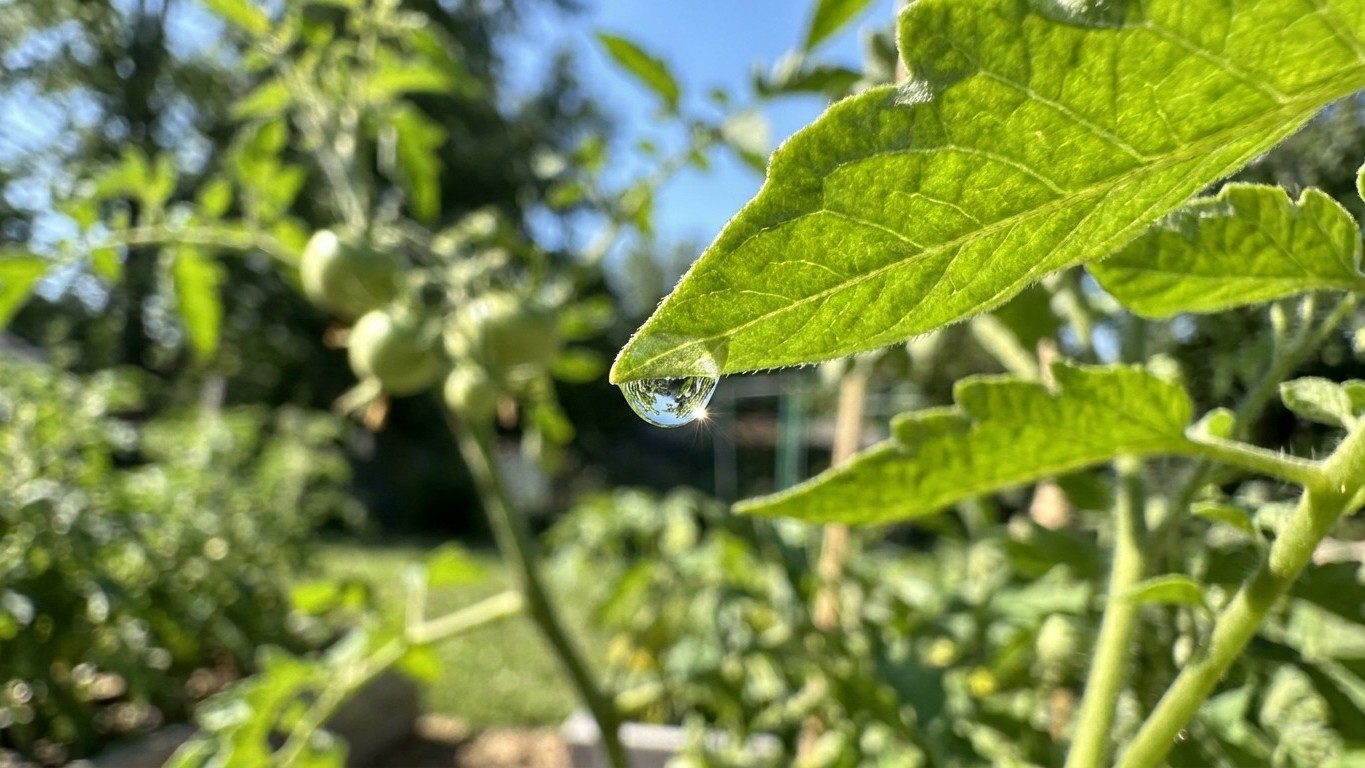
The magnifying-glass panic is wrong. That’s what a longtime community garden volunteer told me after watching me douse my tomato plants under a blazing noon sun, sweat dripping into the soil right alongside the hose water. I braced for a lecture about scorched leaves. Instead, she handed me a folded printout from a university extension service and said, “Read this before you feel guilty again.”
The paper was from Washington State University, and it settled something gardeners have argued about for generations. The idea that droplets act like tiny magnifying glasses and scorch leaves isn’t supported by horticultural research, since leaf scorch comes from inadequate moisture inside the leaf, not from water sitting on top of it. In plain terms: hundreds of scientific publications on crop plants, turf, woody shrubs and trees have examined foliar scorch, and not one of them has implicated midday irrigation as a causal agent.
Key takeaways
- What gardeners have believed for decades about water droplets and leaf scorch is completely unsupported by science
- The real enemy of noon watering isn’t burned foliage—it’s something far more wasteful that’s happening at ground level
- One simple timing shift and watering technique could be the difference between tomatoes that thrive and ones that collapse in heat waves
Why the magnifying-glass myth refuses to die
Here’s the physics nobody explains at the garden center. To burn a hole in paper with a lens, you have to hold it a certain distance from the surface to concentrate the sun’s rays, and a drop of water sitting directly on the leaf is simply too close to do the job. A magnifying glass needs focal distance. A droplet plastered against a leaf surface has none.
There’s also a timing problem with the theory. Drops of water falling on leaves in full sun evaporate too quickly to cause any damage whatsoever to the plant. The horticulturist behind that WSU paper put it bluntly: “dispel this myth, hundreds of other domains on the web keep the misinformation alive.” One expert I found in a gardenmyths.com deep dive made the point even simpler, essentially arguing that if noon droplets really burned foliage, “we would have almost no viable plants” after any midday summer rain.
So no, that gardener wasn’t scolding me for cooking my tomato leaves. Every drop that landed on the foliage was harmless in itself. But she wasn’t done. What she pointed at next was the ground.
What each drop was actually doing, and why it mattered
The real cost of noon watering isn’t burned leaves. It’s wasted water. The main reason not to water when the sun is high in the sky is because of evaporation, since the heat evaporates a significant amount of the water applied to plants, making it an inefficient time to do it. Picture pouring a glass of water onto a sidewalk in August. Half of it is gone before it seeps anywhere. That’s roughly what was happening at the base of my tomato plants every single day.
There’s a second mechanism working against you at noon that has nothing to do with soil at all. Plants absorb water most efficiently when their stomata, the tiny pores on leaves, are open, which typically happens during cooler parts of the day, so watering at the wrong time can mean less water reaches the roots. The plant itself is less receptive when it’s stressed by heat, even as water pools uselessly around its stem.
Container tomatoes take the worst of it. A small terracotta pot in full sun can swing 30°F or more between dawn and mid-afternoon, cooking the root ball from all sides. My raised bed wasn’t a terracotta pot, but I could see the same principle at work: soil that looked damp on the surface was bone-dry two inches down by 2 p.m.
That gardener also flagged a habit I didn’t realize was sabotaging my plants: I’d been giving them a light spritz most afternoons instead of a real soak. Light, frequent surface sprinkling feels productive but does the most long-term harm, training shallow roots that leave plants defenseless against the next hot day. Tomatoes with shallow roots are the ones that collapse the moment a heat wave hits, because they never learned to dig for water on their own.
So when should you actually water?
Morning wins, and it’s not close. Morning, roughly 5 to 9 a.m., wins as a routine because less water evaporates before the soil absorbs it, and foliage dries fast, lowering fungal disease risk. One veteran tomato grower who’s been at it since the 1980s offered a blunter warning about the alternative: “the number one disease mistake I see, year after year, is evening watering in warm weather… You end up with wet leaves going into a warm night, and that is precisely the environment blight thrives in.”
If evening truly is your only window, wet leaves aren’t a death sentence, but timing still matters. The key is watering early enough in the evening that foliage has time to dry before nightfall, but late enough that the sun’s intensity has significantly decreased, while avoiding watering so late that leaves stay wet overnight.
And if noon is genuinely your only option because a plant is visibly wilting? Don’t wait for a more convenient hour. A wilting plant needs water right away, midday or not. As one heat-wave guide summed it up, the leaf-burn fear that stops people from watering at noon is pure myth, and the delay it causes is what actually kills the plant. Depth beats frequency every time, too. Deep watering forces roots to burrow lower into the soil to get water, which helps build a strong root system that can withstand the stresses of hot or dry weather.
I still water in the morning now, before the coffee’s finished brewing. But the real shift wasn’t the clock. It’s that I stopped watching for scorch marks that were never going to appear and started checking how deep the soil was actually wet, which turned out to be the thing my tomatoes needed me to notice all along.
Sources : tomsguide.com | deavita.net