
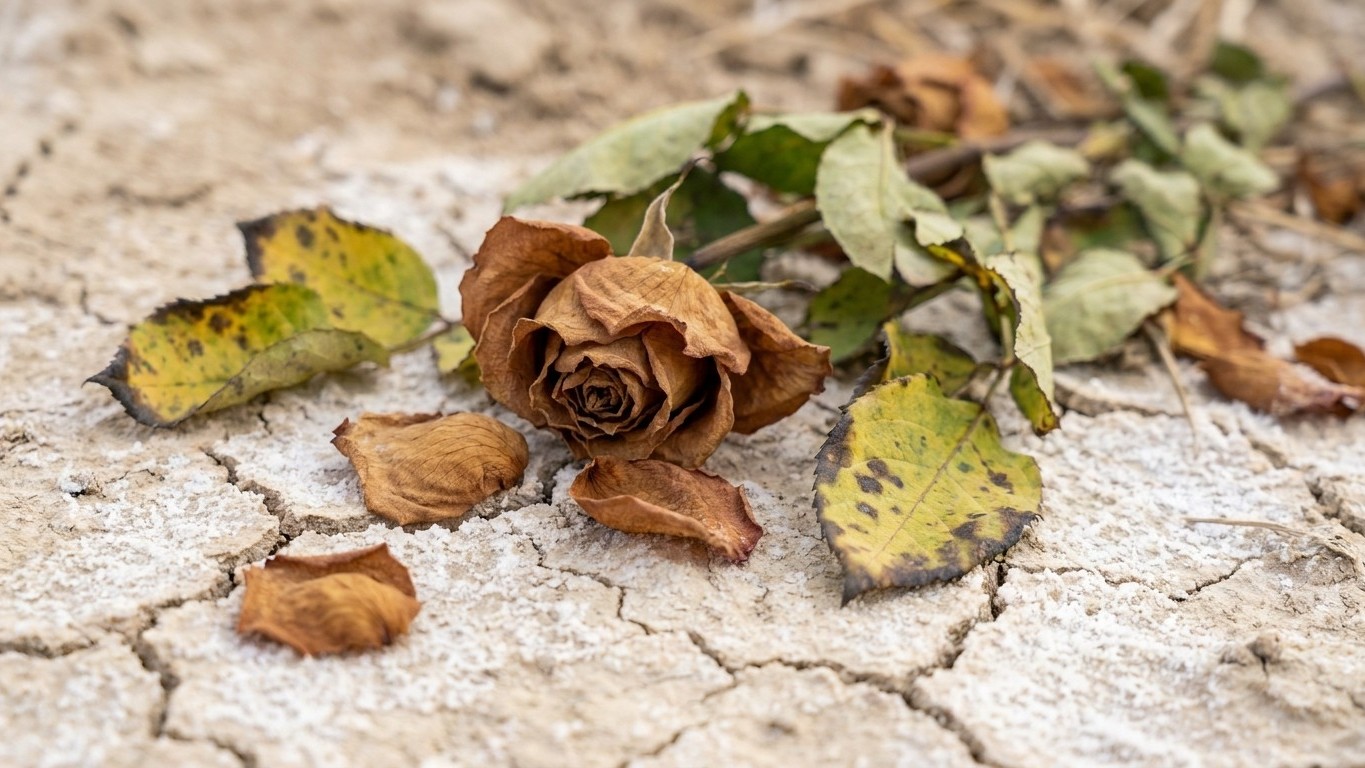
Every gardener has a family ritual passed down like folklore, and mine was watching my father scatter fistfuls of coarse salt across the gravel driveway each spring, convinced he’d found the ultimate weapon against dandelions and crabgrass. It worked, too, for years. Then came a wet April, weeks of steady rain, and I watched the edges of his flowerbeds turn brown in patches that had nothing to do with drought. That’s when I finally understood what the salt had actually been doing this whole time.
Key takeaways
- Salt kills weeds instantly, but unlike vinegar, it never leaves the soil—it just moves around
- One spring of rain taught a harsh lesson about how salt runoff can turn a thriving garden into a toxic dead zone
- The damage isn’t temporary: salt sterilizes soil, blocks nutrient absorption, and poisons groundwater for years
The Trick That Actually Works, At First
There’s a reason this method survives generation after generation: it genuinely kills weeds. When rock salt comes in contact with grass, weeds or underlying soil, it naturally absorbs moisture, which can lead to dehydration of both soil and roots, and the weeds eventually wither and die. Sodium chloride isn’t some new gardening hack, either. Salt has been used as a herbicide for centuries, and its efficacy in weed control is rooted in its ability to absorb moisture, desiccating plant tissues by drawing out water through osmosis. Farmers figured this out long before synthetic herbicides existed. Inorganic salts such as sodium chloride were among the very first herbicides, applied at extremely high rates and later found to be highly toxic and fire hazardous. That last detail matters. If agricultural science abandoned salt as a weed killer decades ago in favor of other chemicals, it wasn’t because it stopped working. It’s because the side effects were too costly to ignore.
What The Rain Revealed
Here’s the part my father never accounted for: salt doesn’t disappear once the weeds are dead. Unlike vinegar, salt doesn’t evaporate. It stays in the soil and travels around the yard with the water. That spring, the runoff from his gravel path carried dissolved sodium and chloride straight into the adjacent flowerbed, and the damage showed up exactly where the water pooled. Salt can be carried with rainwater runoff and end up in places you don’t want it, like your lawn, a flower bed, or nearby streams and ponds. It’s not a hypothetical risk. It’s basic hydrology, and gravel driveways are practically designed to funnel water toward the nearest low point in the landscape.
The chemistry behind the damage is more insidious than simple burning. The dissolved sodium and chloride ions, in high concentrations, can displace other mineral nutrients in the soil, so plants absorb chlorine and sodium instead of needed nutrients like potassium and phosphorus, leading to deficiencies. Worse, chloride ions can be transported to the leaves where they interfere with photosynthesis and chlorophyll production, and chloride accumulation can reach toxic levels, causing leaf burn and die-back. My father’s roses weren’t struggling because of some fungal disease that spring. They were essentially starving in soil that had been quietly poisoned two seasons earlier.
Salt Doesn’t Break Down, It Just Moves
What makes rock salt fundamentally different from vinegar, boiling water, or even most synthetic herbicides is permanence. Salt is not broken down by soil organisms; the only way to reduce salt in the soil is to wait for it to leach out through water movement, and eventually the salt ends up in the groundwater aquifer or moves via subsurface channels into the watershed, a process that can take years. That single fact reframes the whole ritual. My father wasn’t treating his gravel once a season. He was building up a reservoir of sodium that had nowhere to go except sideways, into his garden beds, or down, toward the water table.
The soil itself pays a structural price too. High amounts of sodium harden the soil, limit its ability to absorb and circulate water toward the roots, and lead to soil crusting. And it’s not just about plants directly. Too much salt in the soil kills beneficial fungi, bacteria, earthworms, and insects, which has long-term effects on the ecosystem. The earthworms my father used to point out proudly after a good rain, evidence of “healthy soil,” had quietly vanished from the strip closest to the driveway. I never connected the two until that spring made the pattern impossible to miss.
Better Ways To Win The Weed War
None of this means gravel paths are doomed to be weedy forever. It just means the fix shouldn’t outlast the problem. Pouring boiling water directly on unwanted growth kills top growth almost instantly without leaving any residue behind, and it costs nothing beyond a kettle already sitting on the stove. Hand-pulling right after rain, when soil is soft and roots slide out cleanly, remains unmatched for anything with a deep taproot, and it does zero collateral damage to nearby plantings. For persistent patches, a vinegar-based spray degrades faster in the environment than salt ever will, though household vinegar can act as a contact herbicide, but it’s less effective on deep-rooted perennial weeds and may require multiple applications.
If salt still feels like the only option for a truly isolated patch of gravel far from any bed, lawn, or slope leading toward one, treat it as a last resort rather than a seasonal habit. Long-term soil damage is its biggest downside: it sterilizes the soil, making it impossible to grow anything in that spot for a long time, and this is not a temporary fix. My father eventually switched to a propane weed torch and a stiff wire brush, and his flowerbeds recovered within two growing seasons. The gravel still gets the occasional stubborn sprout. But the roses came back, and so did the earthworms.
Sources : quora.com | lawndoctor.com