
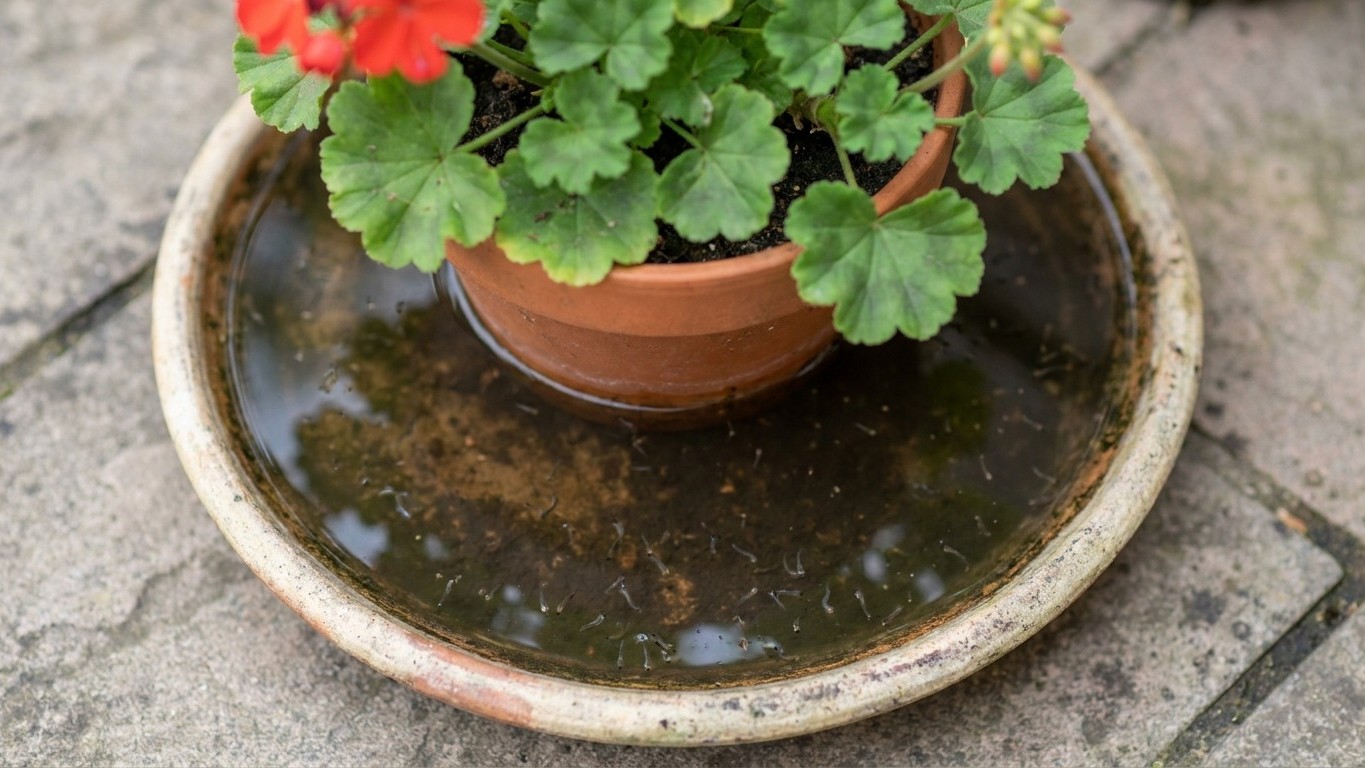
A week of rain, a saucer under a potted geranium, and there it was: dozens of tiny, wriggling commas suspended just beneath the surface, twitching in unison every time a shadow passed overhead. Not dirt. Not algae. Mosquito larvae, alive and thriving in what looked like a harmless puddle of runoff water.
That saucer had been doing its job perfectly, catching excess water so it wouldn’t stain the patio or drown the roots. But a plant saucer left untouched for a week is basically a nursery. Emptying containers like saucers under flower pots, watering cans, and buckets matters because a warm summer enables the development of a mosquito population within one week in such water containers. Seven days. That’s all it takes for a shallow tray of stagnant water to go from empty to infested.
Key takeaways
- A single saucer of stagnant water can produce biting adult mosquitoes in less time than it takes to finish a Netflix episode
- Researchers discovered flower pot saucers harbor more disease-carrying mosquitoes than abandoned pools or rusted tires combined
- One simple weekly habit—or a $5 bag of gravel—can shut down an entire mosquito breeding operation in your yard
Why flower pot saucers are mosquito magnets
Researchers near Tucson wanted to know exactly where backyard mosquitoes were coming from, so they surveyed thousands of containers across residential neighborhoods. Flower pots and plastic containers were the container types most likely to contain water, and flower pots contained disproportionately more larval mosquitoes than other types of containers. The surprise wasn’t just that pots held water. It’s what didn’t turn out to be a problem: of 78 discarded tires found, only two had immature mosquitoes, and of 11 unmaintained pools discovered, none contained mosquitoes. The forgotten saucer under the fern beat out the rusted tire in the side yard.
The scientist leading that research put it plainly: “The most important finding of the study was the importance of flower pots and associated saucers underneath them as preferred Aedes aegypti larval development habitat.” Aedes aegypti, the species behind that finding, is no minor nuisance. It’s a severe health threat, spreading dengue virus, Zika virus, and chikungunya virus, and dengue fever alone infects 400 million people each year, with all of these diseases expanding their range. That’s not a distant, foreign statistic anymore, either. Florida has already logged locally acquired dengue cases in recent years, a reminder that these mosquitoes aren’t just a tropical vacation problem.
What’s almost funny, in a dark way, is how little water it actually requires. Mosquitoes can breed in very small amounts of water, think a bottle cap or the saucer under a plant, in just a few days. Vector control technicians have even found larvae in the water reservoirs of home coffee makers. If a coffee maker’s drip tray can host a mosquito nursery, that decorative saucer catching runoff every time you water the basil is basically prime real estate.
From egg to biting adult: the timeline is brutal
Here’s the part that surprises most gardeners: the whole cycle moves faster than a single Amazon delivery. A female mosquito searches for calm water surfaces, deposits her eggs individually or in clusters called rafts directly on the water’s surface, and depending on the species, can lay between 100 and 300 eggs in a single batch. Under warm conditions, mosquito eggs can hatch in standing water within 24 to 48 hours.
From there, the larval stage, those wriggling “wigglers” you’d spot in a saucer, live in water from 4 to 14 days depending on water temperature. Heat speeds everything up. Warmer water accelerates the mosquito’s metabolism and growth rate, meaning development occurs much faster in summer, and in optimal conditions, development can take as few as five days. After the larvae comes the pupal stage, brief but essential: mosquito pupae, commonly called “tumblers,” live in water from 1 to 4 days, depending upon species and temperature. Add it up and a single saucer of water, left alone during a rainy week, can go from clean to crawling with future biting adults before you’ve even finished a Netflix series.
What actually breaks the cycle
The fix isn’t complicated, but it does require consistency, which is the part most of us skip. Checking containers more than once per week reduces the presence of larvae, and educating residents that frequently checking for standing water can help reduce presence of the yellowfever mosquito, with a particular focus on flower pots. Once a week isn’t a suggestion pulled from thin air. It’s timed almost exactly to beat the larval development window.
Practically, that means walking the yard on a set day, dumping every saucer, birdbath, and bucket. If dumping isn’t realistic for a saucer that catches irrigation runoff daily, there’s a gravel trick worth knowing: filling saucers with fine gravel or sand can make it more difficult for mosquitoes to lay their eggs, as long as the rocks or sand go high enough that there is no visible water surface. That single adjustment, five minutes with a bag of pea gravel, turns a breeding ground into a dead end.
For pots that can’t be modified, treated water is another option. A bacterial larvicide, which comes in liquid, dunk, or granule form, kills mosquitoes but is safe for people, plants, and animals. It’s the kind of low-effort fix that pest control districts recommend precisely because it doesn’t require remembering anything more complicated than checking a label.
The part that stuck with me after finding that saucer wasn’t the larvae themselves, unsettling as they were. It was realizing how ordinary the setup had been: a plant, a saucer, a rainy week, nothing exotic or neglected. A forgotten bucket, a sagging tarp, or a clogged rain gutter can hold enough stagnant water to support an entire generation of larvae, and none of those require a swamp or a jungle climate, just a patio in any American suburb after a storm. Next time it rains for more than a day or two, that saucer under the pot deserves a five-second glance before it becomes something else’s home.
Sources : jcvcd.gov | entomologytoday.org