
Lettuce seeds don’t die in July heat. They simply refuse to wake up. Above roughly 25°C, most lettuce varieties slip into a state scientists call thermoinhibition, a built-in survival reflex that tells the seed the season is wrong, even when your calendar says prime planting time. Lettuce seeds fail to germinate when imbibed at temperatures above 25°C to 30°C, a phenomenon termed thermoinhibition. That’s exactly why your July sowings sat there, silent, week after week.
Key takeaways
- Your lettuce seeds aren’t broken—they’re following ancient survival programming that reads July heat as a death sentence
- A 3-4 day chill in the fridge before planting rewires the seed’s internal clock and triggers germination within hours
- Even after chilling, soil temperature and strategic ice placement matter—but older seed actually outperforms fresh packets in summer
Why 25°C flips a switch inside the seed
The mechanism traces back to lettuce’s wild ancestor, which evolved in a Mediterranean climate of cool, wet winters and scorching, dry summers. The thermoinhibition trait of lettuce seeds is attributed to the natural adaptation of its progenitor species to a Mediterranean climate having cool, wet winters and hot, dry summers. Germinating in August, in that ancestral logic, would be suicidal for a seedling with no chance of surviving until the next rain. So the seed reads heat as a red flag and stays shut.
What’s fascinating is the timing sensitivity. The timing and duration of the high temperature period are critical: a long enough cool period preceding a warm one during imbibition will prevent thermodormancy, while a temperature that could induce it, given briefly early in imbibition, may even accelerate germination. the very first hours after the seed absorbs water decide everything. Sow dry seed straight into hot soil and you’ve lost the game before it started.
Not every variety reacts the same way. Thermodormancy may be induced at temperatures above 25°C and some varieties are more susceptible than others, with triple red lettuce varieties seeming more affected by this phenomenon than others. If you’ve noticed your green oakleaf lettuce sprouting fine while a red batisse variety stalled next to it in the same tray, this is why. Seed age matters too, and commercial seed companies confirm it: lettuce seed can enter thermal dormancy when exposed to high temperatures, with optimum germination results at soil temperatures of 60-68°F (16-20°C).
The fridge fix that actually works
Here’s the part that turned my July disaster around. Market growers across the South have been running the same experiment for years, and their results line up almost perfectly. Growers recommend a period of 24-48 hours in the refrigerator before seeding in trays, a method that involves setting seeded trays in a walk-in-cooler for 48 hours. One grower described pulling a tray out in the afternoon after two days of chilling and finding that by the following morning the seeds had already popped up, achieving almost perfect germination every single week.
The logic is simple: you’re not trying to defeat the heat, you’re tricking the seed’s internal clock before it ever meets the heat. Most seeds require a process called stratification that imitates the natural conditions needed to germinate, and for lettuce this means the seed must be chilled before it’s left to germinate. Some growers go further and simply keep their entire lettuce seed stock in the fridge year-round, so it’s always primed and ready the moment sowing day arrives.
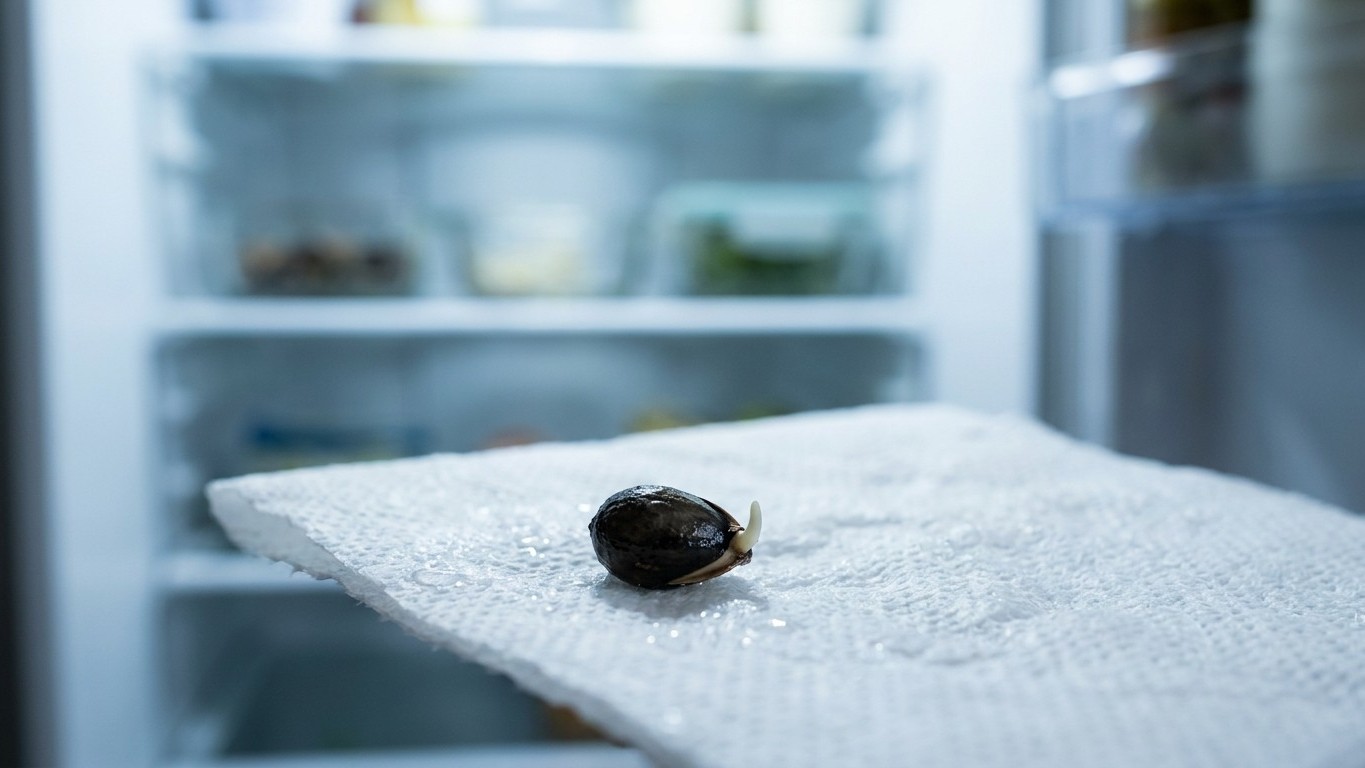
The practical version I now use: dampen a paper towel or coffee filter, scatter the seeds, fold it over, seal it in a plastic bag, and leave it in the fridge for three to four days. Since it’s not the season for lettuce to sprout in the heat, the seeds go for a walk in the fridge, sealed with a damp filter and airtight plastic film, for three to four days. Check daily. The moment you spot tiny white root tips, it’s time to move them into soil, not before, since they’re fragile and any delay risks damage.
Beyond the refrigerator: field-tested summer tricks
Chilling seed solves the imbibition problem, but soil temperature still matters once you sow outdoors. Southern market farmers have refined a whole toolkit for this. For lettuce, soil temperature must be lower than 80°F (27°C), so growers use a soil thermometer, sow in the evening, and after sowing thickly, put ice on top of the soil covering the seeds. It sounds almost theatrical, dropping ice cubes on a vegetable bed in July, but the physics is straightforward: melting ice cools the top inch of soil exactly where the seed sits, without waterlogging the bed.
Shade helps too, and not just a little. From June growers put shade-cloth over the lettuce seedbed and only sow in the evening, and in July and August they water the sowed bed with freshly drawn cold water, line up ice cubes along the seed rows, and cover with shade cloth. If ice cubes feel excessive for a backyard plot, a simple move works nearly as well: pre-water the furrow generously before sowing, since pre-watering ensures that the water is right there at seed level, where it is less likely to dry out.
If none of this feels worth the fuss, buying pelleted or primed seed is the industrial shortcut. To obtain lettuce seeds capable of germinating well above 22°C, seeds are subjected to a process called priming, which allows controlled hydration so seeds complete the first steps of germination before being dried back and stored. It costs more and the seed doesn’t store as long afterward, but it removes the guesswork entirely.
One detail surprised me the most while digging into this: older seed actually performs better in heat than seed fresh off the shelf. Older lettuce seed suffers less from heat-induced dormancy, and a few months of storage can make the difference, though some growers buy seed of their favorite hot-weather varieties a year ahead. So that half-used packet from last spring, sitting forgotten in a drawer, might actually germinate better in August than the brand-new one you just bought.
Sources : researchgate.net | growingformarket.com