
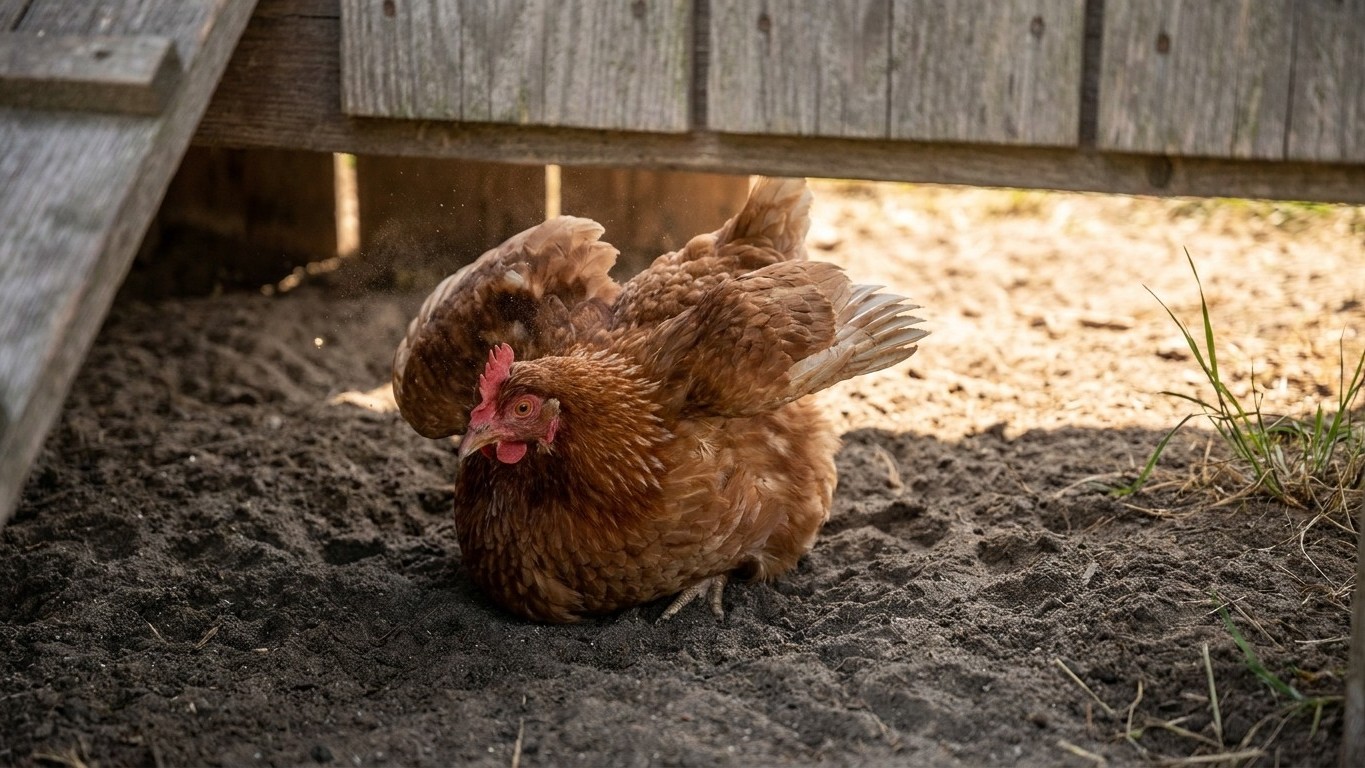
Ninety degrees in the shade and every hen in my run used to stand there, beak open, wings held slightly away from their bodies, breathing like they’d just sprinted across the yard. Since I built a simple shaded tray of damp sand near the henhouse wall, that scene has disappeared. No panting, no drooping wings, no hens hunched in the dirt looking miserable. Just birds taking turns flopping into the sand, kicking it over their backs, and going about their day.
The fix cost me nothing but an old plastic tub and a bag of sand. But the reason it works has everything to do with how chickens are built, and how badly they’re equipped to handle summer heat.
Key takeaways
- Chickens begin heat stress at just 80°F, not the triple digits most keepers assume
- Heat stress doesn’t just look bad—it silently stops egg production for weeks
- One simple trick using basic physics changed everything for this flock
Why chickens struggle so much in the heat
Chickens don’t sweat. Birds can’t sweat as humans do, which makes cooling off in hot climates very challenging. Their main defense against rising temperatures is panting, opening the beak and breathing rapidly to move air across moist respiratory tissue and shed heat that way. It works, up to a point. Chickens pant by opening their beaks and engaging in rapid breathing, much like dogs, chickens release heat by panting to dissipate internal heat.
The trouble starts well before triple digits. Chicken heat stress begins near 80 degrees Fahrenheit, not at triple digits, and active cooling becomes essential in the 90s. And once a bird tips from mild discomfort into real distress, things move fast. The speed of escalation is what makes heat stress more dangerous than most keepers expect. A bird that appears tired in the morning can be in serious distress by afternoon. Panting itself isn’t free, either. Above 90°F, panting accelerates carbon dioxide loss, which disrupts blood pH and calcium metabolism. Shell quality drops, egg production falls, and the bird’s immune response weakens. A hen fighting the heat is a hen that stops laying, sometimes for weeks.
That’s the part I didn’t fully grasp before I started paying attention: heat stress isn’t just an animal welfare issue, it’s an egg-basket issue. A flock that pants through July doesn’t just look unhappy. It quietly stops producing.
Why damp sand actually works
Dust bathing is instinctive behavior. Hens do it to condition feathers and control parasites, but it also plays a direct role in temperature regulation. A good dust bath will help cool birds down, as the movement of feathers will help dissipate heat. Several poultry-keeping guides now specifically recommend damp, shaded sand rather than dry dust for summer relief. Cool, damp sand areas work because chickens naturally dust bathe, and damp sand provides a refreshing cooling effect.
The mechanism is straightforward evaporative cooling, the same principle behind a wet towel on the back of your neck. Hosing down a dirt or sand run two to three times daily and letting evaporative cooling from wet ground reduce ambient temperature locally by 5 to 10°F, with the ground staying cool for two to four hours after wetting, is enough to make chickens want to lie on the damp patch. Position Matters More Than people think, too. Location matters: under tree shade or a covered structure, since direct sun turns a dust bath into a hot spot instead of a cool one. That’s exactly why I tucked mine against the henhouse wall, in permanent shade from midmorning on.
Not everyone agrees that wet is better than dry, and it’s worth being honest about that. Some keepers argue that in a properly shaded dry mix, the sand feels cool to the feet on its own, and that keeping the dust bath dry matters because wet dust baths are considered useless for cooling by that logic. My own experience, and the evaporative-cooling data above, points the other way, especially in dry climates where water evaporating off damp sand pulls heat out of the air right where the birds are lying. In humid regions the calculus shifts, since moisture lingers instead of evaporating quickly. If you’re in a swampy Southeastern summer, a shaded dry sand pit with the top few inches scratched away might serve you better, since chickens instinctively dig small holes to reach cooler soil below the surface, where the top 2-3 inches run hot from the sun but soil six inches down stays significantly cooler.
Building the setup without overthinking it
My tray isn’t fancy. A shallow plastic tub, sand from the hardware store, set in the darkest corner of the run and topped off with a garden hose every few days when the forecast climbs past 85. Guides suggest going a bit bigger if you can. A dust bath dug as a shallow depression roughly 12 to 18 inches across and 4 to 6 inches deep, filled with sand for its cooling and drainage, along with wood ash for parasite control and diatomaceous earth as a drying agent, covers the basics. I skip the ash and diatomaceous earth on the days I’m keeping it damp, since a soggy, caked mixture stops draining and turns into something closer to mud than a bath.
Water still comes first, no matter how good the sand pit looks. When it comes to cooling chickens down, the same three pillars always apply: water, shade, and airflow. Get those right and you prevent the overwhelming majority of heat emergencies before they start. I keep two waterers going during heat waves now, refreshed morning and evening, because a single knocked-over founts on the hottest afternoon of the year is exactly the kind of thing that ruins a good system.
What actually changed the daily rhythm of the flock wasn’t the sand alone. It was watching where the hens chose to spend their afternoons once the option existed. Before the tray, they’d cluster panting under the coop’s eave, doing nothing but suffering through the worst hours. Now that same corner stays empty by 2 p.m., because they’ve relocated ten feet over to a patch of damp, shaded ground that never got so much as a mention in my original coop plans. Sometimes the fix that matters isn’t the expensive one. It’s the one that copies what the bird already wanted to do in the first place.
Sources : poultryhatch.com | backyardchickenshub.com