
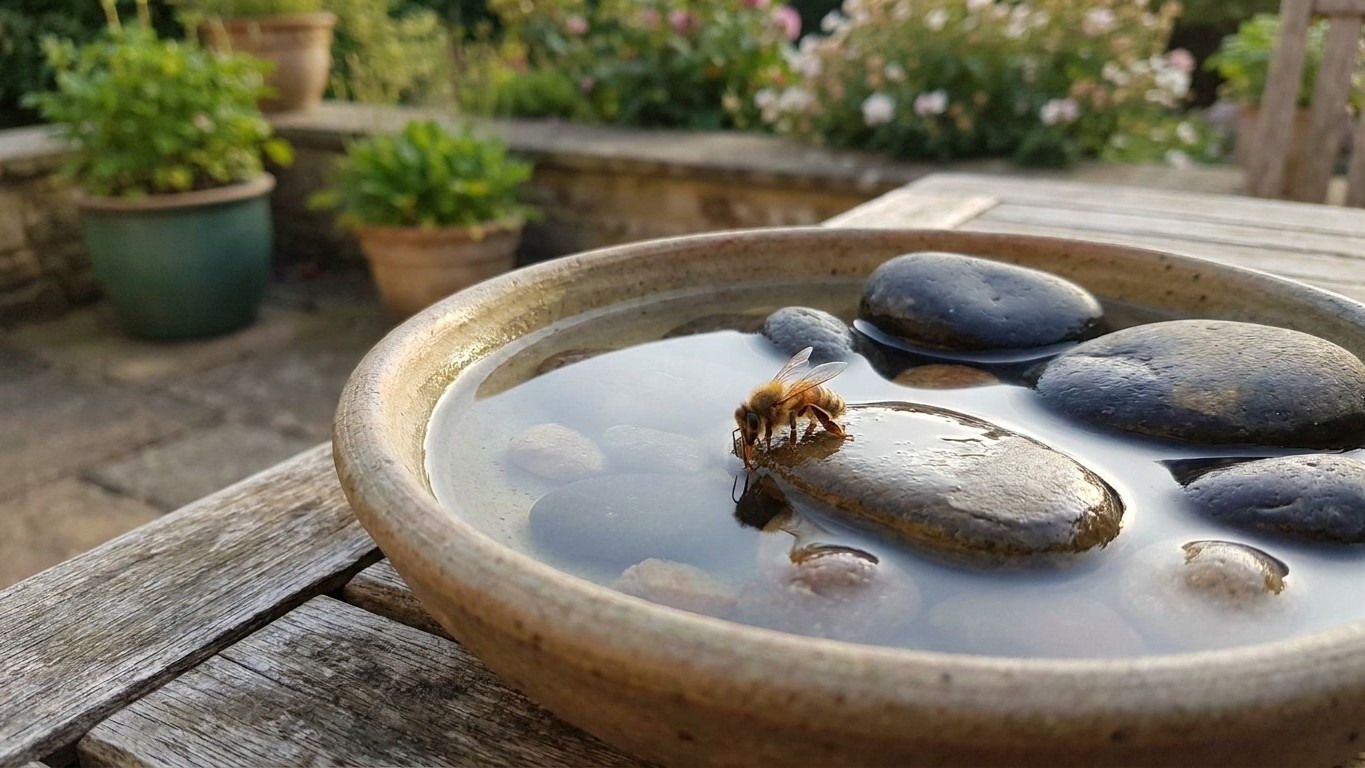
That empty bowl each morning isn’t a mystery. It’s a sign the water is working exactly as intended, just not for the birds you expected. What’s happening on that terrace is a small ecosystem shift: birds get their sips at dawn and dusk, while bees discover a reliable oasis and start showing up in droves, draining the bowl dry by mid-morning.
Key takeaways
- A single bowl of water can attract hundreds of foraging bees every day during summer heat
- Birds and bees operate on completely different schedules—and bees are winning the competition
- Honeybee colonies need a quart of water daily just to air-condition their hives
Why bees suddenly care about a bowl meant for birds
Heat does something specific to a honeybee colony that most people never think about. The ideal temperature for a honeybee colony is 93 degrees, so when summer temperatures creep into the 90 degree range, honeybees create their own air conditening, workers deposit droplets of water throughout the hive, then fan their wings to draw the heat out of the air, similar to using a swamp cooler. That single mechanic explains almost everything happening on that terrace right now.
A colony isn’t sipping for pleasure. A summer colony needs at least a quart (liter) of water every day, and even more when it’s warm. Multiply that by every hive within flying range and a single backyard bowl becomes a genuine watering hole. Extension entomologists confirm the pattern directly: bees may be able to get sufficient water from the nectar they drink to get by, but they are often found drinking water from other sources in the summer, because honey bees particularly need extra water to cool their hives in the summertime. Despite weighing barely a tenth of a gram, the thousands of honey bees in a colony can generate a lot of heat.
What’s disappearing from the bowl isn’t a mystery ingredient, it’s simply evaporation and daily withdrawals by dozens of foragers. And once a colony finds a dependable source, it doesn’t forget. Bees know exactly where to return for the same water source, because foragers seem to seek water sources that are scented. That’s why the visits become a daily ritual rather than a one-off. It also explains why the bird bath from three houses down might suddenly go quiet: bees can take over a bird bath entirely, to the point where the birds won’t use it anymore, because the bees prefer that bath to other water sources nearby.
The birds haven’t left, they’ve just adjusted their schedule
Nothing at the bottom of the bowl in the morning doesn’t mean birds have abandoned the terrace. It usually means they drank earlier, before the heat built up and before the bees arrived in force. Birds tend to visit water sources at first light and again near sunset, precisely the hours when bee activity drops off because foragers wait for temperatures to climb before leaving the hive. The overlap in the middle of the day is where the competition happens, and bees, being persistent and numerous, often win that particular real estate.
This coexistence isn’t automatically peaceful, though. Bees aren’t strong swimmers, and deep or uncovered water sources, like bird baths or pools, can easily lead to drowning accidents. A standard bird bath, smooth-sided and several inches deep, is essentially a swimming pool from an insect’s point of view. Bees can’t swim, though, and they can’t sip while on the wing like a hummingbird, so they must land to take a drink and need a “platform” to reach the water. Without one, some of those daily visitors simply don’t make it back to the hive.
Making the bowl work for everyone, safely
The fix costs nothing and takes five minutes. Grab a pan or shallow bowl, and add a good amount of stones, pebbles or marbles before filling with water, since the rocks and knick-knacks give bees a nice landing spot and help avoid drowning. The same principle applies to a repurposed saucer, a poultry feeder, or the terrace bowl already in use, it doesn’t need to be purpose-built.
The placement of those stones Matters More Than the material. Fill the container with water so that only the tops of your marbles or pebbles are exposed, which provides a safe landing spot for the bees when they come to drink. Broken tile, acorns, small twigs, even a scrap of bark, all work equally well. The goal isn’t decoration. It’s simply giving every visitor a dry perch within reach of the surface.
Hygiene deserves attention too, mostly because standing water and summer heat are exactly what mosquitoes are waiting for. Completely changing out the water every 3 days works because mosquitoes need more than that to complete their lifecycle, so dumping and refilling water sources before they mature breaks the cycle and prevents them from maturing. Some beekeeping guides recommend refreshing even more often during a genuine heatwave, both to limit larvae and because evaporation alone will empty a shallow dish within a day or two anyway.
One thing worth resisting: the urge to sweeten the deal. Sugar and honey are the main culprits to avoid, because bees are very good with directions, and if they make one stop at a watering station and taste sugar, they might keep returning with their friends to collect it instead of picking it up from flowers. Plain water does the job. It’s also worth noting that honeybees won’t be the only guests. Native species like mason bees, sweat bees, and carpenter bees also need water and may visit, alongside butterflies that appreciate the same dry landing zones.
There’s a strange kind of proof of concept in watching the bowl empty faster than it should. It means the colony a few gardens over found the terrace, marked it, and now treats it as part of its daily supply route, the same way a delivery driver learns a shortcut. Add the stones, change the water on a schedule, and that same bowl keeps doing double duty: birds at dawn, a small buzzing crowd by noon, and one less thing dying of thirst in a heatwave that shows no sign of easing.
Sources : bigbird.alibaba.com | birdsandblooms.com