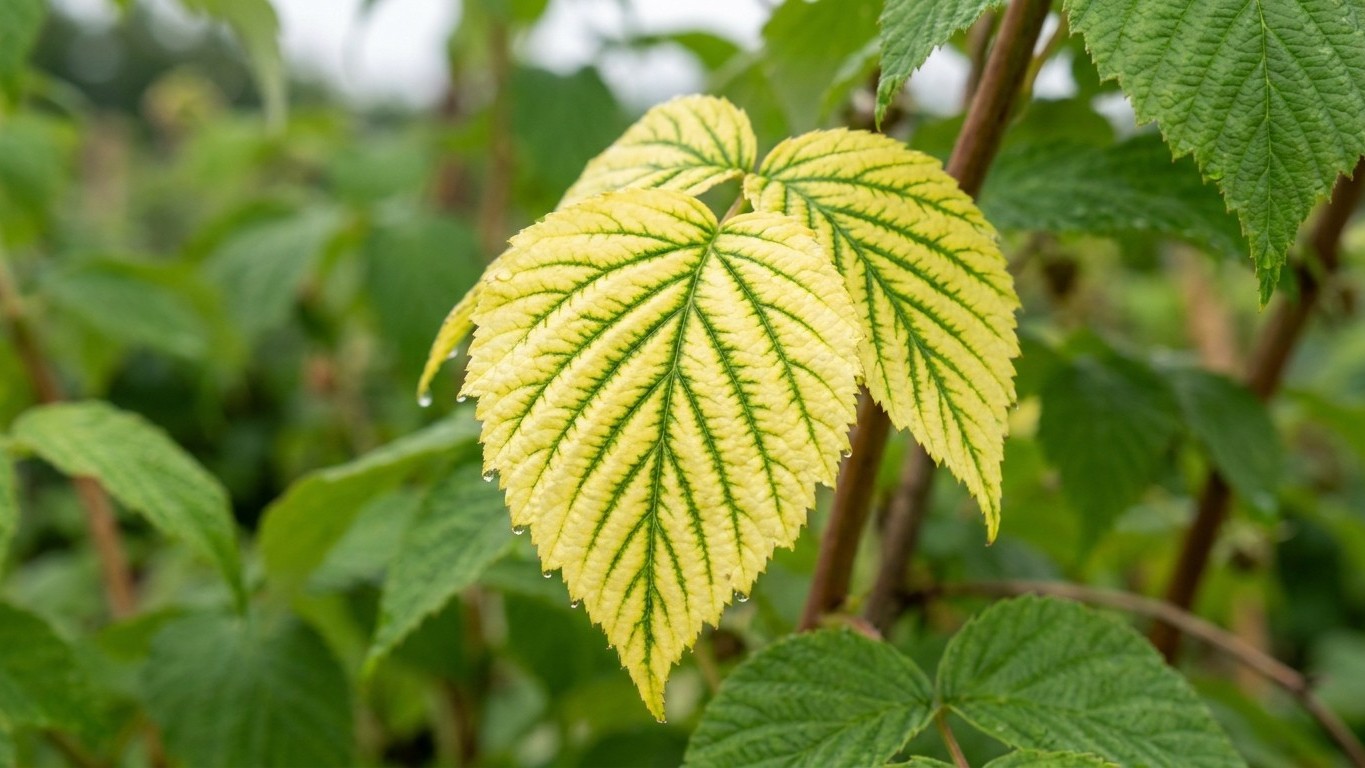
Those yellow leaves striped with dark green veins on raspberry canes usually mean one thing: too much alkalinity, not too little food. And the barbecue ash spread with good intentions each spring is often the exact cause.
Iron chlorosis refers to a yellowing caused by an iron deficiency in the leaf tissues, with the primary symptoms being interveinal chlorosis, a general yellowing of leaves with veins remaining green. That’s the pattern showing up on raspberry canes by August: the leaf blade fades to a washed-out yellow while the vein network stands out in sharp, healthy green. It looks almost decorative, like a leaf someone drew with a highlighter. It isn’t decorative. It’s a plant signaling distress.
The confusion is understandable. Wood ash has a genuine reputation as garden gold, and for good reason. Wood ash contains 3-7% potassium and 20-35% calcium that plants can use immediately. Potassium especially matters for fruiting plants, since it drives flowering and fruit development, which is exactly why gardeners reach for the ash bucket when they see raspberry canes loaded with berries. The problem isn’t the nutrients themselves. It’s what ash does to soil chemistry along the way.
Key takeaways
- Wood ash contains valuable nutrients but has a pH of 10-12, which can push raspberry beds into dangerous alkalinity within seasons
- Those decorative-looking yellow leaves with green veins appearing in new growth are actually a plant distress signal most gardeners misread
- A simple $5 soil pH test in spring reveals the problem before it happens, and the fix doesn’t require tearing out established canes
Why Ash Turns Against Berry Plants
Ashes contain chemicals which are very alkaline with a pH of 10 to 12, and they are harmful at high rates, especially in soils that are already alkaline. Raspberries have narrow preferences here. Raspberry plants prefer a soil pH of 5.6-6.2. That’s slightly acidic territory, a full point or more below neutral. Spread ash repeatedly around the base of the canes, and that pH climbs steadily upward, season after season, especially in a small backyard bed where the same handful of square feet absorbs every load of ash from every cookout.
Once soil pH crosses into alkaline territory, the plant’s relationship with iron changes completely. If soil already measures above 7.0, adding ash will make it too alkaline for most plants, and alkaline soil prevents plants from absorbing iron and other nutrients, causing yellowing leaves and poor growth. Iron is usually still physically present in the dirt. In most cases, the wrong pH of the soil is responsible for the lack of iron and magnesium, since the nutrients are actually available, but the plant can no longer absorb them sufficiently. The mineral sits there, locked in a form the roots simply can’t process. It’s the gardening equivalent of having cash in a bank account you can’t access.
Reading the Leaf Correctly
Not every yellow raspberry leaf tells the same story, and that distinction matters before reaching for a fix. The primary symptoms of iron deficiency are interveinal chlorosis, a general yellowing of leaves with veins remaining green, and in severe cases, leaves may become pale yellow or whitish, but veins retain a greenish cast. Nitrogen deficiency looks different. Nitrogen deficiency shows as a uniform yellowing of the entire leaf including the veins, and it appears first in the older leaves, while iron chlorosis appears first in the newer growth. So the location on the cane matters as much as the color pattern: if the freshest growth at the tips is the most affected, and the veins stay defiantly green, ash-induced alkalinity is the leading suspect.
There’s also a viral look-alike worth ruling out. Raspberry vein chlorosis virus can cause some yellowing of the veins, as opposed to chlorosis, which is more visibly widespread. That’s essentially the reverse pattern: veins going yellow rather than staying green, spread by aphids rather than caused by soil chemistry. Worth knowing, because no amount of soil correction fixes a virus.
Fixing the Bed Without Starting Over
The straightforward diagnostic step comes first. Have your soil tested to see if the pH is above 7.0 to 7.5, and if pH is high and other problems have been ruled out, iron deficiency is likely. A basic pH kit from a garden center or a sample sent to a local extension lab settles the question in a way that guessing never will.
If the reading confirms alkaline soil, the ash bucket needs to go somewhere else entirely, ideally toward vegetables that tolerate higher pH rather than back toward the raspberry patch. The solution when soil is too alkaline is to add sulfur or peat moss to lower pH. For a faster, visible response on canes already struggling, fertilizing with a specific amendment such as zinc sulfate, Epsom salts, iron chelates, and nitrogen-rich fertilizer can green things up within weeks rather than the full season a pH correction takes to filter through the soil.
Longer term, the more sustainable fix skips ash almost entirely and leans on organic matter instead. Feeding healthy plants humus, peat, and compost once every two to three years at a rate of five to six kilograms per square meter builds fertility without the pH swing. Mulch helps too, both for moisture retention and for the slow, gentle way it buffers soil chemistry compared to a sudden dump of ash.
The irony is that ash isn’t a bad amendment in general. It’s simply mistimed for raspberries specifically, and mistimed applications compound year after year in a way that catches gardeners off guard by midsummer. A pH test taken every spring, before the first cookout of the season even happens, costs less than five dollars and settles the question before a single yellow leaf appears.
Sources : megsediblelandscapes.com | realselfsufficiency.com