
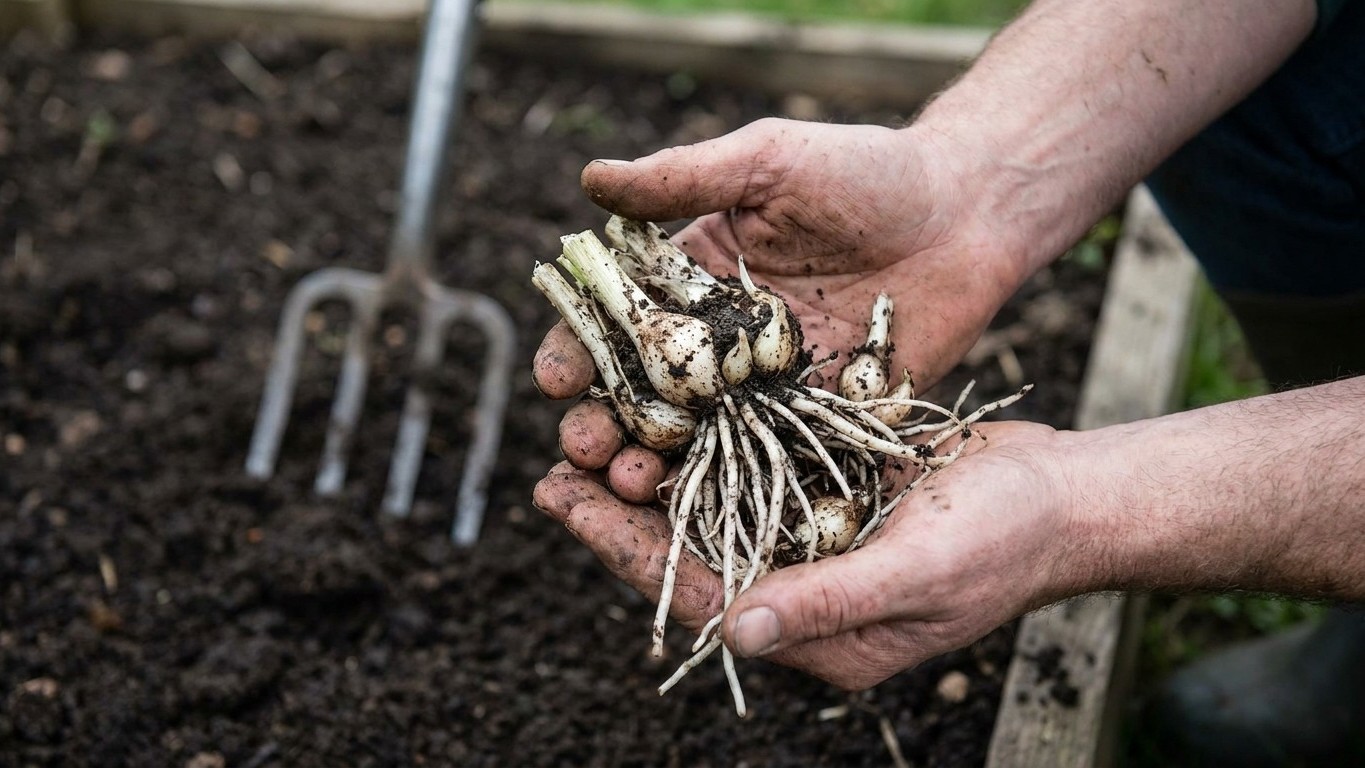
Every August, like clockwork, my neighbor grabs a garden fork and rips his entire leek clump out of the ground. Then he tears it apart with his bare hands and replants the pieces a few feet away. It looks brutal. It looks wasteful. And no, he’s not doing it to multiply his stock of freebies for the allotment swap. He’s doing it because if he doesn’t, his leeks will strangle themselves into uselessness.
The plant in question is what growers call the perpetual leek, perennial leek, or sometimes multiplier leek, a relative of the standard supermarket leek but with a very different survival strategy. Instead of setting seed and dying off after one season like an annual leek, this variety multiplies naturally by forming clumps of new plants each year. That sounds like a gift. It is, for a while. But left unchecked, that generosity turns into a traffic jam underground.
Key takeaways
- A clump that starts as a gift becomes a traffic jam—each year brings more baby bulbs competing for the same soil and nutrients
- Late August isn’t random timing; it’s when the plant naturally enters dormancy and can handle the stress of division without dying back
- The spacing matters more than gardeners expect—replant too close and you’ve just created the exact crowding problem you were trying to solve
The Clump Gets Crowded, Whether You Like It or Not
Here’s what nobody tells you when you first plant one of these things: success eventually becomes the problem. As the years go on, the individual plants get smaller as the clump gets bigger. One seed company selling the popular Delft Perpetual variety puts it bluntly: eventually your perpetual leek patch will get crowded and the leeks will start getting thin. That’s the trade-off baked into the plant’s biology. Every offset, every baby bulb clinging to the base of the mother plant, is another mouth competing for the same patch of soil, the same water, the same nutrients.
The Propagation mechanism itself is what causes the crowding. Growers note that perennial leeks are propagated by replanting the small offsets that form around the clump, and to propagate you simply divide the clump and start a new row with the offsets. Skip that division for a few seasons and you don’t get one impressive leek. You get a dozen skinny ones, all squeezed together, none of them worth much in a soup pot. My neighbor isn’t dividing his clump because he wants more leeks scattered around his garden. He’s doing it because his existing leeks were shrinking, and he wanted them back to a size worth cooking with.
Why the End of August, Specifically
The timing isn’t arbitrary either. Perennial leeks run on their own internal calendar, tied to flowering and dormancy rather than the neat spring-to-fall rhythm of annual vegetables. One nursery describes the cycle this way: plants emerge in early winter, harvest from March to June, flowers emerge July to August, and heads of bulbils can be collected in August, after which plants then go into a period of dormancy and all top growth will disappear until moisture returns. Late August lands right at that hinge point, after the flowering flush, right as the plant is winding down and before it goes fully dormant.
That dormant window matters for a practical reason: disturbing roots is far less stressful when the plant isn’t actively pushing new growth. It also lines up with when replanting material becomes available. According to growers who work with these bulbs, there are no seedlings, and the calendar for clove planting starts in August and ends in late winter. late August isn’t just a convenient date my neighbor picked out of habit. It’s the moment the plant itself is naturally ready to be moved, split, and reset without punishing it for the interruption.
How the Actual Splitting Works
Watching him do it, the process looks almost careless, but there’s a method underneath the roughness. The standard approach across growing guides is remarkably consistent:
- Loosen the soil with a garden fork and lift the whole clump intact rather than yanking individual stems.
- Gently pull the bulbs apart by hand, keeping as many roots attached as possible.
- Replant single shoots a few inches deep, spaced well apart rather than crammed back together.
One gardening resource recommends you open up the clump, gently teasing it apart so you don’t tear any roots, and place it in a hole about 4 to 6 inches deep. Spacing matters just as much as depth. The same guide suggests setting divided bulbs in small clusters spaced roughly ten inches apart in clusters of 4 or 5 shoots, spaced around 10 inches apart, which gives each new plant enough elbow room to bulk up rather than immediately re-crowding itself. Skip the spacing step and you’ve just recreated the exact problem you were trying to fix, only a season later.
There’s a bonus most people discover by accident rather than design. Because the plant produces smaller, tender leeks constantly around its base, one grower noted that this habit means you end up with a demographically-diverse patch of leeks that will mature in succession rather than all at once. That succession is actually useful in a kitchen. Instead of forty leeks all demanding to be eaten the same week, you get a rolling harvest that stretches from autumn well into spring, since these varieties tend to hold in the ground through early fall to late spring without bolting or turning woody.
What surprises most people is how forgiving these plants are about the whole operation. This isn’t some fussy specimen leek. It’s hardy enough that certain winter selections tolerate conditions tolerating USDA zone 3, meaning gardeners well into the northern half of the country can leave a clump in the ground through brutal cold and still have something to lift, split, and eat the following season. The August ritual isn’t about generosity toward the neighbors. It’s routine maintenance dressed up as a garden chore, the kind of unglamorous task that quietly determines whether next spring’s leek soup is worth making at all.
Sources : incrediblevegetables.co.uk | nature-and-garden.com