
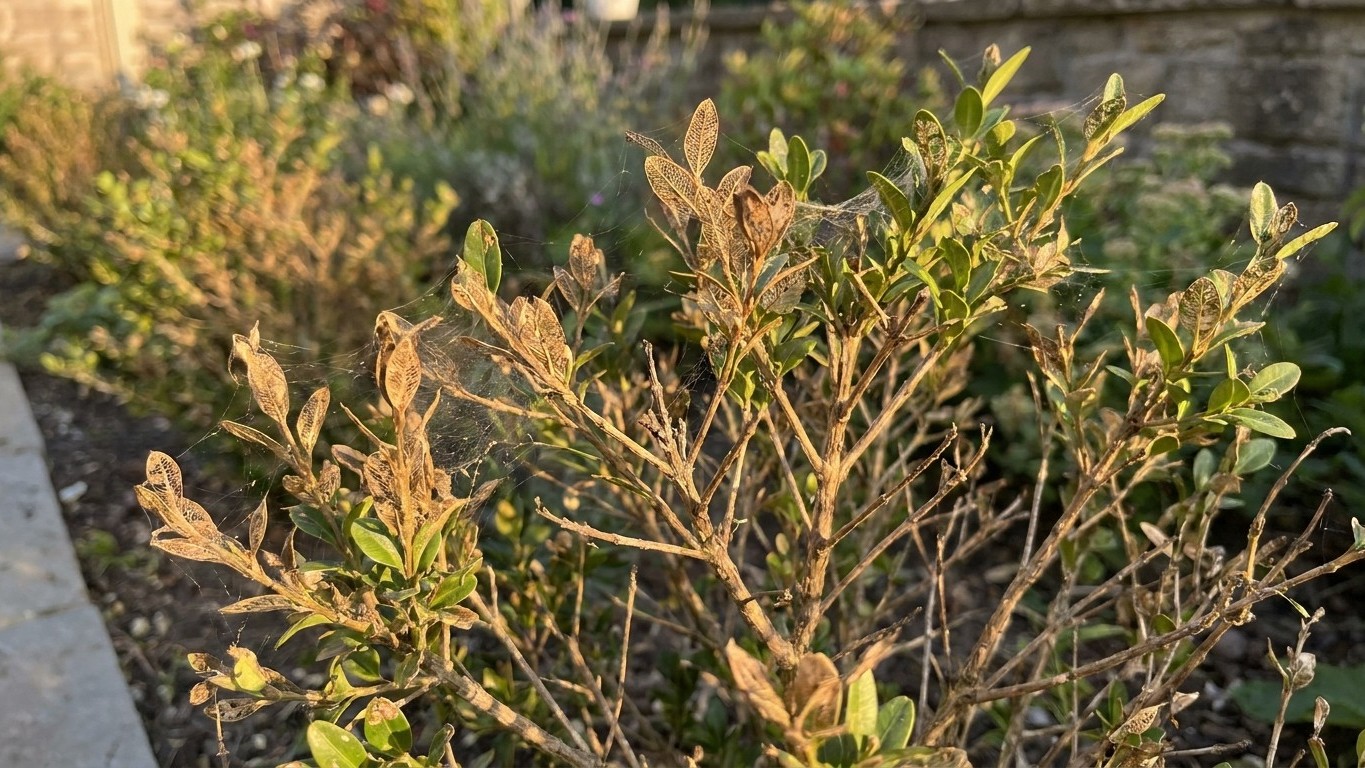
Two weeks. That’s all the time I gave myself to unplug this August, and it cost me a boxwood that had been shaping the corner of my garden since before either of my grandparents were born. I left for vacation on a Friday with a full, dense, glossy green hedge. I came back to find brown patches spreading through the foliage, webbing between the branches, and leaves reduced to skeletal veins. The damage wasn’t spread evenly across fourteen days. It hit hardest in the first ten.
What I was looking at wasn’t drought stress or a bad pruning job. It was the unmistakable signature of the box tree moth, an invasive caterpillar that has turned “boxwood” and “vulnerable” into synonyms across a growing swath of the country.
Key takeaways
- A single vacation during peak season exposed a boxwood to damage that took a century to build but only ten days to nearly destroy
- The box tree moth can reduce entire boxwood stands by 95% in eight years—and it’s spreading from Michigan to Massachusetts
- Preventative pesticides don’t work; the only real defense is a neighbor willing to peek inside your hedge every few days in July and August
The Insect That Turns a Century-Old Hedge Into Lace
The box tree moth, Cydalima perspectalis, arrived from East Asia and has been steadily working its way through North American landscapes since it was first confirmed on the continent in Toronto in 2018. It was first detected in North America in 2018 in Ontario, Canada and later confirmed in Niagara County, New York in July 2021. Since then it has been found from Michigan to Massachusetts, and new state detections keep surfacing almost every year.
What makes this pest so brutally efficient is its appetite. Box tree moth caterpillars damage boxwood plants by chewing boxwood leaves and bark, leading to leaf browning, defoliation, and girdling. Young larvae start subtly, scraping away at the leaf surface from underneath, but they don’t stay small for long. Older caterpillars will eat the entire leaf, leaving only the midrib, and once the leaves have been eaten, the caterpillars may also feed on the bark. That bark-feeding detail matters more than people realize: it’s not just cosmetic damage. Box tree moth caterpillars have also been observed chewing boxwood bark, leading to girdling, a circular groove around a woody stem that cuts off the movement of nutrients, and potentially plant death. A shrub can look thin one week and be structurally dying the next.
August is precisely the wrong month to look away, and here’s why. Boxwood extension specialists in Ohio describe how there is a second emergence of adults in late July/early August as the next generation of box tree moths emerge, looking for mates, and during summer overlapping of generations has been observed, with multiple life stages of the moth present at the same time. One UK pest control resource puts it bluntly: the summer waves are the ones to fear, since while the spring generation are smaller and slower, the summer generations, typically peaking in July and August, are much larger and hungrier. My hedge wasn’t unlucky. It was simply on the calendar.
Age Is No Defense
I’d assumed, wrongly, that a boxwood old enough to have outlived several owners of my house had earned some kind of resilience. It hasn’t. The moth doesn’t care about a plant’s age, size, or sentimental value, and boxwood happens to be its only real target. Boxwoods, Buxus species, are the only known hosts of box tree moths. That narrow diet is oddly reassuring for the rest of the garden and completely useless for the boxwood itself.
The scale of the threat isn’t anecdotal, either. Researchers tracking outbreaks in already-infested regions found something sobering: in introduced areas where box tree moth has two generations per year, boxwood stands have declined over 95% in eight years or less. Multiply that by the two to five overlapping generations the species can produce in warmer climates, and a single missed inspection window in peak season stops being a minor oversight.
What Ten Days Actually Looks Like on a Living Plant
The visual progression is faster and uglier than most people expect from an insect the size of a fingernail. Early signs are easy to miss: injury begins with young caterpillars that chew on the undersides of leaves, removing one layer of leaf tissue. By the time damage is obvious from a normal walking distance, the caterpillars have usually already matured, and the plant is telling a different story entirely. Extensive feeding can result in “see-through” brown boxwoods and potentially plant death. That’s exactly the phrase that kept running through my head standing in front of my own hedge. See-through. Not thin. See-through.
Alongside the missing leaves, look for the telltale mess the caterpillars leave behind. Plant symptoms can include green-black frass and unsightly webbing/silk threads on the host plant. If you spot fine silk holding clusters of leaves together, with tiny dark droppings caught inside, you’re not dealing with ordinary leaf drop. You’re dealing with an active colony that’s been feeding, undisturbed, for however long you’ve been away.
What I’ll Do Differently Before My Next Trip
Spraying preventively before leaving town sounds logical, but experts actually advise against it. Applying preventative pesticides to boxwoods will not effectively control box tree moth, and unnecessary pesticide applications can negatively impact beneficial insects and can even cause secondary pest outbreaks. The better strategy is vigilance during the exact window when risk peaks, meaning regular visual checks rather than a chemical shortcut. Monitor your boxwoods regularly, from April through October, and look for signs and symptoms of box tree moth.
If you do have to travel during late July or August, the smartest move is recruiting a neighbor or a plant sitter to do a thirty-second inspection every few days, specifically checking the interior of the shrub where webbing hides. Treatments containing the biological insecticide Bt remain the most recommended option once caterpillars are confirmed, since box tree moth larvae can be effectively managed with the biological insecticide Bt, a naturally occurring bacterium found in the soil that is also registered for organic food production, but it only works while larvae are actively feeding, not after they’ve already stripped the plant bare.
My hedge isn’t dead. Boxwood can sometimes push new growth from bare wood if the roots and enough stem tissue survive, though nobody can promise it’ll ever look the way it did a hundred years in the making. What I know for certain is that the caterpillars that did this were probably already on the plant before I even packed my suitcase, quietly waiting for the one thing every gardener eventually gives them: a couple of unwatched weeks in the middle of summer.
Sources : bygl.osu.edu | environpestcontrol.co.uk