
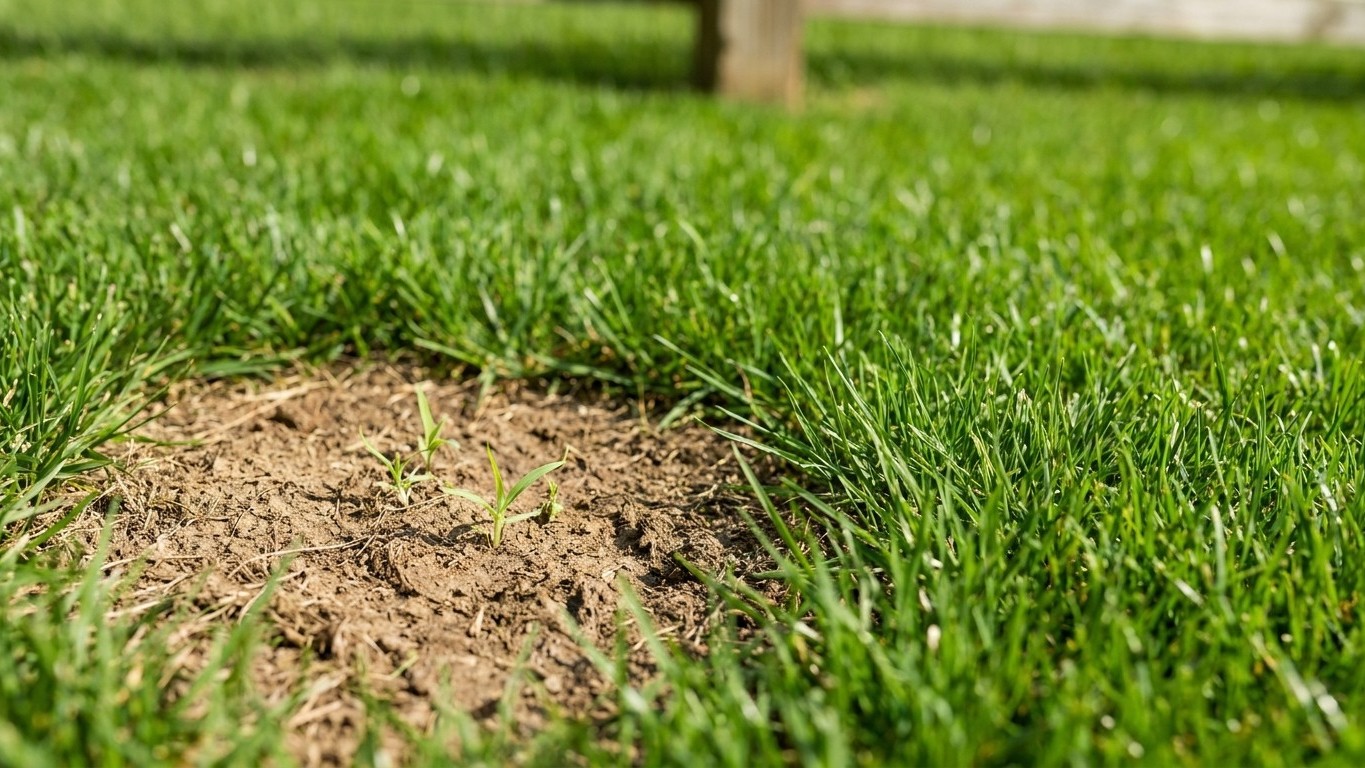
Three weeks after cutting a drought-stressed lawn down to the dirt, hoping the return of August rain would trigger a fast green comeback, what showed up in those bare patches wasn’t turf. It was crabgrass, spreading low and fast, along with a scattering of broadleaf weeds that moved in before the grass had a chance to recover. This is one of the most common lawn care mistakes homeowners make right after a dry spell breaks, and it’s backed by turfgrass science, not just bad luck.
Key takeaways
- Cutting drought-stressed grass too short removes the leaf tissue it desperately needs to rebuild—right when recovery is critical
- Bare, scalped patches create the perfect incubator for crabgrass: exposed soil, direct sunlight, and heat
- The fix isn’t another aggressive mow—it’s raising the deck high and waiting for nature to fill small patches on its own
Why Scalping a Drought-Stressed Lawn Backfires
The instinct makes sense on the surface: the grass looks ragged and yellow, rain finally shows up, so why not cut it low and let it grow back fresh? The problem is that drought-stressed turf is already running on fumes. Mechanical damage from mowing during extremely hot, dry weather can almost destroy a lawn by thinning out or completely killing grass, according to A. J. Powell, an Extension turf specialist. Cutting it short right as it’s trying to wake back up removes the very leaf tissue the plant needs to rebuild.
Keeping the mower on its highest setting, around 3.5 to 4 inches, is what turf experts recommend while a lawn recovers, since the biggest mistake is getting excited when the lawn greens up and mowing it too short, which removes leaf area the grass needs to rebuild roots. Extension turf specialists at multiple universities echo the same guidance. Raising mowing height to a minimum of 3 to 3.5 inches during drought conditions, and in summer generally, helps alleviate stress on the turf. The rule of thumb almost every agronomy program repeats: never remove more than one-third of the leaf blade in a single mowing. Scalping obliterates that ratio in one pass, and the grass pays for it exactly when it should be putting energy into new roots instead of emergency repairs.
What Actually Fills a Bare Patch (Hint: It’s Not Grass)
Bare soil doesn’t sit empty for long. Thin or bare soil is an open invitation for weeds like crabgrass to move in before the grass can recover. That’s not a coincidence of timing, it’s a documented pattern. Weeds germinate rapidly when turf is scalped by mowing too low or mowed too infrequently, since both create an open canopy that favors weeds, according to the University of Missouri Integrated Pest Management program.
Crabgrass in particular is built for exactly this moment. Because seedling crabgrass isn’t very competitive, a vigorously growing turf will crowd out new seedlings, while an underfertilized, weak lawn has a greater chance of being invaded by weeds. A scalped lawn recovering from drought checks both boxes at once: it’s weak, and there’s suddenly a lot of open ground with direct sunlight hitting the soil, which is precisely the germination trigger crabgrass seed is waiting for. Height matters more than most people realize. Mowing tall fescue at 3 to 4 inches can cut weed pressure by up to 80 percent compared to short mowing, according to University of Maryland Extension research. Flip that height the other direction, down to a scalp, and the weed pressure doesn’t just return, it compounds.
There’s a secondary effect too, one that rarely gets mentioned. Mowing grass too short can cause the soil to heat up and can create an unfavorable environment for healthy turfgrass, and as the healthy turf thins out, crabgrass will eagerly fill in. So the scalped patches aren’t just exposed, they’re hotter than the surrounding soil, which happens to be the exact condition crabgrass seed prefers for germination. It’s a lawn care irony: the cut meant to “reset” the yard actually built a small incubator for the weed everyone’s trying to avoid.
The Fix Isn’t Another Scalp, It’s Patience and Timing
Reaching for the mower again to fix a scalp mistake usually makes things worse, not better. Turf specialists are blunt about this. Scalping the lawn to remove crabgrass usually opens more soil for new weeds. The better path is recovery first, correction second.
That starts with raising the deck. Multiple extension programs, from South Dakota to Wisconsin to Virginia, converge on the same range. Setting the mower height to two-and-a-half to four inches gives the lawn a deeper and larger root system, keeps moisture in, defends against weeds, and keeps the soil cooler. In practice, that usually means the highest setting the mower offers, not a middle-ground compromise.
Timing the next mow matters just as much as the height. If the grass is growing but slowly, the recommendation is to mow at the highest setting and only cut off the top third of what has grown, so if it grew half an inch since last week, take a quarter inch off. That’s a much gentler cadence than the impulse to “catch up” all at once.
For the patches that are genuinely dead rather than just dormant, overseeding is the real fix, and late summer happens to be good timing for it. The best time to overseed cool-season grasses like tall fescue and Kentucky bluegrass is late summer to early fall, when soil temperatures are still warm enough for germination but air temperatures are cooling down. Small bare spots often don’t even need intervention. If the open spots are 6 inches or less, grass typically fills in on its own, though fine fescues may be a little slower.
One detail worth remembering before reaching for a crabgrass killer on those newly weedy patches: pulling out the herbicide too soon can undercut the very seeding effort meant to fix the problem. Some products for preemergent crabgrass control, like pendimethalin, cannot be applied when seeding lawns and will be effective for 4-5 months, so seeding cannot follow for that time period. Fixing a scalp mistake, it turns out, takes more patience than making it did.
Sources : weau.com | news.vt.edu