
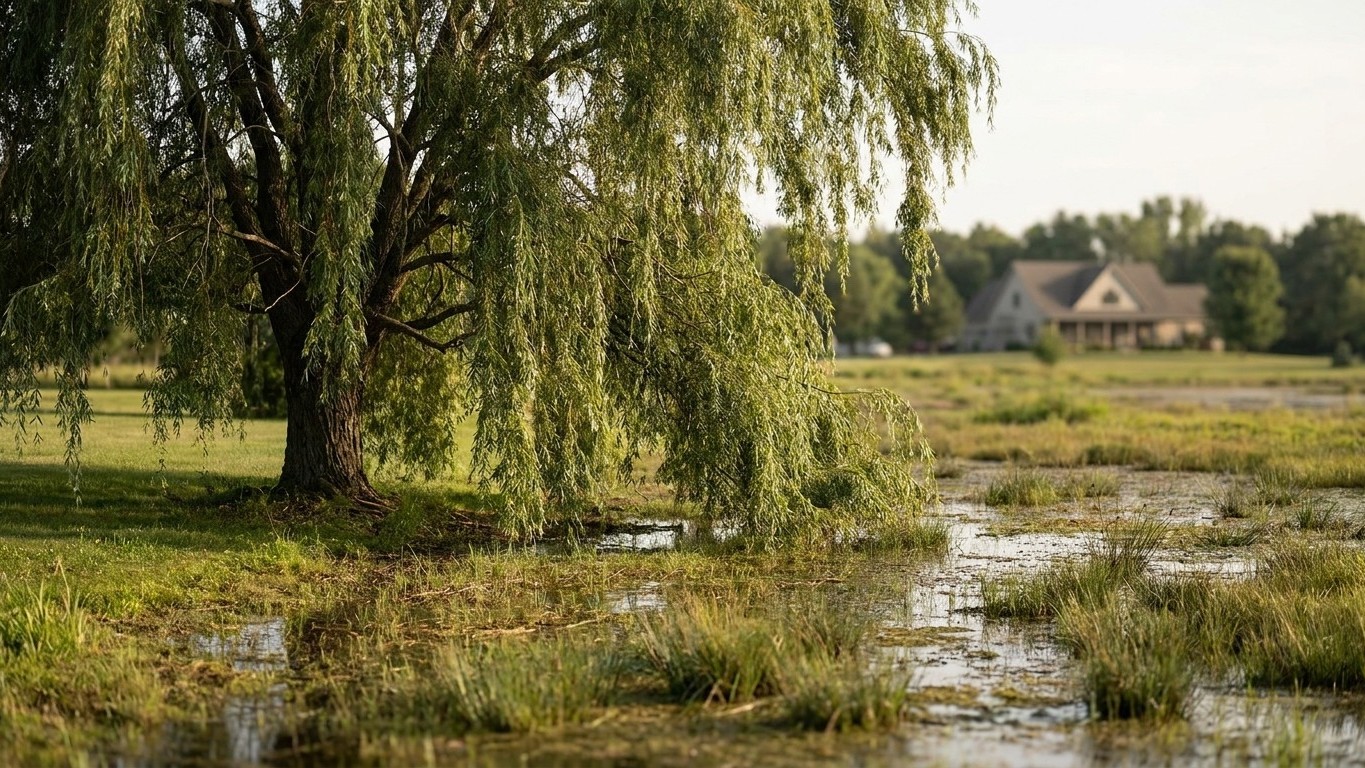
That willow at the far edge of the property isn’t there for the scenery. It’s there because your neighbor read the fine print on what weeping willows actually do underground, and decided the septic tank and foundation walls should stay far, far away from those roots.
Weeping willows (Salix babylonica) have a reputation problem, and it’s earned. Care should be taken not to locate weeping willows near underground water or sewer lines or close to septic tank drain fields where the roots could cause significant damage, since roots are aggressive and will spread about three times the distance from the trunk to the edge of the canopy and often grow on the soil surface. Do the math on a mature tree and you’re looking at a root zone that can stretch well past a typical suburban lot line. One home-improvement source puts it bluntly: plant your weeping willow at least 50 feet away from your house, as the roots can cause problems around foundations as well as water and sewer pipes.
Key takeaways
- Weeping willow roots can extend 100+ feet and aggressively seek water sources—including your sewer pipes
- A mature tree reaching 50 feet tall needs 50 feet of clearance from houses, septic systems, and underground utilities
- Placed correctly in wet, low-lying areas, willows function as natural drainage systems, potentially saving thousands in landscaping costs
The roots go looking for trouble, not the other way around
Willow roots aren’t malicious. They’re just really good at their one job, which is finding water. Most tree roots that harm foundations aren’t themselves causing the cracks, but are exploiting preexisting weak points in the foundation, and roots do expand in size as the tree matures, seeking out water depending on the type of tree. A willow, more than almost any other landscape tree, is built for that search. Botanically speaking, willows belong to a group plant scientists call phreatophytes, species that essentially tap directly into groundwater. Willows are phreatophytes, plants that essentially mine the water table, having evolved to live in riparian zones, floodplains, and marshes where soil oxygen is low and moisture is high, thriving through specialized structures called lenticels that facilitate gas exchange even in saturated conditions.
That’s a fancy way of saying a willow will crack open a clay sewer pipe joint the way you’d crack a walnut, given enough time. Once they reach the pipe, the roots will enter and expand, eventually causing a total blockage or a structural collapse. One homeowner’s cautionary tale, shared on a gardening forum, describes exactly this scenario after a willow cracked into a sewer line, and the plumbing company would only guarantee the fix for six weeks instead of the usual six months to a year offered for other tree species. That’s not a coincidence. It’s a pattern common enough that plumbers price it in.
Why the far corner of the yard is the only sensible spot
Distance recommendations for these trees are surprisingly consistent across arborists, extension offices, and landscape professionals, and they’re never modest. Houses, driveways, sidewalks, pools, water lines, and septic tanks should all be very far away, 50 feet or more, since to plant a weeping willow anywhere closer is to court disaster. University horticulture guidance from Florida is just as direct, noting the tree is not for residential lots, best located near water where soil will be undisturbed.
There’s a sizing reality behind all this caution, too. A weeping willow isn’t a modest ornamental. Ultimately reaching a height of 30 to 50 feet with an equal or greater spread, weeping willow should be given plenty of room to develop its broad, rounded crown. Picture a tree roughly as tall as a four-story building, with a canopy just as wide, and you understand why “the bottom of the plot” isn’t a design choice so much as damage control. Push that tree anywhere near the house and the branches alone start interfering with the roofline long before the roots ever reach the foundation.
And the roots don’t slow down to be polite about the neighbor’s fence line either. The roots of a weeping willow can spread over 100 feet long, and if the tree has reached maturity with foliage between 45 to 70 feet long, the root system can spread out over 100 feet. That’s why a smart planting spot isn’t just far from one’s own house. It’s far from everyone’s house, pipes, and patio slabs within reach.
The upside your neighbor is probably banking on
None of this means the tree is a mistake. Placed correctly, at the bottom of a slope, near a pond, along a ditch that floods every spring, a weeping willow becomes free drainage infrastructure. Its substantial root system efficiently soaks up large amounts of water, acting like a sponge for soggy patches. Landscapers increasingly recommend it specifically for the low, wet corner of a yard that never quite dries out, the exact spot where grass struggles and mosquitoes throw a party after every rainstorm.
The mechanism is almost mechanical in its efficiency. A mature willow acts as a hydraulic pump, drawing moisture from the deep soil layers and releasing it into the atmosphere through transpiration. A single mature tree can process an extraordinary volume of water this way, day after day, all season long, no pump or French drain required. That’s almost certainly the real logic behind the placement next door: not scenery, but a living solution to a drainage headache that would otherwise cost thousands in regrading or piping.
Worth knowing before copying the idea, though: willows aren’t forever. Their limitations are their need for copious amounts of moisture and their weak wood, which makes them prone to storm damage, and the lifespan of a typical weeping willow is fairly short compared to other trees that grow to a large size. Most last somewhere between three and five decades. So that willow at the back fence isn’t just solving a drainage problem quietly. It’s doing it on borrowed time, which is one more reason smart owners keep it as far from anything expensive as the property line allows.
Sources : quora.com | arboristsite.com