
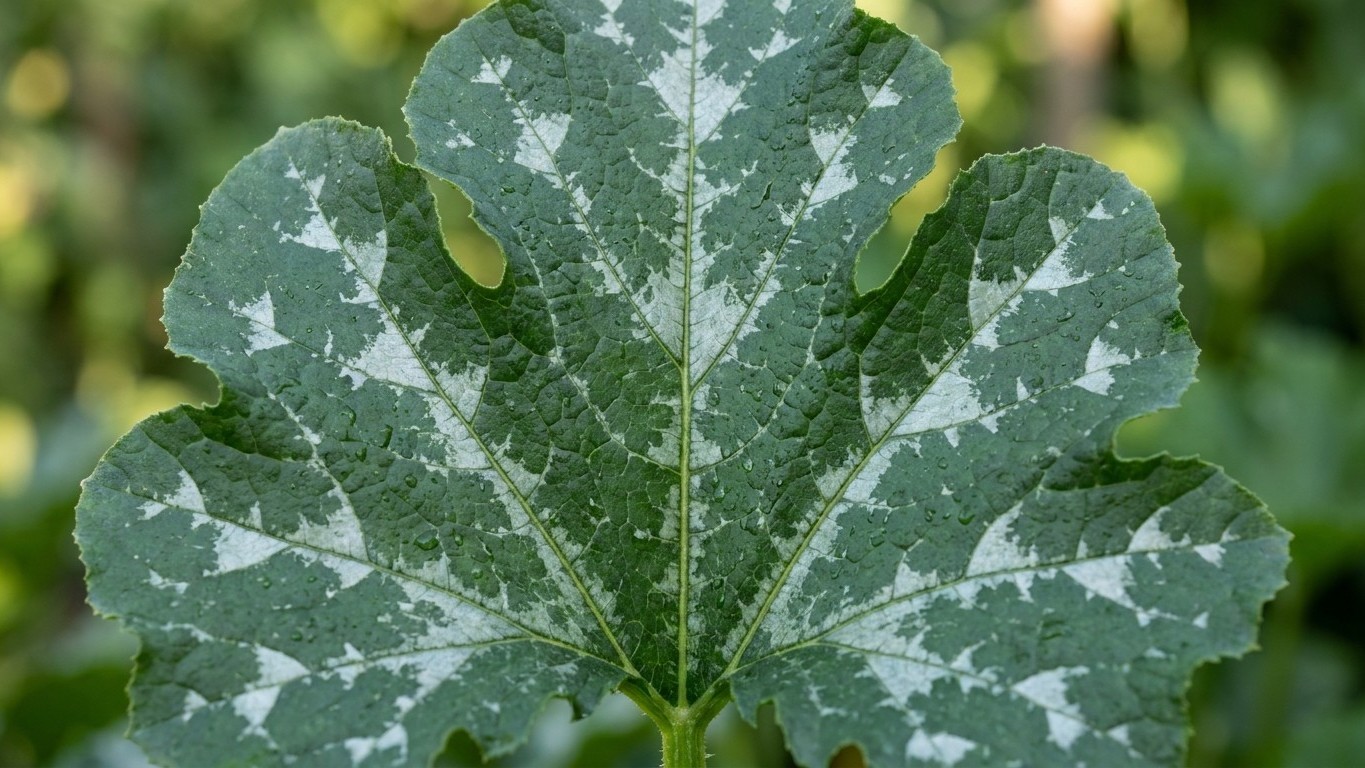
Three mornings of faithfully misting courgette leaves with diluted milk, and the white patches hadn’t budged. But that wasn’t the surprise. The real shock came when brand-new leaves, ones that had never been touched by the spray bottle, unfurled with the exact same pale markings, arranged in neat, mirrored patterns along the veins. That symmetry is the tell. Powdery mildew doesn’t work that way.
The confusion is common enough that gardening extension services and horticulturists write about it every summer. White spots on squash and melon foliage are usually caused by one of two things: disease or natural variegation. On the other hand, some (but not all) cucurbit varieties including zucchini, squash, pumpkins, cucumbers and melons have natural silvery-white spots, markings, or patterns on their leaves that are totally harmless. No fungus, no infection, nothing to spray at all.
Key takeaways
- A gardener spent three days spraying courgettes with milk for a problem that didn’t exist
- New leaves revealed a perfectly symmetrical pattern that no fungus ever creates
- A two-second finger test could have prevented the entire misguided treatment
Why the Milk Spray Made Sense (In Theory)
Reaching for milk instead of a fungicide wasn’t a random impulse. The remedy has actual research behind it, which is more than can be said for most kitchen-cupboard garden hacks. A Brazilian study from the late 1990s found that fresh cow milk was tested in five greenhouse experiments against powdery mildew on zucchini squash, sprayed at concentrations from 5 to 50%, either once or twice a week, and the results were striking: high concentrations of milk were more effective than the conventional fungicides tested.
Follow-up work on field-grown pumpkins in Connecticut confirmed the effect held up outside a controlled greenhouse, though less dramatically. Treatments based on milk were, on average, about 50–70% as effective in reducing foliar symptoms and post harvest fruit rot and 40–50% as effective in increasing marketable yield as the chemical control, with skim milk not as effective as whole milk, especially in rainy years.
The mechanism is still debated. The leading theory is that proteins and compounds in milk produce a reaction in sunlight that is hostile to the fungus, and that milk may also boost the plant’s natural defenses. Whatever the exact biochemistry, the classic ratio used across most of these trials is simple: roughly a 1:9 ratio of milk to water, meaning about one part milk to nine parts water. Spraying that mix every morning wasn’t a bad instinct. It just aimed at a target that, in this particular garden, didn’t exist.
The Finger Test Nobody Mentions Often Enough
There’s a two-second diagnostic that would have settled the question before the first spray bottle came out. The quick and straightforward way to test a spot is to rub it with your finger, since powdery mildew spores will come off the leaf with gentle rubbing, while white spots that are part of the leaf pattern will be unaffected. No smear on the fingertip, no dusty residue. Just a leaf that looks the same before and after.
The visual differences matter too, and they’re more specific than “white versus not white.” White spots caused by natural variegation are usually fairly uniform, displayed in a mirrored pattern on all leaves and concentrated around leaf veins, the markings are flat rather than raised and only visible on the top side of the leaf, and this pattern typically appears when the plants are still young seedlings. Mildew tells a messier story. Powdery mildew spots are more irregular and scattered than natural variegation, some big, some small, some leaves with none at all, and they’re usually round, fuzzy, dusty-looking, sometimes slightly raised, and found on both the top and bottom of leaves and stems.
Timing gives another clue. Powdery mildew generally shows up later than variegation, with the oldest leaves becoming most heavily infected. A courgette plant covered in symmetrical silver blotches on its youngest leaves right out of the gate is showing off a genetic trait, not fighting a disease. Some varieties are simply bred, or naturally prone, to display it. There are some zucchini varieties that have white mottling or variegation in their leaves, and in this case those white markings will be regular and symmetrical, which is no cause for concern.
When the Spray Actually Earns Its Keep
None of this makes the milk spray useless, only misapplied that particular week. Real powdery mildew, caused by fungi that appear as white powdery spots on leaf surfaces, is a genuine threat to squash-family crops, and it does spread aggressively once established. White powdery spots appear on leaf surfaces when temperatures start to increase, and over time the entire leaf can be covered, since the “powder” on leaves is the fungal mycelium and spores. That’s a different situation entirely, and one where early intervention genuinely changes the outcome.
The window matters more than the ingredient. Milk spray works best as a preventive tool used early, not as a miracle cure for plants already covered in mildew. Save it, along with the daily ritual, for a case where the finger test actually leaves residue on your skin.
What tipped things off in this garden wasn’t a lab result or a diagnosis from a nursery. It was simply watching new growth long enough to notice the pattern repeat itself, leaf after leaf, vein after vein, in a way that no fungus bothers to be that tidy about. Powdery mildew, when it does show up on cucurbits, tends to prefer humid nights following warm days and thrives in stagnant air around crowded plants, so the fix for real infections has less to do with the fridge and more to do with spacing plants generously and watering at the soil line instead of overhead. The courgettes never needed rescuing. They needed someone to stop squinting at healthy leaves and start trusting what was already growing exactly as it should.
Sources : sciencedirect.com | sundaygardener.co.uk