
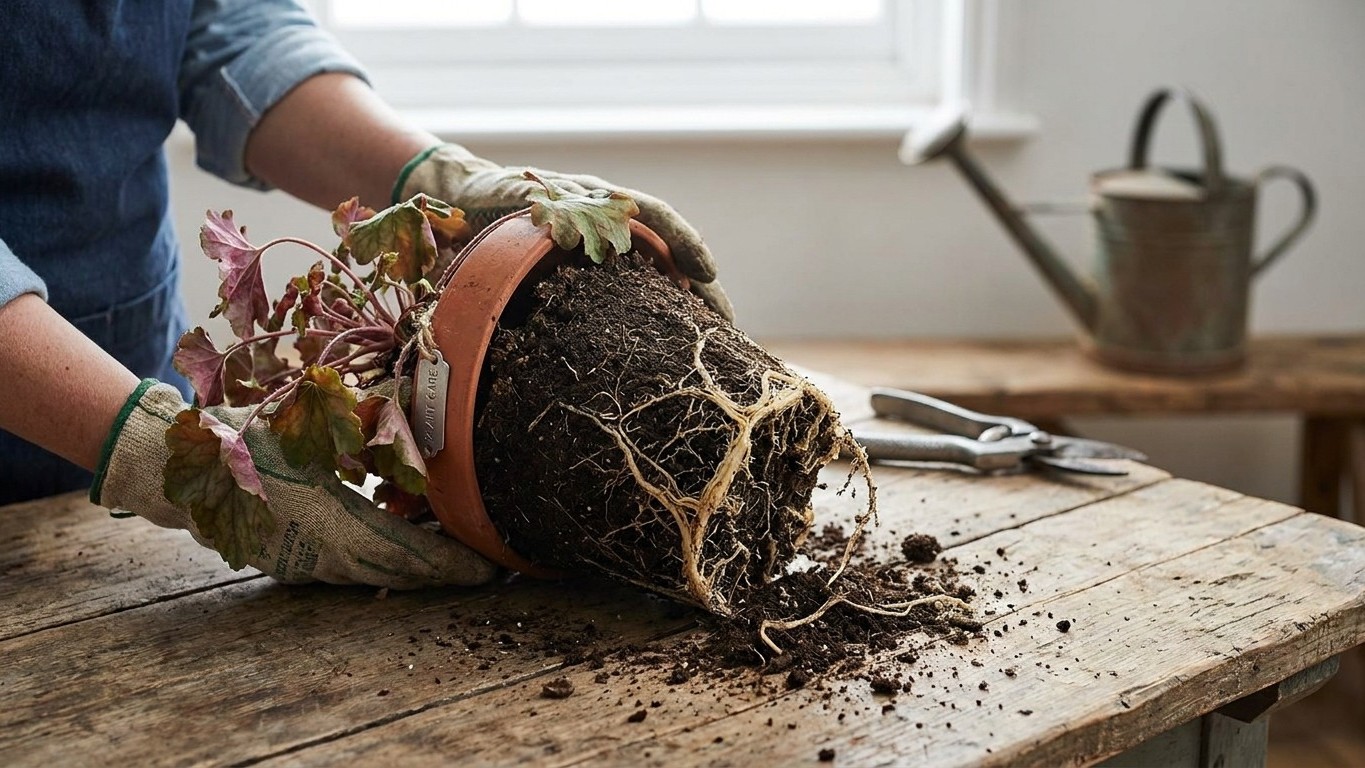
Notched leaf margins on a heuchera almost never mean much on their own. The real damage happens underground, months later, invisible until you tip the pot and see what’s been quietly hollowed out beneath the soil line.
That’s the cruel trick of vine weevils. Adult vine weevils eat leaves and the grubs eat roots, with the adults feeding on leaves during spring and summer while it’s the grubs that cause the most damage over autumn and winter. By the time a gardener notices wilting foliage in February, the insect responsible for the notching finished its work in leaves months earlier and its offspring have already spent an entire cold season underground, feeding.
Key takeaways
- Leaf notches are cosmetic damage from adults, but they mark the presence of something far more destructive below
- Larvae spend an entire cold season feeding on roots, intensifying their appetite as temperatures drop through winter
- A heuchera that seemed healthy in October can be reduced to a crumbling root ball by February with almost no visible warning
What Those Notches Actually Mean
The telltale sign is specific: the adult weevil bug eats leaves, always starting from the edge to form semi-circle notches, and working their way inwards. That distinguishes vine weevil from slugs or caterpillars, which tend to chew ragged holes in the middle of a leaf rather than tidy crescents along the rim.
Here’s the part most gardeners get wrong: the notching itself is cosmetic, not a crisis. Adults that feed along leaf margins produce typical crescent shaped notches, and moderate to light notching seems to have little effect on plant health. The RHS backs this up plainly, noting that adults rarely cause enough damage to affect the vigour of plants. So the notches you spot on a heuchera leaf in June or July are essentially a warning label, not the injury itself.
The injury comes later, from a source you never see. Young larvae feed on fine roots and mature larvae feed on stems, crowns and larger roots, often feeding in the crown and severely reducing root systems, causing plant death in herbaceous perennials. Heuchera sits near the top of the vulnerability list. Perennials prone to this damage include astilbe, bergenia, epimedium, helleborus, heuchera, heucherella, hosta, physostegia, phlox, primula, saxifrage, sedum and tricyrtis. Container-grown plants take the hardest hit, since vine weevil is especially associated with plants grown in pots and containers because the larvae can quickly consume the limited root system available.
The Timeline That Explains the February Surprise
Understanding why the damage shows up in late winter requires following the weevil’s full year. Adult females, and there are almost never males involved since reproduction happens without them, emerge in spring and start feeding on foliage to build up energy for laying eggs. The female weevil emerges from the soil in early spring, and over a 3-4 month period each adult can lay up to 1000 eggs close to suitable host plants. Eggs go into the soil near the crown, and within roughly two weeks, the next generation hatches and burrows straight down toward the root ball.
From there, the larvae feed steadily through the warm months and then intensify their appetite as temperatures drop. It is the grubs that can cause the most damage over autumn and winter when they feed on plant roots, and this damage can result in wilting and plant death. A heuchera that looked perfectly fine in October can be reduced to almost nothing by the roots come February, simply because that stretch of cold months is exactly when the larvae are largest and hungriest, right before they pupate into the next generation of adults in spring.
That’s also why a gentle tug test works as an early warning. Look for sick or wilted plants, give them a gentle tug to see if the roots have been eaten, or carefully tip them out of their pots to examine the roots. A heuchera that lifts out of its soil with almost no resistance, root ball crumbling rather than holding together, has almost certainly lost its fine roots to grubs over the winter.
What Actually Helps, and What Doesn’t
Once you’ve found the damage, the plant itself may or may not be salvageable. If enough healthy roots remain and treatment is applied early, the plant may recover, but severe root loss can be fatal, especially in containers. If there’s any green crown left and a handful of intact roots, repotting into fresh, weevil-free compost and cutting back top growth to reduce demand on what’s left often gives the plant a fighting chance through spring.
Prevention matters more than rescue, and biological control is the standard recommendation from horticultural authorities. Biological control for the larvae is available as microscopic insect pathogenic nematodes, with several species and combinations available, and they are suitable for use in containers and in the open ground. Timing is everything here, since nematodes are temperature-sensitive. For optimal results, apply in August or early September when soil or potting media temperatures are sufficient for nematode efficacy, and before vine weevil grubs have grown to a size capable of causing severe damage.
Physical checks stay useful too. Because adults can’t fly, a simple habit of shaking pot-grown plants over newspaper on a summer evening or checking under pots with a torch catches the beetles before they’ve had a chance to lay hundreds of eggs. Adult vine weevils can be caught by hand and squashed, either by inspecting plants at night by torchlight when the beetles are active or by shaking pot-grown plants over newspaper.
One detail worth remembering next time you inspect a container heuchera: the grubs themselves are unmistakable once you see them, creamy white, legless, curled into a tight C-shape with a small brown head. Finding even two or three in a small pot’s worth of compost is enough justification to treat the whole container, since a single female can lay hundreds of eggs and the larvae she leaves behind won’t announce themselves again until the roots are already gone.
Sources : gardening-naturally.com | bestall.co