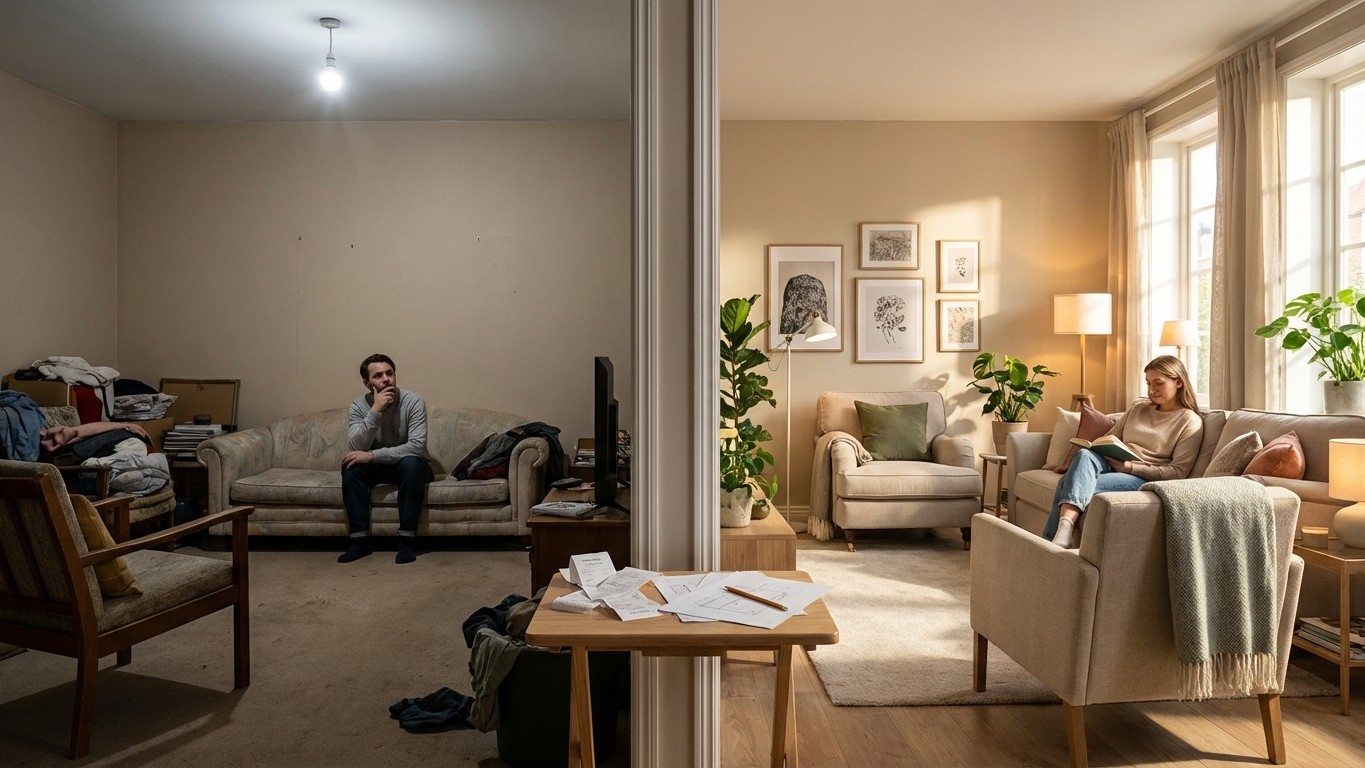
Forty euros spent on a single cushion. That’s often where a living room makeover begins, and ends, with nothing to show for it but one lonely accent piece on a sofa that still looks exactly the same as before. The real transformation happens when you approach your salon with a plan, not a shopping cart.
A budget living room makeover doesn’t mean settling for less. It means making smarter decisions about where your money actually creates visual impact. Some changes that cost under 30 euros can shift the entire atmosphere of a room. Others that cost 300 euros leave you wondering what changed. The difference is almost always strategy, not spending power.
This guide breaks down the full process, from reading your existing space honestly to executing specific projects within defined budget ranges, so you can walk into your living room next weekend and see something genuinely different.
Les bases d’un budget living room makeover réussi
Évaluer l’état actuel de votre salon
Before buying anything, spend twenty minutes in your living room doing nothing but looking. Sit in each seat. Notice what your eye lands on first, and whether that’s intentional or accidental. Take photos from the doorway, which is how guests actually experience the room. Most people are surprised by what they see when they stop moving through a space and actually observe it.
Write down three things that bother you most. Not a wishlist, a problem list. “The room feels dark” is actionable. “The room doesn’t feel luxurious” is too vague to budget for. Specificity is what separates a makeover that works from one that just shuffles things around.
Définir votre budget réaliste pour la transformation
A realistic budget starts with an honest number, not an aspirational one. If you have 150 euros to spend, that’s your working reality, and it’s enough to change a room noticeably if spent well. The broader framework for budget home makeover planning applies here too: separate your budget into impact categories rather than product categories.
Reserve roughly 40% of your budget for the one highest-impact change you identified. The remaining 60% covers supporting layers. Spreading money evenly across every element is how budgets evaporate without visible results.
Identifier vos priorités et besoins essentiels
Not all living room elements carry equal visual weight. Walls occupy the most surface area, so changes there read immediately. Lighting shapes how every other element looks, which makes it a multiplier investment. Textiles add warmth and texture at relatively low cost. Furniture placement costs nothing and yet most people never experiment with it.
Rank your priorities before spending a single euro. The goal is transformation, not accumulation.
Stratégies de décoration salon petit budget qui font la différence
La puissance de la peinture : transformer l’ambiance pour moins de 100€
Paint is the single highest-return investment in any living room transformation. One wall painted in a deep, saturated tone can make a room that felt forgettable suddenly feel designed. The effect comes from contrast and intention, two things that cost nothing extra beyond the paint itself.
You don’t need to repaint the entire room to see dramatic results. A single accent wall behind the sofa or around a fireplace, done in a thoughtfully chosen shade, often creates more impact than four new walls in a safe neutral. For color selection that won’t clash with existing furniture, exploring budget friendly living room paint colors gives you a starting framework with specific tone recommendations that work across different light conditions.
Budget reality: a quality 2.5L tin of paint runs between 25 and 45 euros depending on brand. Add primer if you’re going dark over light, brushes, and tape, and you’re typically under 80 euros for a single wall transformation completed in one afternoon.
Réagencement intelligent : maximiser l’impact sans dépenser
Moving furniture around costs exactly zero euros and regularly produces the most dramatic before/after results of any living room change. Most living rooms are arranged around a television by default, which creates a passive, one-directional room that feels more like a waiting room than a living space.
Try pulling the sofa away from the wall by 30 to 40 centimeters. Create a conversation zone with seating facing each other rather than all pointing at a screen. If your room is small, angling furniture at 45 degrees to the walls can make the space read larger without removing a single piece. These aren’t decorating tricks; they’re spatial logic.
Éclairage abordable : créer une atmosphère chaleureuse
Overhead lighting is the enemy of atmosphere. That single central ceiling fixture, present in the majority of French apartments and houses, flattens a room and makes it feel functional rather than inviting. The solution isn’t expensive: add two floor lamps or table lamps at different heights, switch bulbs to warm white (2700K), and turn off the overhead entirely in the evenings.
Three light sources at different heights create what interior designers call layered lighting. The investment required to achieve it can be as low as 40 euros if you shop second-hand or at budget home stores. The transformation in atmosphere is immediate and significant enough that guests will comment on it without being able to explain what changed.
Idées déco salon économiques par zone d’impact
Murs et décoration murale : solutions créatives à petits prix
Bare walls are a missed opportunity, but gallery walls done without intention look chaotic. The key is treating a wall grouping as a single composition with a clear center of gravity. Start with your largest piece, whether that’s a framed print, a mirror, or a textile panel, and build outward with consistent spacing.
For DIY approaches that go beyond framed prints, the possibilities for diy living room wall decor on a budget include woven hangings, painted geometric shapes directly on the wall, and shelf arrangements that mix objects with framed pieces. The investment can stay well under 50 euros while creating a focal point that anchors the entire room.
Mirrors deserve special mention. Placed opposite a window, a large mirror effectively doubles your natural light. The visual effect of expanding a small room is real, not illusory; it genuinely changes how the space feels to move through.
Sol et tapis : astuces pour délimiter et réchauffer l’espace
A rug does three things simultaneously: it defines a zone, adds warmth underfoot, and introduces texture and color. In an open-plan living area, a well-placed rug is often the only thing that tells the eye where the living room actually begins and ends.
The most common Mistake is choosing a rug that’s too small. A rug that only fits under the coffee table while leaving all the sofa legs floating on bare floor looks accidental rather than deliberate. Size up whenever possible. Budget tip: vintage and second-hand rugs often cost 20 to 40% less than comparable new pieces and carry character that flat-woven mass-market rugs rarely offer.
Fenêtres et rideaux : encadrer la lumière naturelle
Curtains hung at ceiling height, even when your windows sit lower, make ceilings read taller and light feel more generous. This is one of those cheap living room decorating hacks that sounds like a styling trick but is grounded in how the eye processes vertical lines. The cost difference between a curtain hung at window height versus ceiling height is zero; it’s just a matter of where you place the rod.
Linen-look curtains in neutral tones, available at most budget home stores, drape well and photograph beautifully without requiring a significant investment. Replace standard curtain hardware with something slightly more architectural, a thicker rod or bracket with more presence, and the whole window reads as a design choice rather than an afterthought.
Relooking mobilier salon : transformer l’existant
Techniques de relooking pour canapé et fauteuils
A tired sofa doesn’t automatically mean a new sofa. A fitted slipcover in a fresh color or texture can completely reframe a piece that still has structural life in it. For fabric sofas showing wear, a quality throw draped deliberately, not just tossed, can camouflage problem areas while adding the kind of layered texture that makes a room feel considered.
Cushion covers are probably the highest-impact-per-euro purchase available for a living room. Change the cushion covers, not the cushions themselves, and the sofa reads as an entirely different piece. Mixing textures, velvet with cotton, linen with something more structured, creates depth that a single-fabric arrangement never achieves.
DIY table basse et meubles de rangement
A coffee table doesn’t need to be purchased new to look intentional. A wooden crate from a brocante, painted or sealed, becomes a table with more personality than anything from a flat-pack catalog. Stacked vintage suitcases create height variation. A large ceramic pot or basket turned upside down, topped with a tray, becomes a side table that costs almost nothing and looks styled.
For existing furniture that feels dated, the full range of affordable furniture makeover techniques covers paint, new hardware, contact paper for shelf interiors, and caning for drawer fronts. Changing the hardware on a media unit can shift it from generic to something that looks deliberately chosen, often for under 20 euros in new pulls and handles.
Création d’espaces de rangement stylés
Visible storage that looks good is one of the harder problems in a living room makeover. The solution most designers use is the 60/40 rule: keep roughly 60% of shelf space as display (books, objects, plants) and leave 40% as breathing room or conceal the rest in baskets and boxes with visual consistency.
Matching baskets in a natural material on open shelving immediately make a cluttered bookcase look curated. This costs between 15 and 40 euros depending on size, and has the secondary benefit of actually hiding things you’d rather not see.
Shopping malin : où trouver la déco pas chère
Bons plans et adresses pour accessoires déco abordables
Budget home stores have improved significantly over the past few years, but they still reward selective shopping rather than browsing. Go in with a specific list: one large vase, two cushion covers in a specific color, a particular type of lamp. Entering without a brief is how you leave with seven things you didn’t need and nothing you did.
Supermarket homeware sections, particularly those that run seasonal collections, often stock surprisingly solid pieces at prices that make no sense given the quality. Timing purchases around seasonal changeovers, typically February to March and August to September, means access to clearance pricing on perfectly usable items.
Seconde main et upcycling : dénicher les pépites
Second-hand platforms are currently having a genuine moment. Supply has increased significantly as more people declutter, which means the quality of available pieces has risen while prices remain accessible. The advantage over new purchases isn’t just price; it’s that vintage and pre-owned pieces tend to have character, specific proportions, and material quality that budget new production often lacks.
Upcycling works best when you start with a good structural piece and change the surface rather than the form. A solid wood chest with an ugly varnish becomes something entirely different with chalk paint and new hardware. The transformation takes a weekend and costs under 30 euros in materials.
DIY déco : créer ses propres éléments décoratifs
Making decorative objects doesn’t require artistic skill; it requires a good eye for proportion and material. A glass vase filled with dried grasses or eucalyptus costs roughly 8 euros and looks like something from a high-end interiors shop. A canvas primed and painted in a single color with one geometric stripe can pass for purchased art. Framed fabric swatches or pressed botanicals work on the same principle.
The DIY pieces that work best in a living room are those that read as intentional rather than crafted. Stick to simple materials, clean lines, and a restrained color palette, and the result will integrate with purchased pieces rather than standing out awkwardly.
Projets living room makeover par budget
Transformation express : moins de 200€
With 200 euros and a weekend, you can: repaint one wall (45 euros), add two table lamps with warm bulbs (50 euros), replace cushion covers across the sofa (30 euros), introduce a medium rug (60 euros), and rearrange all furniture at no cost. That sequence targets lighting, color, texture, and spatial logic simultaneously. The result reads as a significant transformation, not a refresh.
The key is executing all five changes together rather than spreading them over months. Cumulative changes in one session create the before/after effect that makes a makeover feel real.
Makeover intermédiaire : 200€ à 500€
In the 200 to 500 euro range, you can add a full accent wall treatment, introduce new window treatments hung at ceiling height, invest in a larger or higher-quality rug, add a second-hand statement lamp or mirror, and create a gallery wall with a mix of purchased prints and DIY pieces. This budget allows one mid-investment purchase alongside multiple smaller impact layers.
At this level, it’s worth spending an afternoon walking through second-hand markets before purchasing anything new. A 40-euro brocante mirror that’s been cleaned up will outlast and outperform a 40-euro new mirror every time.
Relooking complet : 500€ à 1000€
A 500 to 1000 euro budget allows a comprehensive transformation touching every layer of the room. Full repaint, new lighting across multiple sources, quality rug, furniture hardware updates, textile refresh, and potentially one reupholstered or slip-covered piece. At this investment level, the approach described in a full budget home makeover strategy applies: sequence changes from structural to decorative, and treat the room as a coherent whole rather than a collection of individual upgrades.
This is also the budget range where professional-looking results become achievable without professional spending, provided the choices are cohesive rather than eclectic-by-accident.
Erreurs à éviter dans votre budget living room makeover
Pièges budgétaires les plus fréquents
Buying decorative accessories before solving structural problems is the most common budget trap. If your sofa is positioned awkwardly, adding throw pillows won’t fix the room. If your lighting is harsh, adding a beautiful rug won’t make the room feel warm. Address the foundational issues first, even when the fixes are less photogenic than a new centerpiece purchase.
Trendy pieces bought without consideration for the existing room are a reliable source of regret. A terrazzo vase that doesn’t relate to anything else in the room doesn’t add personality; it adds noise. The best-decorated rooms on tight budgets tend to have restraint as their defining characteristic.
Comment préserver l’harmonie avec le reste de la maison
A living room that’s been completely overhauled while the hallway and dining area remain unchanged can feel like a stage set rather than a home. Coherence between spaces doesn’t require redecorating Everything simultaneously; it requires picking up at least one element from the adjacent spaces and referencing it in your living room treatment.
If your hallway has warm wood tones, bring that material into the living room through a side table or picture frame. If adjacent rooms use a particular color family, either echo it or deliberately contrast it rather than ignoring it entirely. The goal is a home that reads as curated rather than composed of rooms that happened to end up next to each other.
The most interesting living rooms tend to be the ones where the budget was tight enough to force real decisions about what actually mattered. Constraint, as it turns out, is often the clearest path to a room with genuine character. The question worth sitting with before you start spending is this: what would you keep if you could only keep three things?