
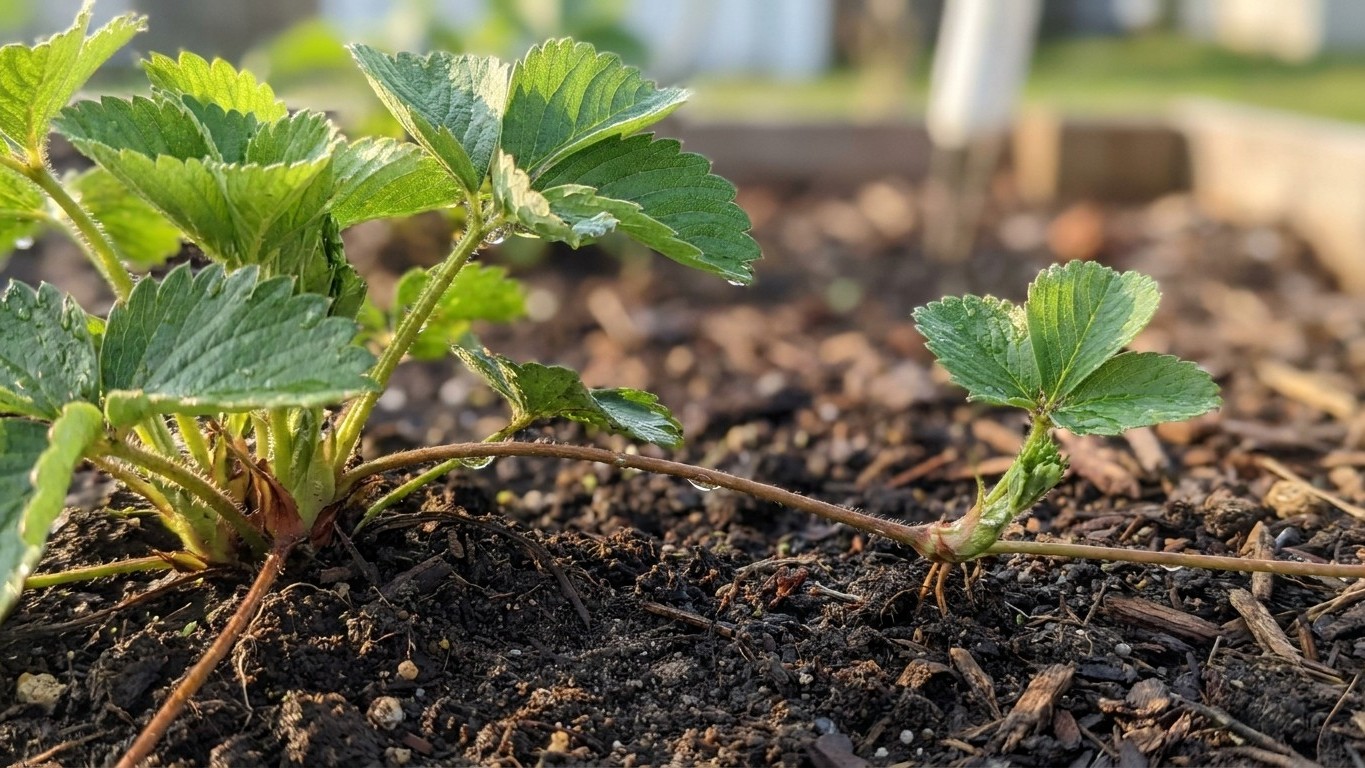
Rooted runners left dangling on the mother plant from August through winter don’t multiply your strawberry patch for free. They quietly steal the exact resources that mother plant needs to build next year’s flower buds, and by the time you’re crouched in the bed counting blooms in April, the damage is already locked in.
Here’s what actually happens biologically. A Strawberry runner needs roots before it can survive on its own, and that process takes weeks, not days. After about 4 to 6 weeks, a small strawberry plantlet will have started to grow new leaves, so it’s time to cut it free from the parent plant. Detach it too early and the young plant may not be able to fend for itself and could simply shrivel up. So far, so good, that’s the whole point of layering runners in the first place. The mistake creeps in after that window closes. If the daughter plant is left tethered well past the point where it’s already rooted, it keeps pulling carbohydrates and nutrients through that stolon connection, right when the mother plant should be redirecting everything toward the following year’s harvest.
Key takeaways
- Your strawberry mother plant is secretly building next year’s flowers right now—but only if you let it
- A single plant can produce 120 runners, but keeping even half of them costs you more than you gain
- The four-to-six-week window for severing runners is real, and missing it locks in a spring disappointment
The fall window you didn’t know you were wasting
Late summer isn’t a quiet lull for strawberries, even though the plants look like they’re just sitting there. Even though it may look like little is going on with strawberries in September, the plants are busy during the fall months developing the latent buds that will grow into next spring’s flowers. That’s the crucial detail most gardeners miss when they get excited about free plants. The flower buds you’ll count next spring aren’t formed in spring at all, they’re initiated the previous fall, inside leaf axils, using energy the plant has left over after fruiting.
Growers who track post-harvest care closely put it bluntly: the single most important practice beginners miss is post-harvest care in July–August, immediately mowing or trimming foliage to 1–2 inches above crowns, because the new leaves grown during this period develop fruit buds in their leaf axils, and those buds become next spring’s berries. Every runner still attached in August is competing directly with that bud-building process. It’s not a minor tradeoff. It’s a straight resource fight between fruiting next year and multiplying this year, and the mother plant can’t fully win both.
Why “just a few free plants” turns into a yield problem
The scale of the issue surprises most people. A single June-bearing strawberry plant can produce up to 120 daughter plants in one season. Left unchecked, that’s not generosity from your plant, it’s exhaustion. Rooting too many runners is quantity over quality that exhausts the mother plant and produces weak daughters. You don’t end up with 120 free strawberry plants. You end up with a depleted mother, a scattering of mediocre offshoots, and a spring flower count that makes you wonder what went wrong.
Commercial and home-garden advice converges on the same number for a reason. These types of strawberries produce more fruit if you clip off most of the runners, allowing each plant to produce no more than 3 daughter plants each summer. Experienced propagators echo the same restraint: allow just 3–4 runners per plant to root, master the timing and technique before expanding, because it’s better to have 12 perfect plants than 50 struggling ones. Three or four rooted daughters, severed on schedule, beats an entire uncut mat of runners left to fend for themselves through winter.
The visual tell shows up before you even count flowers. If you’re not propagating any more strawberries, it’s best to remove any runners that are formed, to keep the energy within the plant so it has more oomph behind it to produce plenty of flowers, and if you don’t cut back your runners, you’ll end up seeing way more leaves than fruit. A patch that looks lush and sprawling in September is often the same patch that disappoints in May. Foliage and flowers draw from the same energy pool, and runners left on all fall tip that balance toward leaves every time.
How to actually get free plants without the spring letdown
The fix isn’t to stop propagating from runners, it’s to stop treating “leave it attached” as a set-and-forget strategy. Sever daughter plants as soon as they’ve rooted, generally within that four-to-six-week window, rather than letting them ride out the season on the mother’s supply line. If you’re transplanting a rooted daughter in August, resist the urge to let it flower right away. Pinch the first flower buds if transplanting in August, directing energy to root development before winter, which produces a stronger plant than a handful of late-season berries. The same discipline applies to trials, guides, and controlled comparisons: removing flower clusters from newly rooted runners until late August in Zones 5–7 or early September in Zones 8–9 works because energy must go into root and crown development, not fruit.
None of this means you have to choose between propagation and production forever. It just means the calendar matters more than the impulse to let everything root wherever it lands. Cap your runners at three or four per plant, cut them free once rooted instead of leaving them as permanent hangers-on, and give the mother plant its fall recovery period uninterrupted. If runner management still feels like more upkeep than you want, there’s a shortcut worth knowing about: Alpine types like White Alpine and Fresca put all their energy into fruit, with no runners to manage, ever. For everyone else growing June-bearers, the flower count next spring will tell you, in the plainest possible terms, whether August was spent building next year’s crop or quietly spending it away.
Sources : bloomingexpert.com | thegroundedhomestead.com