
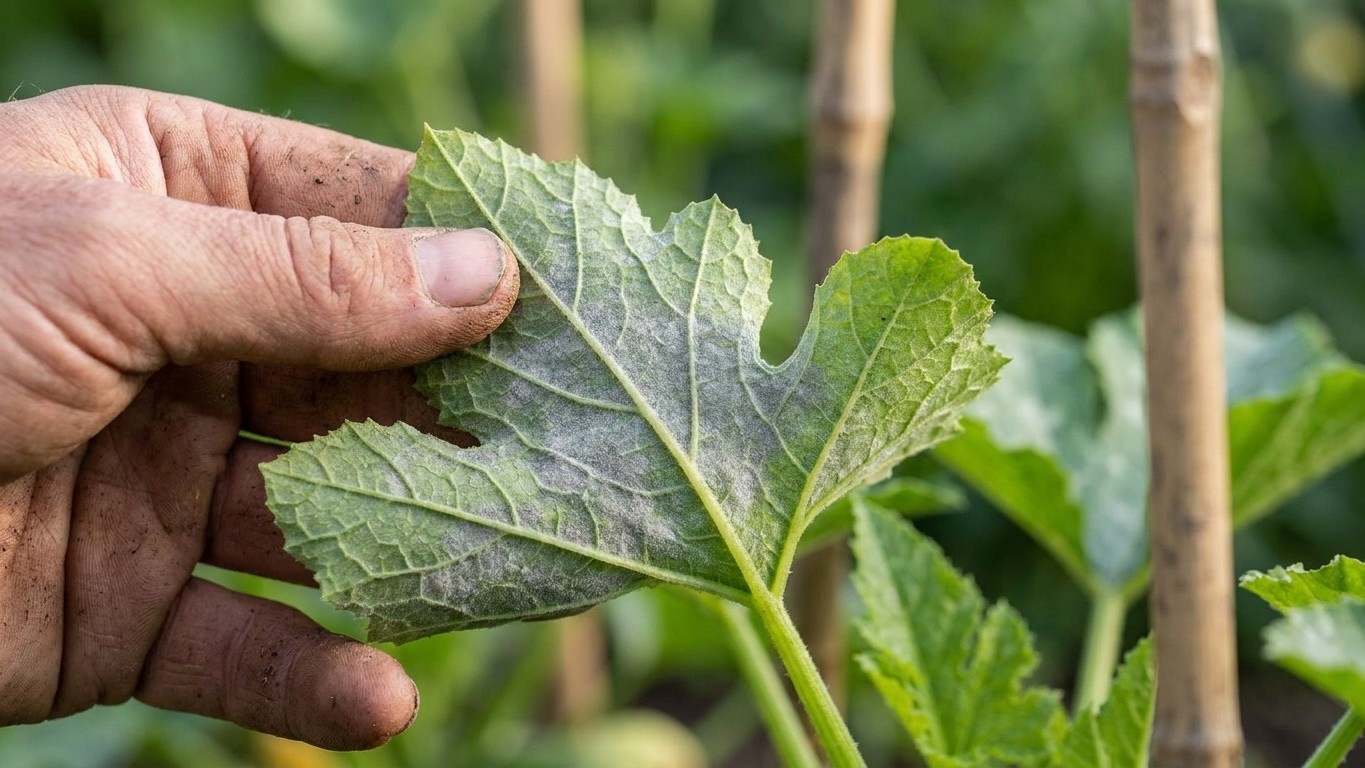
Every evening for two weeks, the watering can made its ritual trip to the courgette patch. The logic seemed sound: shield the plants from the punishing August sun, let the water soak in overnight, avoid wasting a drop to evaporation. Then came the morning that changed the routine for good. Lifting the oldest leaves near the base, the underside told a different story: a dusty gray coating, soft mushy patches, stems already weakened. The damage wasn’t from lack of water. It was from watering at the wrong time.
Key takeaways
- Evening watering leaves courgette foliage wet for 8-10 hours, creating ideal conditions for fungal spores to germinate in darkness and cool temperatures
- The oldest leaves near the base are your plant’s early warning system—where fungal disease establishes itself quietly before you notice
- One timing change beats any chemical fix: morning watering with drip irrigation at soil level, plus disease-resistant varieties, transforms results
Why an evening soak turns against you
Courgette plants (zucchini, for anyone using the American term) don’t fear the heat as much as they fear staying wet in the dark. Zucchini and its relatives are highly susceptible to powdery mildew and other foliar fungal diseases, and when water from overhead irrigation, dew, or rain sits on the leaves into the cooler evening hours, the conditions for fungal spore germination are ideal. High humidity, low light, mild temperature: a fungal spore couldn’t design a better environment if it tried.
The math is brutal. Evening watering can leave foliage wet for 8 to 10 hours overnight, plenty of time for disease to establish. Compare that to a morning watering session, where morning watering gives foliage the full day to dry in the sun, and even if some water splashes onto leaves, solar radiation and airflow dry it within an hour or two. Same amount of water, same plant, completely different outcome depending on the clock.
Powdery mildew, the white-gray dust that eventually claimed those lower leaves, has surprisingly specific preferences. It thrives in temperatures between 68–86°F (20–30°C), especially around 77–82°F (25–28°C). Temperatures above 95°F (35°C) inhibit the disease, and prolonged exposure to over 104°F (40°C) can kill the fungus. Which means a scorching August afternoon actually works against the fungus. The real danger window opens after sunset, when temperatures drop back into that comfort zone and the leaves are still damp from a well-meaning evening watering can.
The oldest leaves: your plant’s early warning system
There’s a reason the damage showed up first on the bottom, oldest leaves rather than the fresh growth at the top. Zucchini plants are sensitive to both over- and underwatering, and either extreme can cause yellowing leaves, typically starting with the oldest foliage near the base. These leaves sit closest to the soil, catch the least airflow, and are usually the last ones anyone bothers to inspect. By the time a gardener lifts them up out of curiosity, the fungus or rot has often had days to establish itself quietly underneath.
Overwatering compounds the problem in a way that’s easy to miss until it’s advanced. Overwatering fills the soil with moisture and blocks air from reaching the roots, and without enough oxygen, roots begin to rot, becoming soft and brown instead of strong and healthy. A plant with struggling roots sends even less energy to its oldest leaves, which yellow, weaken, and become the first casualties. It’s not one single mistake. It’s a chain reaction that starts underground and becomes visible only once you go looking.
Downy mildew is the other suspect worth knowing about, since it’s often confused with its powdery cousin. To prevent the development of downy mildew disease, don’t allow drops of water to fall on the zucchini leaves, and unlike the dust-like powdery mildew, downy mildew has a yellow blotchy appearance. Both diseases love the same conditions an evening watering routine happily creates.
What actually protects courgettes from the heat
The fix isn’t watering less. It’s watering smarter. The most consistent guidance across extension services and horticultural institutions is to water in the morning, and the reason is disease management, not just tradition. That single change in timing does more for plant health than any amount of extra volume poured on at dusk.
Where the water lands matters just as much as when. The number one most important preventative method is watering from the base, avoiding overhead irrigation on zucchini or any squash, since powdery mildew spreads via rainfall and water splashing up from the soil, making drip irrigation or soaker hoses key to keeping the leaves dry. A simple soaker hose laid at the base costs less than a fungicide treatment and solves the problem before it starts.
Frequency deserves a rethink too. Rather than daily evening sessions, zucchini thrives on one deep soak weekly, given 1–2 inches of water at soil level to prevent disease and boost yields over shallow daily watering. During genuine heatwaves that volume can climb, since in hot weather above 90°F, zucchini plants may show signs of moisture stress even at 1 inch per week, so it’s worth pushing toward 1.5 to 2 inches during heatwaves. The plant doesn’t need daily attention. It needs one thorough, well-timed drink that reaches the roots without ever touching the foliage.
Airflow finishes the job that watering technique starts. Proper distance between zucchini plants ensures good air circulation, and pruning lower leaves and thinning internal foliage improves airflow without sacrificing vigor. Removing a few of those oldest, shaded leaves before disease even shows up isn’t cruel pruning, it’s preventive maintenance, and it happens to make it much easier to spot trouble early next time you check underneath.
One detail rarely mentioned: some squash varieties are bred specifically to shrug off this fungus. Planting a squash variety that is powdery mildew resistant, such as the “Diva” cucumber, “Sunray” yellow squash, or “Wildcat” zucchini, all boast resistance to powdery mildew. Switching a watering schedule solves half the problem. Choosing the Right seed packet next spring solves the other half before a single drop of water ever hits the soil.
Sources : bloomingexpert.com | positivebloom.com