Sixty-eight percent of American households share their living space with at least one animal companion. Translate that to city apartments, and you’ve got millions of people navigating 600 square feet, sometimes less, alongside a dog who thinks the couch is his throne and a cat who’s convinced the kitchen counter is hers. The tension between a curated interior and a genuinely livable space for pets is real. But the idea that you must choose one or the other? That’s a design myth worth dismantling right now.
A well-planned small apartment can accommodate both a cuddly rescue mutt and a territorial tabby without looking like a pet supply warehouse exploded inside. It requires thinking differently about space, not just the floor plan, but the walls, the furniture, and the daily routines that hold it all together. Here’s how to do it, from the structural choices down to the color palette.
Why Small Apartments Demand a Different Pet-Design Strategy
Cats and dogs don’t get a lot of say when it comes to interior design, but they do have their own set of wants and needs. This planning is particularly necessary in small apartment design, where a litter box without a dedicated spot could really wind up cramping your style.
Dogs need somewhere to decompress after a walk. Cats crave vertical territory and private corners. In a studio or one-bedroom apartment, every square foot that goes to an ugly wire crate or a carpeted cat tree is a square foot taken from you, and your sanity.
Dogs often need room to roam, places to nap, and access to the outdoors. Cats crave vertical spaces, hiding spots, and areas for scratching.
Understanding these distinct needs is the starting point. A dog’s zone and a cat’s zone don’t have to overlap, and in a small space, keeping them separate actually benefits everyone, including your furniture.
This kind of design reflects a broader interior design trend: “people are prioritizing elegant solutions that integrate their pets’ needs into their homes while maintaining visual and functional harmony.”
Small-apartment living simply forces that conversation earlier. You can’t procrastinate on organization when clutter becomes suffocating in 500 square feet.
For a deep dive into how each room can be adapted, the guide on pet friendly home design cat dog furniture lays out the full material and furniture framework for cohabiting stylishly with both cats and dogs.
The Art of Zoning: Four Dedicated Spaces, Zero Wasted Square Footage
Creating designated spaces for feeding, sleeping, and play while designing your space will ensure the right routines are established from the jump.
Think of your apartment as having four micro-zones for your pets: rest, play, meals, and hygiene. Each zone can be as small as a cabinet corner or a single wall shelf, what matters is intentionality.
Rest and retreat: the power of a defined corner
Start by carving out a designated area just for your pet. It doesn’t have to be large — a corner of your living room, bedroom, or even a hallway nook can do the trick. Add a soft bed, a crate or kennel if crate training is part of your routine, and a few favorite toys to signal that it’s their zone.
A dog who has his own clear corner, complete with a stylish furniture-grade crate, is less likely to colonize the sofa. A cat with a dedicated window perch at her favorite height stops claiming the countertop.
One particularly elegant solution: a floor-to-ceiling storage closet by the entrance that doubles as a pet bedroom. A circular cutout allows the dog to access the lowest shelf of the closet, where there’s a big cushion and a blanket. Above, the shelves store human things.
Two uses, one footprint. That’s the small-apartment mantra.
Feeding stations and hygiene: hiding in plain sight
Tripping over pets’ food and water bowls can be a frustrating experience. A clever pull-out drawer that can be slid out at mealtime is the key to a clutter-free area.
When not in use, it disappears completely, a feature that doubles as a design detail in tight kitchens or under-counter alcoves.
The litter box is the biggest design challenge in any cat-owned apartment. The solution isn’t to hide it badly — it’s to hide it brilliantly.
For one young couple with two cats, boldly colored laundry room joinery pockets a built-in litter box, ensuring the unsightly container is tucked well out of sight. Front-facing doors allow the owners to clean, while a sneaky opening on the side is a private entrance for their feline friends.
No laundry room? A cabinet-style litter enclosure that moonlights as a sideboard works just as well in a living room corner.
Multifunctional Furniture: The Real Game Changer for Pet Owners
A convertible dog bed, a cat tower laptop table, and a guinea pig hutch bookshelf are among designs that aim to make both pets and people happy in compact apartments.
The multifunctional pet furniture movement took serious design credibility when Never Too Small showcased eleven such concepts at Melbourne Design Week, each built from a single sheet of plywood, each serving at least two distinct human-and-pet functions.
One design takes the form of a boxy dog bed with a hidden bench that can be pulled out for extra seating for guests. In its consolidated form, the piece can also serve as a side or coffee table, small shelf, or storage unit.
Another, the “Dogpod,”
can be folded in half to serve as a half bed when the dog is still a puppy, opened for large dogs to use as a bed, or transformed into a coffee table when guests are over.
Elegant, practical, and about as far from a wire crate as you can get.
Pet parents can also swap a wire crate for a stunning furniture-style version that functions as a stylish end table or console.
Built-in dog crates are rewriting the rules of containment with craftsmanship and care. Integrated seamlessly into cabinetry, sideboards, or kitchen islands, these enclosures feature ventilated panels, soft bedding, and matching finishes. The effect is minimalist yet deeply considered, transforming necessity into design harmony.
For the cat side of the household, a coffee table with a built-in nook satisfies a feline’s love of hiding without stealing floor space from you.
A modern wood grain coffee table featuring a cat resting place serves as a practical surface with storage space for books and magazines, while also being an ideal cat resting place with a built-in nook for sleeping.
These pieces exist. They’re not expensive custom builds. They’re a shift in how we think about what furniture is allowed to do.
For room-by-room inspiration, including furniture layout strategies that work for both cats and dogs, the article on pet friendly living room design with cats and dogs is worth bookmarking.
Going Vertical: How Walls Become Square Footage
The most underused real estate in any apartment isn’t under the bed. It’s the wall space between four feet and the ceiling. For cats, this is everything.
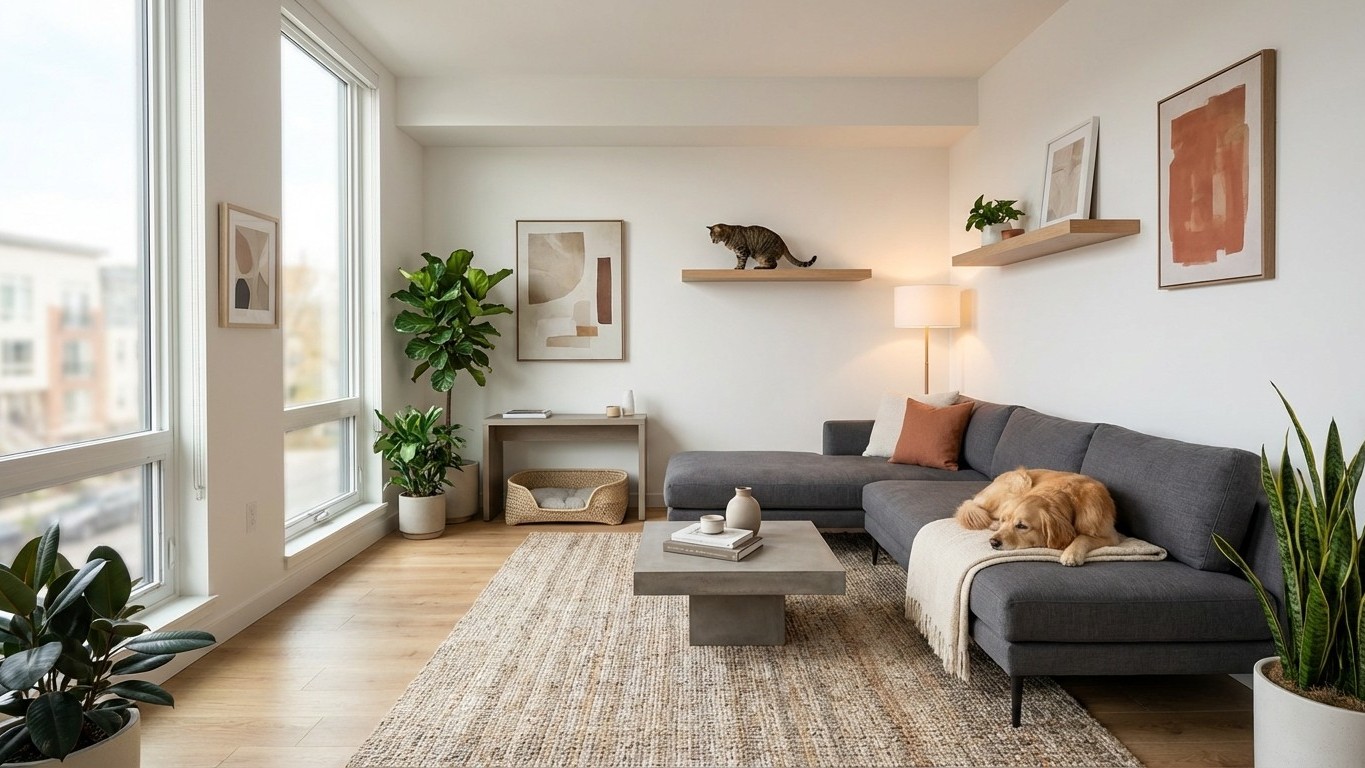
Wall-mounted cat shelves allow you to maximize your vertical space without cluttering your apartment with large cat trees or bulky furniture. By placing shelves strategically on the walls, you provide your cat with their own elevated territory to climb, perch, and relax, all while keeping the floor clear for you.
A staggered system of floating shelves, designed at varying heights and connected by short bridges, turns a bare wall into an enrichment circuit, and from a design standpoint, reads as intentional, architectural wall decor rather than pet furniture.
In small apartments, vertical cat furniture isn’t just cute — it’s survival.
Unlike bulky cat trees that take up valuable floor space, wall-mounted cat shelves let you build a personalized playground without cluttering your living area. They offer a secure place to perch, nap, climb, and observe, something that instinctively makes cats feel safer and more in control of their environment.
In one Taiwan apartment designed for both cats and dogs, a dynamic island TV wall gives dogs circular movement, freedom to run around, while vertical sisal-wrapped climbing posts and up-high nooks and platforms give cats space away from canine companions.
The dog gets a loop circuit at floor level. The cat gets height sovereignty. They coexist without competing for the same space. That’s the blueprint.
Spacing matters too:
cat wall shelves should be spaced 12 to 18 inches apart vertically and 12 to 16 inches apart horizontally. Athletic cats can handle gaps up to 24 inches, while older or cautious cats benefit from closer spacing around 12 inches.
Looking for more on how the living room layout can serve both humans and pets without compromise? The detailed guide on pet friendly living room design with cats and dogs covers furniture placement, rug choices, and dedicated zones in the main shared space.
Materials and Textiles: Where Most Pet-Owners Go Wrong
The sofa is the battlefield. The rug is the casualty. The flooring is the long-term investment most people don’t think about until it’s too late. Getting these three right is what separates an apartment that photographs well from one that actually works.
Microfiber, leather, or performance-grade upholstery is easier to clean and less likely to trap fur, dander, or stains.
Silk, linen, and velvet may look beautiful, but they’re not ideal for households with pets. Claws, shedding, and drool can damage them quickly.
This isn’t about choosing ugly over pretty, performance fabrics now come in textures and colors that rival any high-end line. The difference is they survive Tuesday morning.
There are woven fabrics that are very durable and stain-resistant. The tighter the weave, the better, think chenille and herringbone, fabrics with texture that hide hair. Watch out if your dog is a digger, as their nails can cause damage to some woven styles.
The visual trick here matters too:
using a pet’s coat as a decor palette can simplify the cleaning routine. Choosing rugs, throw pillows, and a sofa in a shade similar to the animal companion’s fur can camouflage shedding.
Flooring is often the first line of defense in a pet-friendly home. Pet-safe flooring includes hard surfaces like ceramic tile, vinyl, and laminate that are durable, easy to clean, and resistant to scratches. They also don’t trap allergens and pet hair the way carpets can.
If warmth is non-negotiable,
consider washable rugs made with stain-resistant materials that are built with the washing machine in mind.
One Amsterdam designer mitigated the scratching issue by adding a scratch pad to the side of their living room cabinet, where he also placed a little hole for the cat to access a secluded sleep zone.
Protect your surfaces by giving cats sanctioned scratch areas, and place them where the cat already gravitates, not where you’d prefer them to go.
Décor, Color, and the Visual Expansion of a Tight Space
A pet-friendly apartment doesn’t have to announce itself as such. The goal is an interior that looks considered, not compromised. A few visual strategies change everything in a small space.
Keep the color palette calm and continuous. Light, neutral tones, warm whites, oat, pale sage, bounce light around and make rooms feel larger.
Soft furnishings like rugs, curtains, and upholstered furniture help dampen sound and reduce echoes, which also helps anxious pets feel more settled in urban environments where noise is constant.
Pet-inspired art can be a stylish way to personalize your home without overpowering the design. Instead of bold or novelty pieces, choose minimal line drawings, abstract pet portraits, or muted watercolors. Keep frames and colors in line with your overall decor for a cohesive look.
Your cat’s presence can become a design feature, not an eyesore.
Pet essentials like leashes, toys, grooming tools, and treats can easily clutter your space if not properly organized. The solution is to incorporate stylish, intentional storage that blends seamlessly into your home. Woven baskets, lidded bins, or storage ottomans complement your furniture, while wall-mounted hooks or peg rails near entryways work well for hanging collars and leashes.
And near the front door? That’s where a leash station earns its keep, functional, visible, styled. For a full breakdown of this often-overlooked space, the resource on pet friendly entryway design dog leash station shows how to set one up without visual chaos.
Keeping a Small Apartment Clean, Fresh, and Actually Livable
Cleanliness is an essential part of creating a comfortable pet-friendly apartment. A regular cleaning routine goes a long way in keeping your apartment fresh and protecting your security deposit. Invest in a high-quality vacuum designed for pet hair, and make it a habit to clean pet bedding and toys frequently.
Odor management in a small apartment is not optional — it’s architectural. The chemistry is worth understanding:
HEPA filters are not efficient against odor molecules or gases. On the other hand, activated carbon is capable of trapping smells and VOCs through a process called adsorption.
So the air purifier that just has a HEPA filter? It handles dander and hair but won’t touch the litter box smell.
Look for an air purifier that includes both HEPA and activated carbon filters, these are the most effective at capturing and neutralizing pet odors.
Wipe your pet’s paws after every walk to prevent tracking in dirt, allergens, or road salts that can damage floors or irritate sensitive paw pads. Consider adding washable mats near entryways for easy cleanup.
In a 600-square-foot space, one muddy dog paw on a light floor covers a disproportionate amount of territory. That washable mat at the door isn’t optional.
A quick daily checklist to keep things manageable:
- Wipe paws at the door (every walk, rain or shine)
- Lint-roll upholstered surfaces before they become fur archives
- Empty litter box daily; deep-clean weekly
- Run the air purifier continuously in the main living area
- Wash pet bedding at least once a week on a hot cycle
Before and After: What a Real Pet-Friendly Transformation Looks Like
The shift from a pet-tolerant apartment to a genuinely pet-optimized one rarely requires a renovation. More often, it’s a sequence of intentional swaps: the wire crate replaced by a furniture-grade kennel that doubles as an end table, the freestanding cat tower replaced by wall shelves that clear the floor entirely, the open food bowl area replaced by a pull-out drawer station tucked under the kitchen counter.
From integrated feeding zones to stylish rest spaces, pet-centered design blends functionality with beauty, honoring animals as equal participants in our living spaces.
The “before” looks like a compromise, a beautiful apartment held hostage by pet gear. The “after” looks like a home where every element was chosen with intention, and the pets just happen to have excellent taste.
Opting for durable and easy-to-clean materials like stain-resistant fabrics and scratch-resistant surfaces helps keep those zones low-maintenance and pet-friendly. The best design tricks marry these priorities with the overall design aesthetic that you’re hoping to achieve.
FAQ: Small Apartment Pet-Friendly Design
How do you optimize a small apartment for both a cat and a dog?
The key is zoning.
Create a dedicated pet zone with their bed, food, and toys all in one place.
Then give the cat independent vertical territory, wall shelves, a window perch, so the two animals aren’t competing for the same floor space. Circulation paths for both need to stay clear, and multifunctional furniture minimizes the total footprint of pet gear.
What multifunctional furniture works best in a pet-friendly apartment?
Cat-friendly interior design can include hidden litter box furniture, while dog-friendly home ideas can include stylish dog beds and designer dog crates. Custom-built furniture, like window seats with integrated pet beds or staircases with pull-out feeding drawers, can provide both function and style.
Storage ottomans that double as pet beds, coffee tables with built-in cat nooks, and crates styled as side tables are among the most practical picks for compact spaces.
How do you keep a small apartment clean and stylish with pets?
When choosing furniture, durability and cleanability are essential. Fabrics like leather, microfiber, or performance fabrics resist scratching and are easy to wipe down. Patterns and textured weaves can help disguise fur and minor stains. Removable and washable slipcovers are another practical solution for keeping furniture fresh.
Layer that with a daily cleaning routine, an air purifier with activated carbon, and a color palette that works with your pet’s fur rather than against it.
The apartment that works for your cat, your dog, and your own desire for a beautiful home isn’t a unicorn. It’s a design problem, and like most design problems, it responds very well to clear thinking, the right materials, and a little creative ambition. The walls you’ve been ignoring? Your cat already knows they’re the answer.