
Moss doesn’t mean your lawn is failing. It means your lawn is telling you something, and for years, I ignored the message and reached for the bottle instead. Iron sulfate, chemical moss killers, the whole arsenal. The moss would die back, turn black, look defeated for a few weeks. Then, inevitably, it crept back. Thicker, if anything. The chemical approach was treating symptoms while the real problem quietly deepened beneath the surface.
The shift happened when a neighbor, a retired groundskeeper who’d spent decades caring for estate gardens in New England — watched me spray yet another round of herbicide and just shook his head. “You’re fighting the wrong battle,” he said. What he taught me that afternoon changed the way I think about my entire yard.
Key takeaways
- Chemical moss killers kill the moss but leave the conditions that created it completely untouched
- A retired groundskeeper reveals the forgotten technique that actually addresses the root cause
- One simple $12 solution combined with aeration transforms lawns over three seasons
Why moss wins every time you fight it wrong
Moss thrives in conditions that grass hates: poor drainage, compacted soil, heavy shade, low soil pH, and weak fertility. Every one of those conditions is something you can actually fix. But chemical moss killers address none of them. They kill the existing moss while leaving the underlying conditions completely untouched, which is exactly why the moss returns with such consistency. You’re essentially evicting a tenant without changing why the apartment was attractive to them in the first place.
The statistic that surprised me most: soil compaction alone can reduce grass root depth by up to 70%, creating the kind of stressed, thin turf that moss colonizes almost instantly. That’s not a lawn problem. That’s a soil problem wearing a lawn costume.
The old-school trick that actually works
The method my neighbor swore by, and that professional groundskeepers have used for generations — centers on a two-part approach: aeration combined with lime application. Simple, inexpensive, and almost boringly effective once you understand the logic behind it.
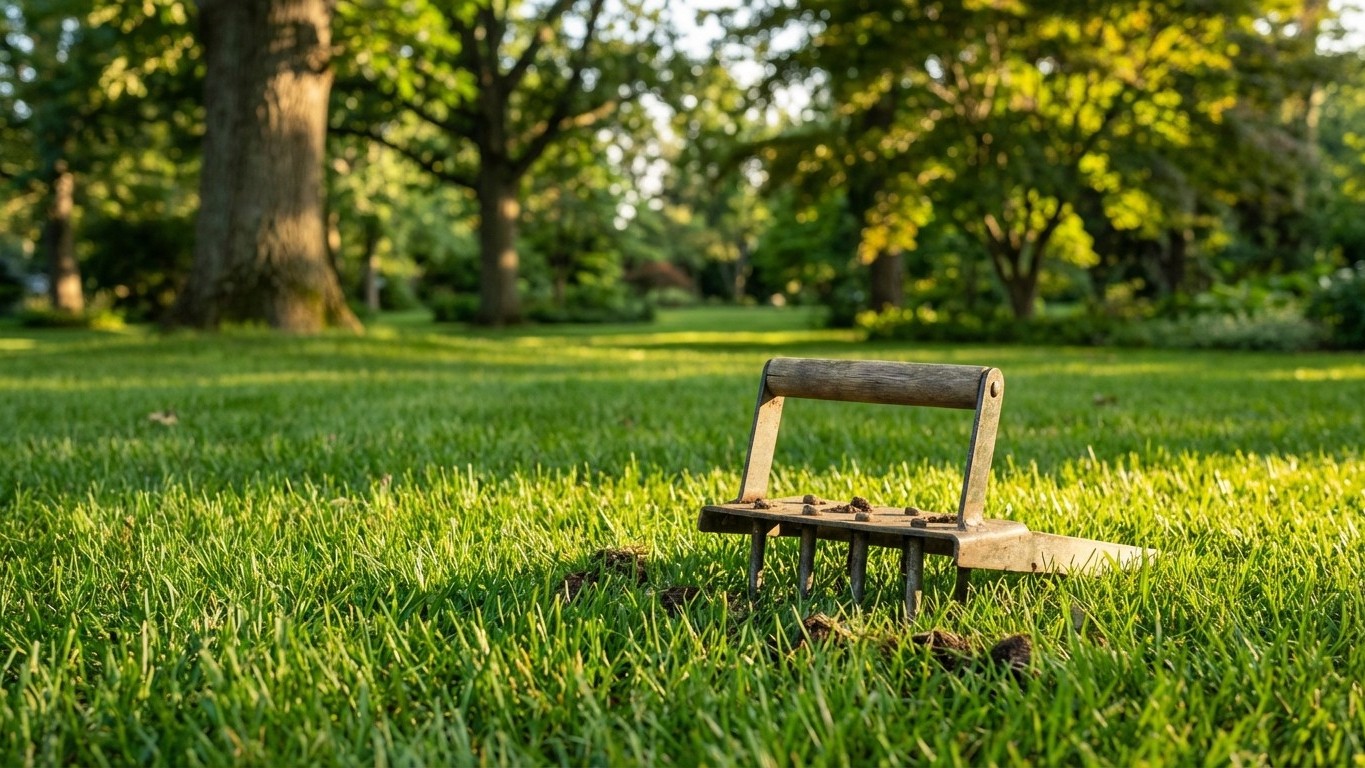
Aeration means physically perforating the soil with small holes, either with a manual spike aerator or a core aerator (the kind that pulls out small plugs of earth). This breaks up compaction, improves drainage, and lets oxygen reach grass roots that have essentially been suffocating. Do this once a year in early fall, and the difference in soil structure over three seasons is genuinely striking.
The lime part is where the old-school wisdom really shines. Moss loves acidic soil, typically a pH below 6.0. Most grass varieties prefer a pH between 6.0 and 7.0. A simple soil test kit (available at any garden center for a few dollars) will tell you exactly where your lawn sits on the scale. If you’re acidic, broadcasting agricultural lime across your lawn raises the pH gradually, making the environment less hospitable to moss and more welcoming to grass. My neighbor’s rule of thumb: test in early spring, lime in fall, and give it a full growing season to see results. Patience is part of the process.
What made this feel like a revelation wasn’t the complexity, there isn’t any. It was realizing that every bag of chemical moss killer I’d bought was solving nothing, while a $12 bag of lime and a Sunday afternoon of aerating would have addressed the actual root cause from the start.
Shade and drainage: the two factors people skip
Lime and aeration will only take you so far if you have serious drainage issues or deep shade. These require a different kind of honesty about your space. A lawn that sits in perpetual shadow from a large tree or a north-facing fence is never going to behave like a sunlit meadow, no matter how aggressively you treat it.
For shaded areas, the practical solution is to either choose a grass seed blend specifically developed for low-light conditions (fine fescues are forgiving here) or to stop fighting the shade entirely and work with it. Ground covers like creeping thyme, sweet woodruff, or native ferns can turn a problem patch into an intentional design choice. Some of the most beautiful yards I’ve seen embrace the mossy sections under old trees rather than waging war against them.
Poor drainage is a more structural fix. Top-dressing with a sand-compost mix after aeration can improve water movement significantly over time. In severe cases, a French drain or simple regrading may be necessary. Neither is glamorous, but both address the actual problem rather than masking it with chemistry.
What to do right now, this season
If your lawn currently looks like a patchwork of green moss and struggling grass, the sequence matters. Start with the soil test, before anything else. Then, if pH is the issue, apply lime in fall and let it work over winter. Aerate during that same fall window. Overseed thin areas with appropriate grass varieties while soil temperatures are still warm enough for germination.
Rake out existing moss manually before overseeding. This is physical work, not glamorous, but hand-raking removes the moss without dumping chemicals into soil you’re trying to improve. A stiff-tined lawn rake works well; the moss comes up in satisfying sheets once the soil beneath is loosened from aeration.
The following spring, fertilize lightly with a balanced, slow-release lawn fertilizer. Strong grass simply crowds out moss over time. You’re not Killing the moss so much as making conditions so favorable for grass that moss loses its competitive edge. That shift in framing, from destruction to outcompeting, is what makes this approach sustainable rather than cyclical.
My lawn today has maybe 10% of the moss coverage it had three years ago. The remaining patches are in a shadowed corner where I’ve honestly decided to let them be, there’s something quietly beautiful about a cushion of moss at the base of an old oak. The question worth sitting with isn’t really “how do I eliminate moss” but “what is my soil actually asking for?” Answer that, and the moss problem tends to answer itself.