
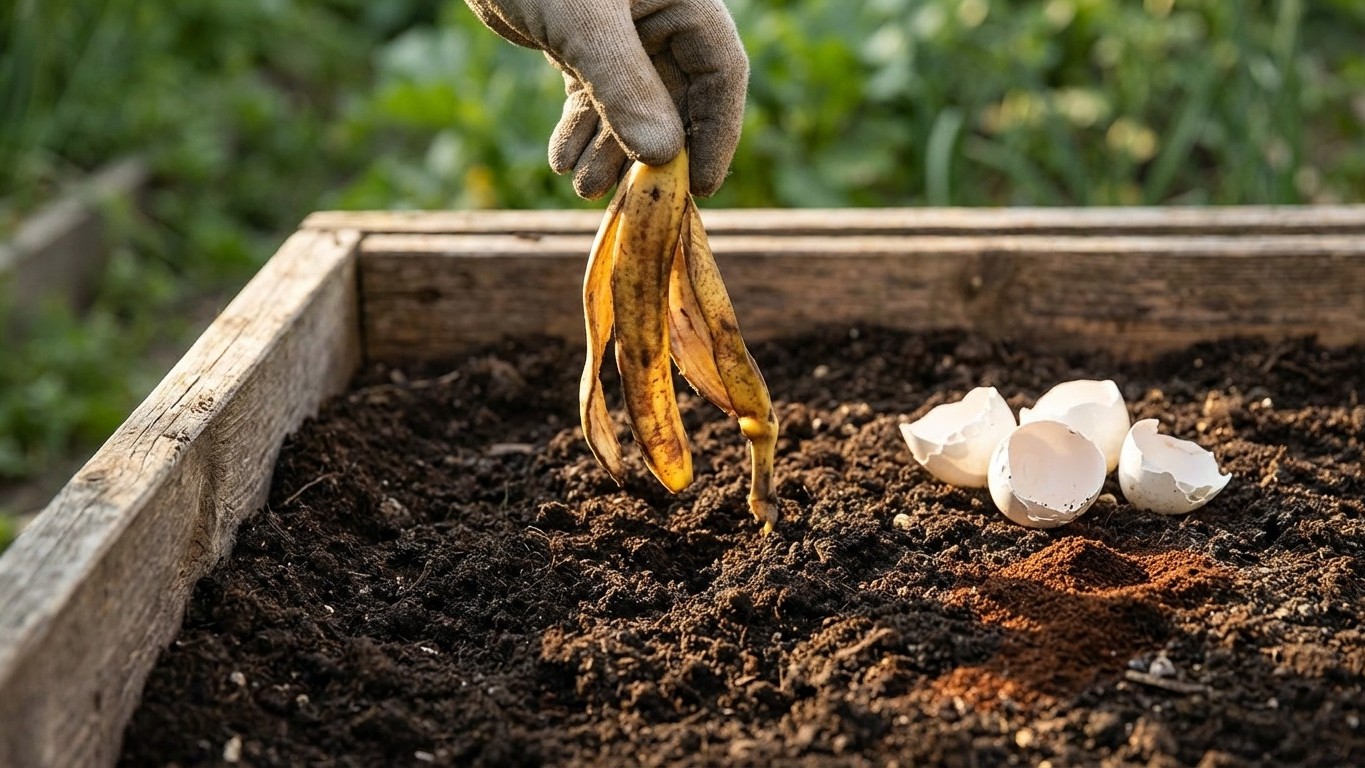
The banana peel sitting on your counter right now is worth more to your garden than a bag of store-bought fertilizer. Not metaphorically. Chemically. The organic matter you rinse down the drain or toss into the trash every single day contains a concentrated cocktail of nitrogen, potassium, phosphorus, and trace minerals that commercial fertilizers spend millions trying to replicate in a lab. You’ve been paying for something you already had.
Key takeaways
- A single banana peel contains potassium and phosphorus that rival slow-release commercial fertilizers
- Coffee grounds deliver the same nitrogen concentration as store-bought products, at zero cost
- One simple Sunday ritual—four minutes of work—Transforms kitchen waste into measurable soil improvement
What Your Trash Can Is Actually Hiding
Coffee grounds are the poster child of this story. Used grounds contain roughly 2% nitrogen by weight, a number that puts them in the same conversation as slow-release commercial fertilizers. Nitrogen drives leafy green growth, which is why your basil and lettuce will visibly respond to a weekly top-dressing of spent grounds around their base. Acid-loving plants like blueberries, azaleas, and tomatoes get a double benefit: the slight acidity of coffee grounds helps lower soil pH in alkaline environments, making nutrients more accessible to plant roots.
Banana peels deserve their own paragraph. A single peel contains meaningful amounts of potassium, phosphorus, and calcium, the trio that supports root development, flowering, and disease resistance. gardeners who grow roses swear by burying peels directly in the soil near the root zone. The decomposition is slow enough to act as a time-release amendment, which is exactly what you’re paying for when you buy those slow-release granule fertilizers at the hardware store.
Eggshells are where most people get it slightly wrong. They do contain calcium carbonate, which soil genuinely needs, but whole shells decompose too slowly to provide quick benefits. The fix is simple: crush them into a fine powder before adding them to your garden beds. A dedicated coffee grinder (one you no longer use for coffee) can reduce a week’s worth of eggshells into a dust that integrates into soil within a few weeks rather than sitting on the surface for months.
The Kitchen Scraps That Work Fastest
Vegetable cooking water is one of the most overlooked liquid fertilizers available. When you boil carrots, potatoes, or green beans, water-soluble minerals leach out of the vegetables into the cooking water. Let it cool completely, and you have a ready-to-use nutrient solution. The one hard rule: never use salted cooking water. Salt is a soil killer. Unsalted pasta water works too, as it carries dissolved starch that feeds beneficial soil microbes.
Citrus peels take a bit more patience. They’re high in d-limonene, a compound that can actually repel beneficial insects and earthworms in high concentrations, so dumping a pile of lemon rinds around your plants is counterproductive. The smarter move is to dry them first, then grind them into a coarse powder. This neutralizes the d-limonene while preserving the potassium and vitamin C (ascorbic acid) content. Scattered lightly through the soil, dried citrus powder also works as a mild deterrent against fungus gnats and ants.
Wood ash from your fireplace or fire pit (assuming you’re burning untreated wood) functions as a fast-acting liming agent. It raises soil pH and delivers potassium almost immediately. A light dusting around brassicas like cabbage, broccoli, and kale makes these already robust plants even more resilient. The caution here is restraint: wood ash is alkaline, and too much will swing your soil pH in the wrong direction. A thin layer once or twice per season is plenty.
Building a System That Actually Sticks
The challenge with Kitchen scraps isn’t effectiveness. It’s consistency. A banana peel tossed into the garden bed once in April won’t move the needle. The gardeners who see real results treat their scraps as a weekly amendment cycle, not a spontaneous gesture.
One practical approach: keep a small ceramic container near the kitchen sink specifically for dry scraps like eggshells and coffee grounds. Every Sunday, take it outside and work it into the top inch of soil in your beds. This takes four minutes. It costs nothing. Over the course of a growing season, you’re adding thousands of small nutrient deposits that accumulate into measurably better soil structure and plant health.
Liquid scraps (cooking water, diluted apple cider vinegar, even flat beer, which contains yeast that feeds soil organisms) can replace one of your weekly waterings with zero additional effort. The mental shift required is small: instead of pouring cooled vegetable water down the drain, you walk it outside. That’s the entire behavior change.
Composting is the most complete version of this system, but it’s not a prerequisite. Direct application of individual scraps works at a smaller scale and doesn’t require a bin, a pile, or any particular technique. Many experienced gardeners actually prefer direct application for specific nutrients, using compost as a base amendment and targeted scraps for precision feeding. Coffee grounds near the tomatoes, banana peels around the roses, eggshell powder in the pepper bed.
The Bigger Picture You Might Be Missing
The average American household generates about 219 pounds of food waste per year, according to the USDA. A meaningful portion of that is organic matter that contains exactly what depleted garden soils need. The fertilizer industry in the U.S. is worth over $20 billion annually, a market built substantially on selling back to us what we were already throwing away.
There’s something worth sitting with in that statistic. Your kitchen and your garden have always been designed to function as a closed loop: waste from one feeds the other. Industrial agriculture severed that connection about a century ago, and we’ve been paying for the disconnection ever since. The scraps on your counter aren’t garbage. They’re the starting point of a system that gardeners grew food with successfully for thousands of years before the first bag of synthetic fertilizer existed. Whether your garden is a window box or a quarter-acre plot, the question isn’t whether kitchen scraps work. It’s how much soil fertility you’ve already sent to the landfill.