
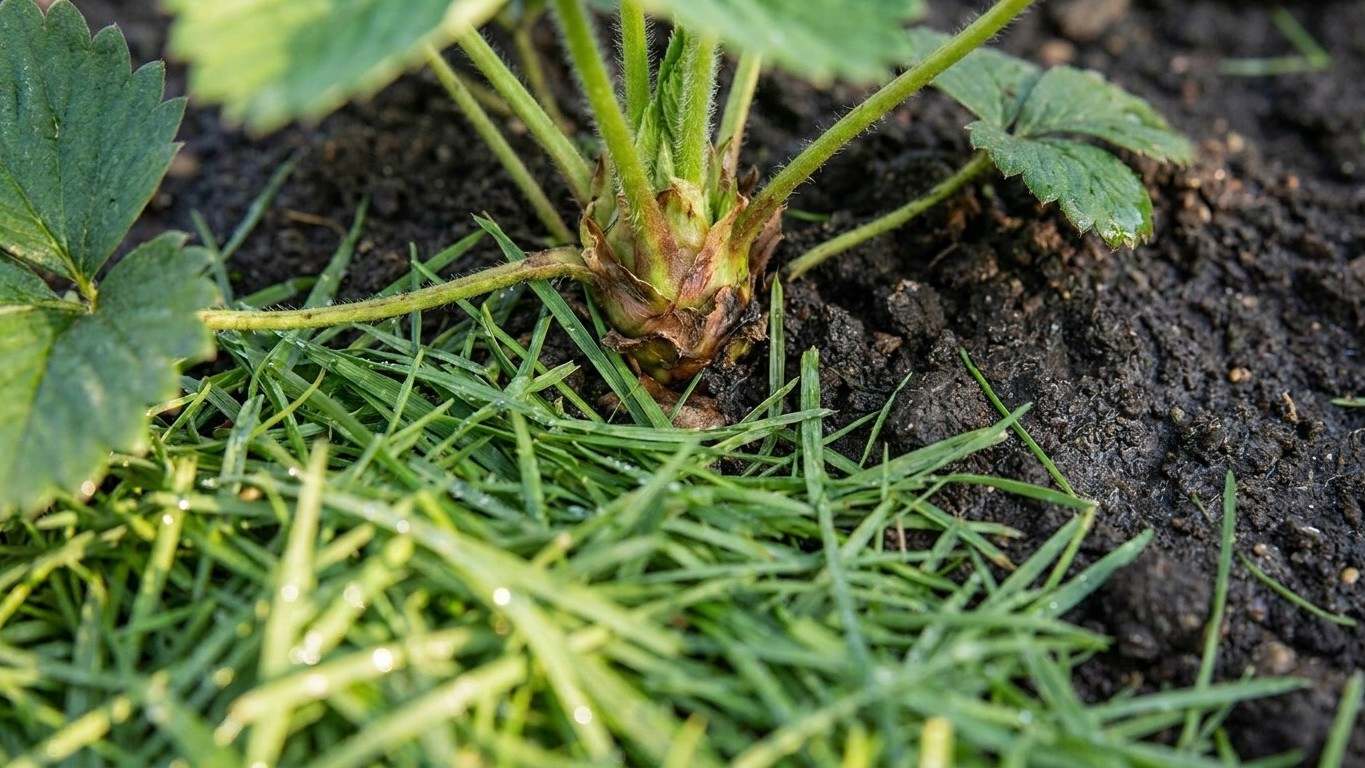
Fresh grass clippings are free, abundant, and smell like summer. So when strawberry season rolls around, the temptation to pile them thick around the plants as mulch feels almost logical. It cost one gardener that lesson the hard way, three days of warm, humid weather under a dense green mat was all it took to find crowns softening at the base, white mold threading through the stems. The strawberries weren’t struggling before the mulch. The mulch caused the problem.
Key takeaways
- Fresh grass clippings are 80% water and compress into an airless mat within hours—creating the exact warm, wet conditions fungi love
- Strawberry crowns sit at soil level where they’re vulnerable to softening in moisture, and three days is enough time for visible rot to establish
- A simple 24-48 hour drying step transforms fresh clippings into a safe mulch, and spacing plants properly saves the ones already affected
What actually happens under a thick layer of fresh clippings
Fresh grass clippings are roughly 80% water by weight. Pack them densely and they compress almost immediately, forming a tight, airless mat that traps heat and moisture against the soil surface. Temperatures beneath that mat can climb several degrees above ambient air temperature within 24 hours, creating exactly the warm, wet, oxygen-deprived conditions that fungal pathogens love. Botrytis cinerea, the gray mold responsible for crown rot in strawberries, thrives in precisely this environment.
Strawberry crowns are particularly vulnerable because they sit right at soil level, they’re neither protected underground like roots nor exposed to drying air like leaves. When a dense clipping layer presses against the crown and holds moisture there for days, the tissue softens and collapses. By the time you see the problem, the infection is already established. Three days is genuinely enough time for this to unfold in warm weather above 65°F.
There’s a second issue beyond moisture: decomposing fresh clippings generate heat as microbes break down the nitrogen-rich material. A thick layer can generate enough internal heat to cause direct thermal stress to shallow roots and crown tissue, similar to what happens inside a compost pile. Gardeners who’ve composted know that a freshly built pile can reach 130–140°F internally within 48 hours. A 4-inch mat of clippings over a strawberry bed won’t hit those extremes, but it doesn’t need to, even localized warming compounds the moisture damage already in progress.
The difference between fresh and dried clippings
Dried grass clippings behave almost like a different material. Once the moisture has evaporated, typically after a day or two spread thin on a dry surface, the clippings become light, airy, and much less prone to matting. They allow air movement, don’t trap heat the same way, and break down more slowly into the soil. That’s the version worth using around strawberries, applied in a layer no thicker than one inch, kept a few centimeters away from the crown itself.
The practical step most gardeners skip: spread fresh clippings in a single thin layer on a tarp or concrete surface for 24–48 hours before applying them to beds. It’s a minor inconvenience that eliminates most of the risk. Some gardeners mix dried clippings with straw at roughly a 1:2 ratio to keep the mulch even more open and breathable, straw being the traditional choice for strawberry beds precisely because it doesn’t compact and its name isn’t entirely coincidental (strawberries were historically bedded on straw to keep fruit off damp soil).
Saving plants after crown rot has started
If you’ve already made this mistake, act fast. Pull back the mulch completely and let the soil and crowns dry out. Remove any visibly infected plants, crowns that are brown, mushy, or show white or gray mold won’t recover and will spread the infection. For plants that look borderline, trim away any discolored tissue with clean scissors and treat with a copper-based fungicide, which is approved for organic use and effective against Botrytis and other common crown pathogens.
Improving air circulation is the other lever. Strawberry plants are often crowded in home gardens, and a combination of dense planting plus mulch error plus a few humid days creates the perfect storm. Thinning runners and removing older leaves from the center of each plant opens the canopy and lets the crown breathe. University extension services consistently recommend maintaining at least 12 inches between strawberry plants for this reason, spacing isn’t just about root competition, it’s about airflow at ground level.
One thing worth knowing: crown rot caused by Botrytis is different from crown rot caused by Phytophthora, a water mold that attacks in waterlogged soils. The treatment and prevention overlap in some ways (both require dry conditions and good drainage) but Phytophthora is harder to eradicate once established in the soil. If multiple plants in a bed collapse and don’t respond to drying out, a soil test or lab diagnosis is worth pursuing before replanting in the same spot.
The mulch materials that actually work around strawberries
Straw remains the gold standard for a reason: it’s loose enough to let air circulate, doesn’t hold excessive moisture, and creates a physical barrier between fruit and soil without smothering the crown. Pine needles are a close second, they’re acidic, which strawberries tolerate well, they shed water rather than absorbing it, and they stay loose even after rain. Black plastic mulch, widely used in commercial strawberry production, eliminates weed competition and controls soil temperature, though it requires drip irrigation underneath and doesn’t add organic matter.
Wood chip mulch can work if kept away from the crown and applied after the soil has warmed in spring, but fresh wood chips carry the same nitrogen-immobilizing effect that can temporarily starve plants of nutrients during decomposition. Shredded leaves, if dry and not from diseased plants, work reasonably well. Cocoa hull mulch, sometimes marketed as a fragrant premium option, has been linked to animal toxicity, a consideration for anyone with pets in the garden.
Fresh grass clippings have their place in the garden: mixed into a compost pile, they provide a nitrogen boost that accelerates decomposition. Applied directly as thick mulch on heat-sensitive, crown-level plants, they’re closer to a slow-acting hazard than a soil amendment. The fix isn’t complicated. The mistake, though, is one that experienced gardeners keep making every spring, usually right after the first mow of the season.