Basil turns bitter before you see it coming. One week you’re tearing fragrant leaves into a caprese salad, the next the same plant tastes like a mouthful of lawn clippings mixed with something vaguely medicinal. The culprit, almost every time, is flowering, or your failure to stop it.
Last July, I ran an experiment I wouldn’t recommend to anyone who actually wants to eat their basil. I left three plants completely unpinched for the entire month, letting them bolt freely while I harvested just enough leaves to convince myself the plants were still productive. They were. They just weren’t good anymore. The leaves that formed after the flower spike emerged were smaller, stiffer, and carried a sharpness that overwhelmed everything I added them to. A pasta sauce I made in week three was genuinely unpleasant. Lesson received.
Key takeaways
- A basil plant completely rewires its chemistry the moment it starts flowering, abandoning aromatic oils for bitter protective compounds
- The central flower spike must be pinched back to a full leaf pair, not just the bud itself—and timing matters more than most gardeners realize
- Even bitter basil isn’t wasted: slow cooking breaks down the bitterness while drying transforms the flavor profile entirely
What actually happens inside the plant when it flowers
Basil is an annual, its biological mission is to produce seeds and die. The moment it senses the right conditions (long days, warm nights, enough water), it redirects nearly all its energy toward that goal. The technical term is “bolting,” and it’s not just a visual change. The plant shifts its entire chemistry.
Before flowering, basil concentrates its aromatic oils in the leaves, particularly in the glandular trichomes you can actually see with a magnifying glass, tiny hairlike structures on the leaf surface that store linalool, eugenol, and estragole, the compounds responsible for that sweet, complex fragrance. Once the plant commits to flowering, production of those volatiles drops sharply in the leaves. The plant also starts synthesizing more phenolic compounds as a protective response to stress, and those phenolics read on your palate as bitterness.
There’s also a textural shift. Post-bolt leaves contain more lignin and cellulose, they’re preparing for the harsher existence of a seed-bearing plant, not a kitchen herb. Chewing them confirms it: they’re tougher, less succulent, less willing to release their oils when you tear or bruise them.
The pinching moment I kept postponing
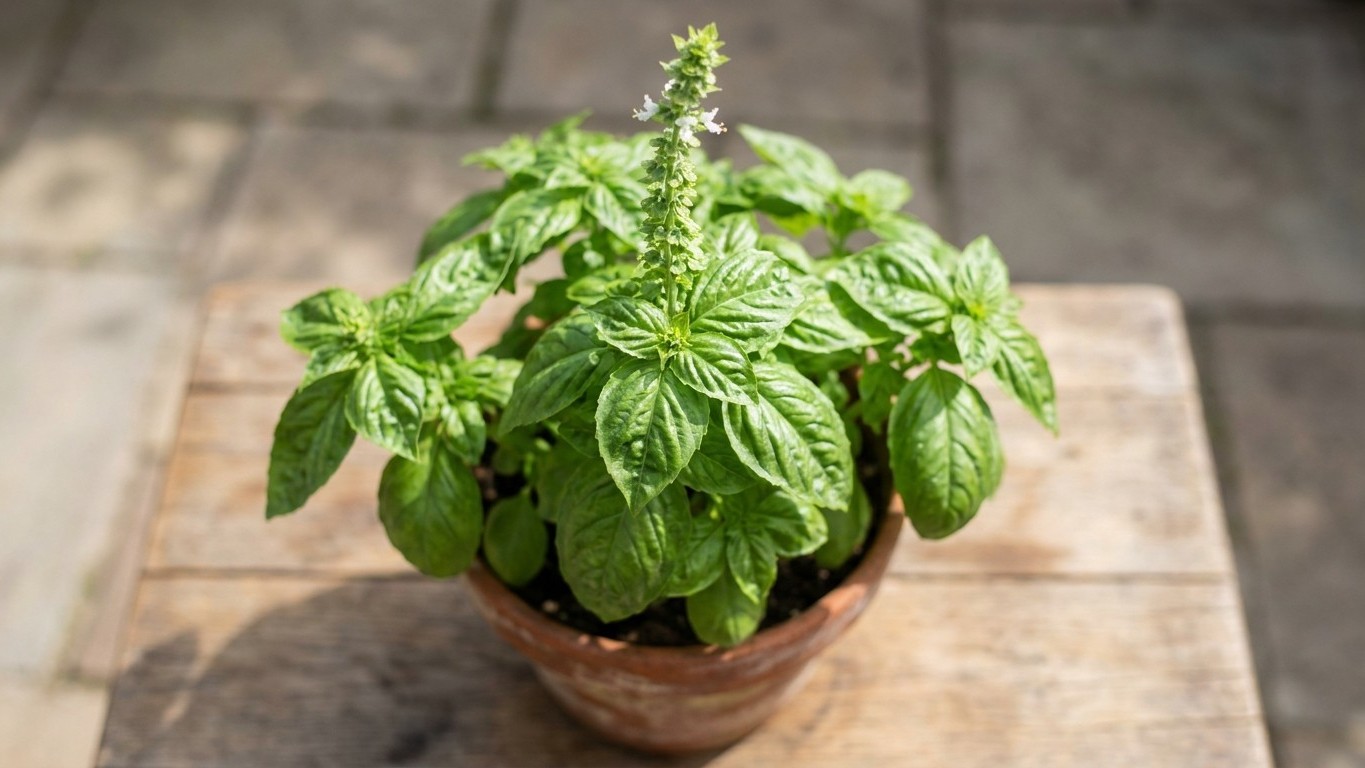
The central flower spike on a basil plant is unmistakable once you know what to look for: a tall, straight stem rising above the leaf canopy, topped with a cluster of tiny white or purple buds arranged in whorls. Most gardening advice tells you to pinch it off the second it appears. Most gardeners, myself included, let it go “just a little longer” because the flowering basil is beautiful and the bees appreciate it.
By late July, my three test plants had grown elaborate branching flower structures six to eight inches above the main foliage. When I finally pinched the central spike, cutting it back to just above a healthy pair of leaves, the plants responded within days. New side shoots pushed out from the nodes below the cut, and the leaves on those new shoots were noticeably more aromatic than anything the plant had produced in weeks. Not as good as early June basil, but genuinely usable again.
The mechanism is straightforward: removing the dominant growing tip breaks apical dominance, the hormonal system that suppresses lateral growth while the plant focuses upward. Pinching redirects auxin distribution, and suddenly the side buds get the green light to develop. You’re essentially tricking the plant into starting over, at least partially.
How to pinch correctly (most people stop too early)
Pinching means using your thumb and forefinger, or clean scissors, to remove the top growth back to just above a node, the point where a pair of leaves meets the stem. Most people clip just the flower bud itself, leaving a long bare stem that desiccates and provides no benefit. The correct cut is lower: find the first or second pair of full-sized leaves below the flower cluster, and cut there. You’ll get a bushier, more productive plant in return.
Frequency matters more than most people realize. During peak summer heat, a productive basil plant can throw a new flower spike in as little as ten days. A weekly walk through your herb garden, pinching as you go, takes about ninety seconds and keeps the plant in its vegetative, leaf-producing state for weeks longer than a hands-off approach.
One counterintuitive detail: leaving one or two flower spikes on a plant you’re planning to let go to seed at the end of the season won’t hurt the others you’re still harvesting, as long as those kept-for-seed plants are physically separate. Bolting is not contagious between plants, but the pollen from flowering basil does attract pollinators that can stress nearby vegetables, so placement matters in a mixed kitchen garden.
Salvaging bitter basil (it’s not hopeless)
If your basil has already turned and you don’t want to waste it, heat is your friend. The bitter phenolic compounds break down under sustained cooking in a way that the volatile aromatics, which evaporate quickly, do not. Bitter post-bolt basil works reasonably well in a slow-cooked tomato sauce where it simmers for forty minutes or more. Raw applications like pesto or caprese are largely a lost cause; the bitterness amplifies rather than mellows without heat.
Drying post-bolt basil is also worth considering. Dried herbs lose most of their fresh aromatic complexity regardless of growth stage, so the quality gap between pre-bolt and post-bolt leaves narrows considerably once both are dried. What you’ll notice less of is the bitterness, drying concentrates but also partially transforms the phenolic profile in ways that make the resulting herb more neutral and kitchen-friendly.
One last thing worth knowing: Genovese basil, the classic Italian variety, bolts faster than almost any other type under heat stress. Thai basil holds its flavor profile longer after flowering begins, partly because it was bred in climates where bolt resistance matters. If you’re gardening in a reliably hot summer zone and losing the flavor battle every August, switching varieties might solve more of your problem than any amount of diligent pinching.