
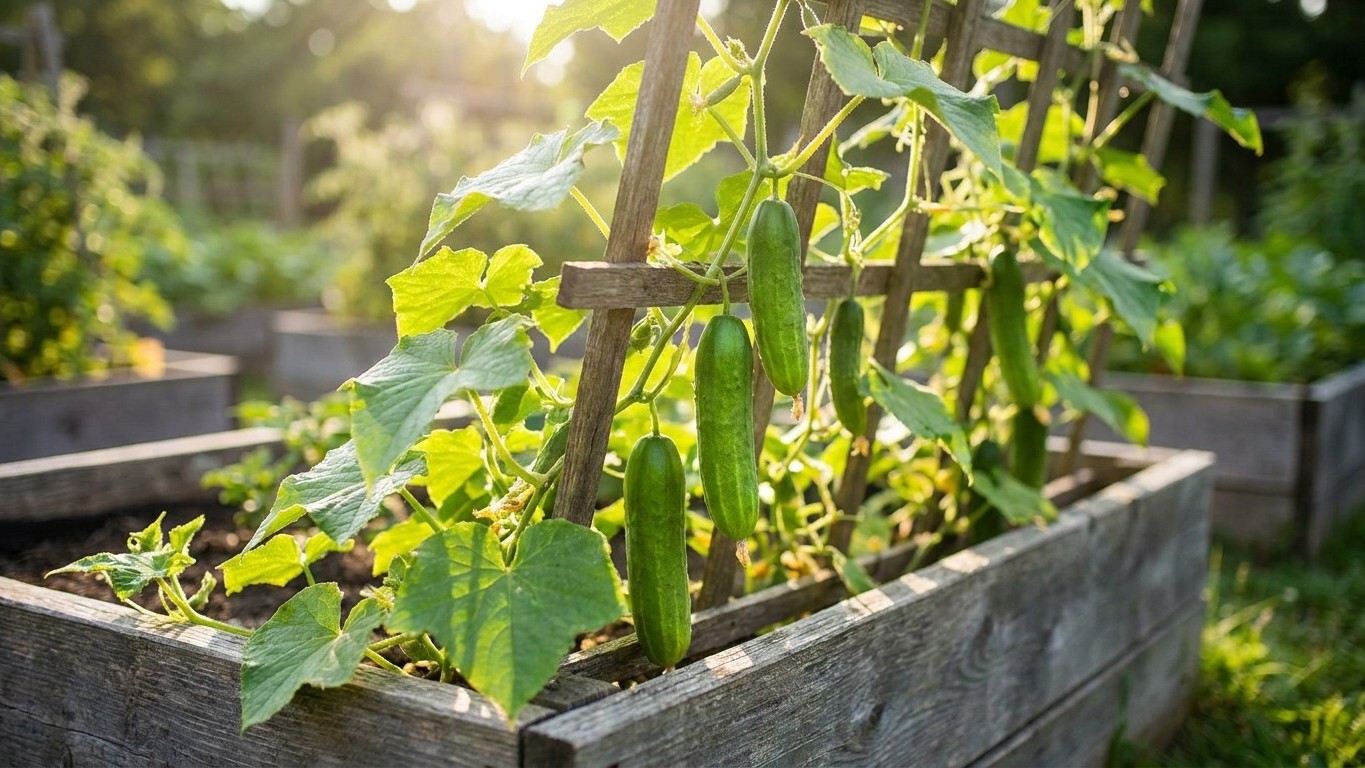
Ten days. That’s all it took for my neighbor’s intervention to completely change the trajectory of my cucumber plants, literally. He’d walked past my raised bed, paused, tilted his head, and asked the question with the kind of gentle bewilderment only seasoned gardeners can pull off: “Why are you letting them crawl on the ground?” I had no real answer. I’d just assumed cucumbers did their own thing. They don’t. And that simple conversation in early May turned out to be one of the most practically useful gardening moments I’ve had in years.
Key takeaways
- A neighbor’s simple observation about cucumber training revealed a hidden gardening failure most home gardeners don’t even realize is happening
- What looks like lush, productive ground-cover is actually a disease-breeding microclimate that cuts yields in half
- Ten days after vertical training, three new healthy cucumbers appeared while fungal infection stopped spreading—backed by horticultural research
Cucumbers on the ground: a slow disaster hiding in plain sight
Left to sprawl on the soil, cucumber vines look productive, lush, spreading, alive with big green leaves. The problem is that what’s happening underneath tells a different story. Leaves and fruit resting directly on damp earth become prime targets for fungal diseases like powdery mildew and anthracnose. The moisture trapped between vine and soil creates exactly the kind of humid microclimate these pathogens love. According to research from the University of Minnesota Extension, good air circulation is one of the most effective passive defenses against fungal infections in cucurbits.
There’s also a pest issue. Ground-level cucumbers are accessible highways for cucumber beetles, slugs, and squash bugs. When the fruit develops while lying on soil, it’s in constant contact with insects that would otherwise have to work much harder to reach it. Vertical growing effectively raises the harvest out of easy reach, a simple mechanical barrier that requires zero pesticides.
My neighbor, who has been growing vegetables in our shared alley garden for over two decades, put it even more plainly: “On the ground, the plant works twice as hard and produces half as much.”
What vertical training actually does to the plant
Training cucumbers upward isn’t just about saving space, though it does that too, a trellised plant can occupy a 2-foot footprint instead of spreading 6 feet in every direction. The real change happens in how the plant allocates its energy. When vines climb, the leaves angle themselves more efficiently toward sunlight. Photosynthesis improves. The plant stops investing resources in sprawling and redirects them toward fruit development.
Trellised cucumbers also benefit from what farmers call “even exposure.” Every part of the plant gets consistent sun and airflow, which means pollination is more uniform and fruit develops more evenly. You end up with straighter cucumbers, which sounds cosmetic but actually indicates that the fruit developed without interruption, no moisture pockets, no contact rot, no growth stalls from irregular pressure against the ground.
The technique itself is straightforward. My neighbor used a combination of garden twine and the existing wire fence along our plot. He gently looped the main vine around the lower wire, then used soft fabric strips (cut from an old cotton t-shirt) to tie lateral shoots at intervals of about 8 inches. No clips, no specialty hardware. The whole process took maybe 20 minutes for three plants.
The ten-day difference, measured, not imagined
Here’s where it gets concrete. Before the intervention, my three cucumber plants had been in the ground for about five weeks and had produced exactly two small cucumbers, both of which showed yellowing at the base where they’d rested on soil. The leaves on the lower portion of each vine had visible powdery patches, early-stage mildew I’d been hoping would resolve itself. It wasn’t resolving.
Ten days after trellising, the mildew on new growth had stopped spreading. The existing affected leaves were trimmed away, and the new ones coming in above the trellis line were clean. More striking: three new cucumbers had set on the upper portions of the vines, all hanging freely, none showing the base yellowing I’d seen before. The plants looked taller, more structured, like they’d stopped wandering and started working.
This isn’t anecdotal magic, it reflects documented horticultural principles. Vertical growing in cucumbers is standard practice in commercial greenhouse production precisely because it maximizes yield per square foot while reducing disease pressure. A 2019 study published in HortScience found that trellised cucumber plants produced measurably higher marketable yields compared to ground-grown controls under field conditions.
Timing matters more than most gardeners realize
May is the right window for this intervention in most of the continental United States, the vines are long enough to train but haven’t yet committed fully to a sprawling habit. Once a cucumber vine has been ground-level for months, redirecting it becomes more disruptive; the stems can crack if bent too sharply, and the root system has often spread in ways that make repositioning risky. Early is better. Think of it like staking a young tree versus trying to correct a mature one.
The other timing consideration is temperature. Cucumbers set fruit most reliably when daytime temperatures are between 65°F and 90°F. In May, before summer heat peaks, the plant is in its most receptive growth window. Trellising during this period means the plant experiences improved conditions exactly when it has the most productive weeks ahead of it, rather than when it’s already stressed by heat.
One detail worth knowing for next season: starting with a trellis already in place at transplant time avoids the problem entirely. Some gardeners plant directly at the base of an existing structure, training from the very first tendrils. The cucumbers never learn the ground is an option. As a habit, it eliminates the mid-season scramble, and spares you the slightly embarrassing question from a neighbor who can’t quite believe you’ve been doing it the hard way.