Three years ago, a gardener in Vermont put down her spade and never picked it up again. Not out of laziness, out of curiosity. She had read about no-dig gardening, felt skeptical, and decided to test it on half her vegetable plot. By the end of that first season, the untouched half was outperforming the dug half by a margin she hadn’t expected. The soil was darker, the earthworms were multiplying, and her tomatoes didn’t care about the drought that had hit the region in July.
No-dig gardening, sometimes called no-till when practiced at larger scales, isn’t a new idea. Farmers in Japan were practicing versions of it in the 1970s, and Charles Dowding in the UK has spent decades documenting its results with almost obsessive precision. But it’s gaining serious traction in American backyards right now, and the science behind it has finally caught up with what practitioners have been observing for years.
Key takeaways
- One simple decision to stop digging revealed a hidden underground ecosystem working against every turn of the spade
- What happens in year two will make you question everything you thought you knew about garden maintenance
- The soil beneath your feet holds more intelligence than most gardeners ever discover
What’s Actually Happening When You Dig
Every time you drive a spade into your garden bed, you’re disrupting something that took years to build. Soil is not just dirt, it’s a living architecture. Fungal networks called mycorrhizae thread through healthy soil like a root internet, connecting plants, shuttling nutrients and water between them. A single teaspoon of healthy soil contains more microorganisms than there are people on Earth. Digging breaks those fungal threads, exposes anaerobic bacteria to oxygen (killing them), and brings weed seeds from deeper layers up to the surface where light will germinate them.
There’s also the issue of soil structure. Over time, undisturbed soil forms aggregates, tiny clumps where particles of clay, silt, sand, and organic matter bond together. These aggregates create the pore spaces that hold both air and water, giving roots room to breathe and moisture somewhere to go during rain. Tilling collapses those structures. The soil compacts after watering, forms a surface crust, and you end up needing to dig again just to restore the tilth you destroyed. It becomes a cycle that serves the shovel more than the plants.
What Replaces the Fork: Compost as a Surface Treatment
The no-dig approach doesn’t mean doing nothing. The work shifts from below the soil to above it. The core practice is applying a layer of compost, typically one to two inches deep, directly on top of the existing ground, whether that’s lawn, weedy soil, or an existing bed. You don’t mix it in. You leave it there and let the ecosystem pull it downward.
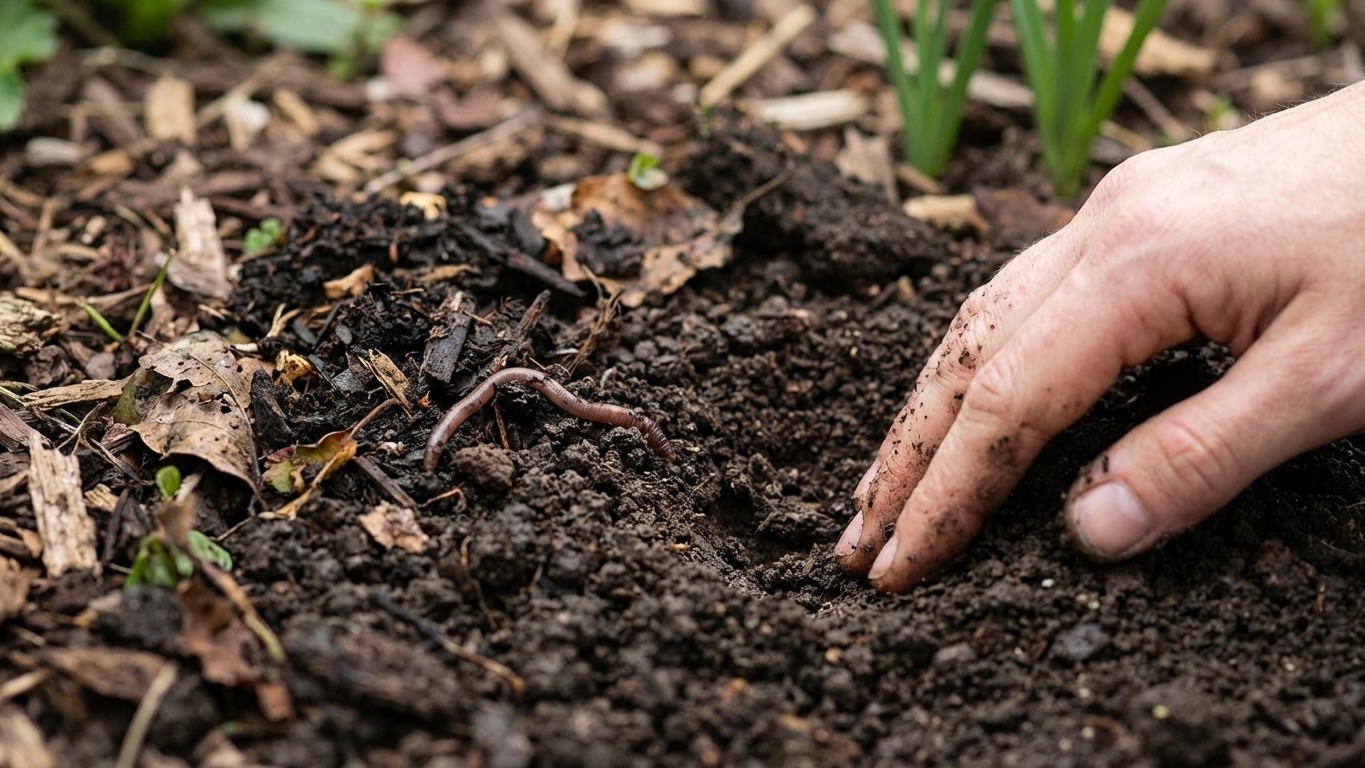
Earthworms are the unsung workers here. They consume organic matter at the surface and move through the soil, creating channels, called burrows, that improve drainage and aeration far more effectively than a garden fork ever could. A healthy no-dig bed can host earthworm populations several times greater than regularly tilled soil, and those worms are doing constant structural work. Their castings are also among the most nutrient-dense soil amendments available anywhere.
Starting a new bed on top of lawn or weeds requires one extra step: smothering. A thick layer of cardboard (overlapping by at least six inches at the seams, with all tape and staples removed) blocks light, kills the existing vegetation, and breaks down into organic matter within months. Pile compost on top of that, and you have a functional growing bed without a single stroke of digging. Some gardeners add wood chips on top of pathways to keep weeds down and maintain the soil-friendly moisture levels around the beds.
The Results You Can Expect (and When)
Season one is often unremarkable. The soil biology is recovering, the cardboard is decomposing, and you’re essentially setting up a system rather than seeing its full output. Expecting a dramatic harvest in year one is like expecting a sourdough starter to bake you bread on day two. The activity is happening, just not visibly yet.
By year two, something shifts. The soil becomes noticeably softer and darker. You can push a finger several inches in without resistance, a test that tells you more about soil health than any kit. Weed pressure drops dramatically, because the weed seed bank at the surface has largely been exhausted, and you haven’t been bringing buried seeds up by digging. Many no-dig gardeners report spending a fraction of the time on weeding compared to their earlier methods. Charles Dowding’s long-running trial plots, which he has documented publicly, show consistent yield improvements for no-dig versus dug beds across multiple vegetable types, with the gap widening over successive years.
Drought resilience is another outcome that surprises people. Undisturbed soil with good organic matter holds moisture far longer than tilled soil. The difference becomes obvious during a dry spell in August when your neighbor is hauling a hose every evening and your beds are still damp three inches down.
What This Means for How You Think About Soil
The conceptual shift is almost as big as the practical one. Treating soil as something to be worked, broken up, turned, restructured by hand, assumes that human intervention improves on the system. The evidence suggests otherwise. Left undisturbed and fed from above, soil builds complexity and resilience on its own timeline, following processes that were running long before anyone thought to patent a tilling machine.
This doesn’t mean every garden technique needs to go. Raised beds, succession planting, crop rotation, these all coexist with no-dig principles. A broadfork (a two-pronged fork used to aerate without inverting soil layers) can be a sensible tool for extremely compacted ground in year one, used once and then put away. The point isn’t rigidity. It’s understanding what the disturbance costs before making it a habit.
The Vermont gardener is still not digging. She added two more beds last year, both started with cardboard and compost, both thriving. The question worth sitting with isn’t whether no-dig works, at this point the evidence is fairly solid. It’s what else in the garden might improve if we interfered less and observed more.