
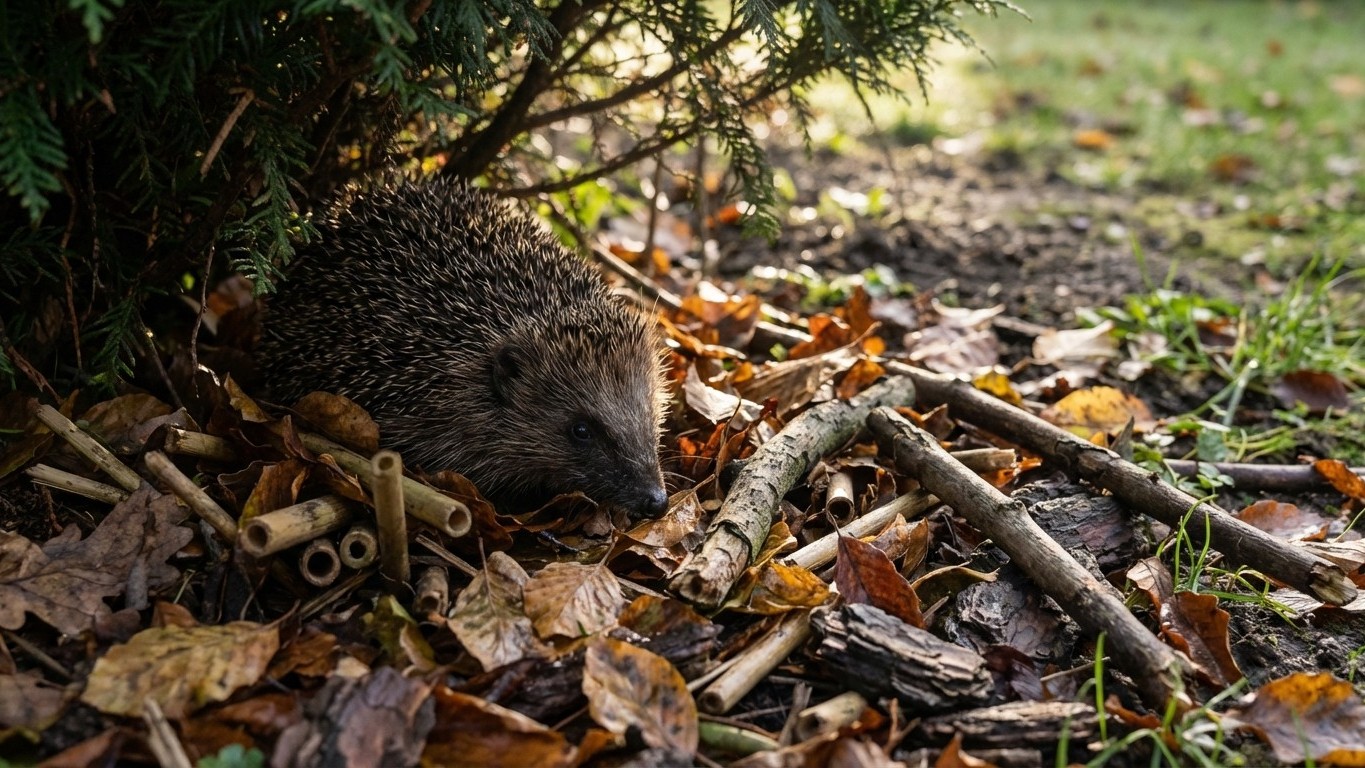
A pile of dead leaves, a few twigs, maybe some roughly chopped branches left to rot quietly in the shadows. Walk past most suburban gardens this spring and you might spot something that looks, at first glance, like someone forgot to finish tidying up. Except they didn’t forget. They did it on purpose, and they’re onto something the rest of us should pay attention to.
Hedgerow bases and the shaded ground beneath dense shrubs are becoming the preferred drop zone for a growing number of home gardeners who are deliberately leaving what they call a “dead hedge” or wildlife debris pile right there, season after season. The practice has a name, it’s sometimes called a “habitat stack” or simply a “bug hotel Without walls” — and the ecological payoff is quietly extraordinary.
Key takeaways
- The one thing gardeners are leaving under hedges isn’t garden waste—it’s deliberate wildlife architecture
- A single debris pile costs nothing but provides shelter that’s become critical for endangered hedgehog populations
- Leaving things messy in spring might be the most effective pest control system you never have to maintain
What Gets Left, and Why It Matters
The raw material is humble almost to the point of comedy: fallen leaves, spent flower stalks, hollow stems from last year’s perennials, small logs beginning to go soft, maybe a layer of bark. Nothing that costs money. Nothing that requires a trip to the garden center. The beauty of a debris pile under a hedge is that it mimics exactly what a forest floor does naturally, layering organic matter so that decomposition happens slowly, creating a mosaic of microhabitats within a single square foot of ground.
Hedgehogs are the headline act. A single adult hedgehog needs somewhere between 150 and 300 acres of territory to forage adequately, but it needs only a tiny corner of sheltered ground to nest and, if you’re lucky, to hibernate. A loose pile of leaves and sticks under a thick hedge is close to ideal real estate. Britain’s hedgehog population has fallen by roughly a third since 2000, a loss comparable to watching an entire city the size of Chicago simply disappear from the map — and the culprit is mostly habitat loss in gardens and farmland margins. A debris pile costs you nothing and gives them a fighting chance.
But hedgehogs are just the visible part of the equation. Ground beetles, which are voracious predators of slugs and aphid eggs, overwinter in exactly this kind of loose, sheltered debris. Bumblebee queens, the ones responsible for founding next year’s entire colony, burrow into leaf litter at the base of hedges to spend the winter. Slow worms, which eat more slugs per day than most gardeners realize, shelter under flat pieces of bark and rotting wood. The debris pile is, without exaggeration, a functioning pest control system that runs itself.
The Spring Timing Is the Whole Point
Spring is when the debate usually starts. Gardeners feel the urge to clean up, to rake, to restore order after the gray chaos of winter. And that instinct, as understandable as it is, is precisely when leaving things alone pays off most. Insect larvae that overwintered in hollow stems are still pupating in March and April. Queen bumblebees are only just beginning to emerge, groggy and cold, and they need the debris layer both as a physical shelter and as a source of ambient warmth, decomposing organic matter generates measurable heat, which is why a compost heap stays warm even in frost.
The gardeners who are making this a spring ritual aren’t ignoring their gardens. Many of them are meticulous about everything else, the beds, the lawn edges, the Pruning schedule. They’ve simply drawn a line around one corner, usually the least visible spot under the hedge line, and declared it a no-go zone until at least late April or early May. Some go further and refresh the pile each spring, adding the previous season’s hollow-stemmed plants, some rough-cut wood, a loose layer of unshredded leaves.
There’s also a soil benefit that doesn’t get talked about enough. Over years, a debris pile slowly feeds the hedge itself. As fungal networks break down the organic matter, nutrients migrate into the surrounding soil. The hedge grows denser, more sheltered, more useful. The microclimate beneath it stays cooler in summer and fractionally warmer in winter. You’re not just creating habitat, you’re slowly building a better hedge.
Getting It Right Without Overthinking It
The risk with any wildlife gardening trend is that it becomes complicated. It doesn’t have to be. A debris pile under a hedge works best when it’s loose rather than compacted (animals need to get in and move through it), when it includes at least some woody material (logs, thick branches, chunks of bark), and when it’s left genuinely undisturbed for long stretches. Checking it every week out of curiosity, or rearranging it “to see what’s living there,” defeats the purpose almost entirely.
Placement matters more than composition. The north or east-facing side of a hedge tends to stay damper, which suits fungi and the invertebrates that feed on them. A south-facing base is warmer and drier, better for reptiles and overwintering bees. If you have the space, one of each is ideal, though even a single pile, anywhere sheltered from direct wind and heavy rain, will attract something within a season or two.
Some gardeners find the aesthetic adjustment the hardest part. There’s a deeply ingrained cultural equation between tidiness and care, between a raked border and a responsible garden. Leaving a messy corner takes a certain confidence, the willingness to explain to a neighbor that no, it’s not neglect, it’s intentional. But that confidence tends to come quickly once you spot the first hedgehog nose emerging at dusk, or notice that the slug problem on the nearby bed has quietly, mysteriously improved.
Which raises a question worth sitting with as spring proper gets underway: how much of what we call “gardening” is actually for the garden, and how much of it is just for us?