
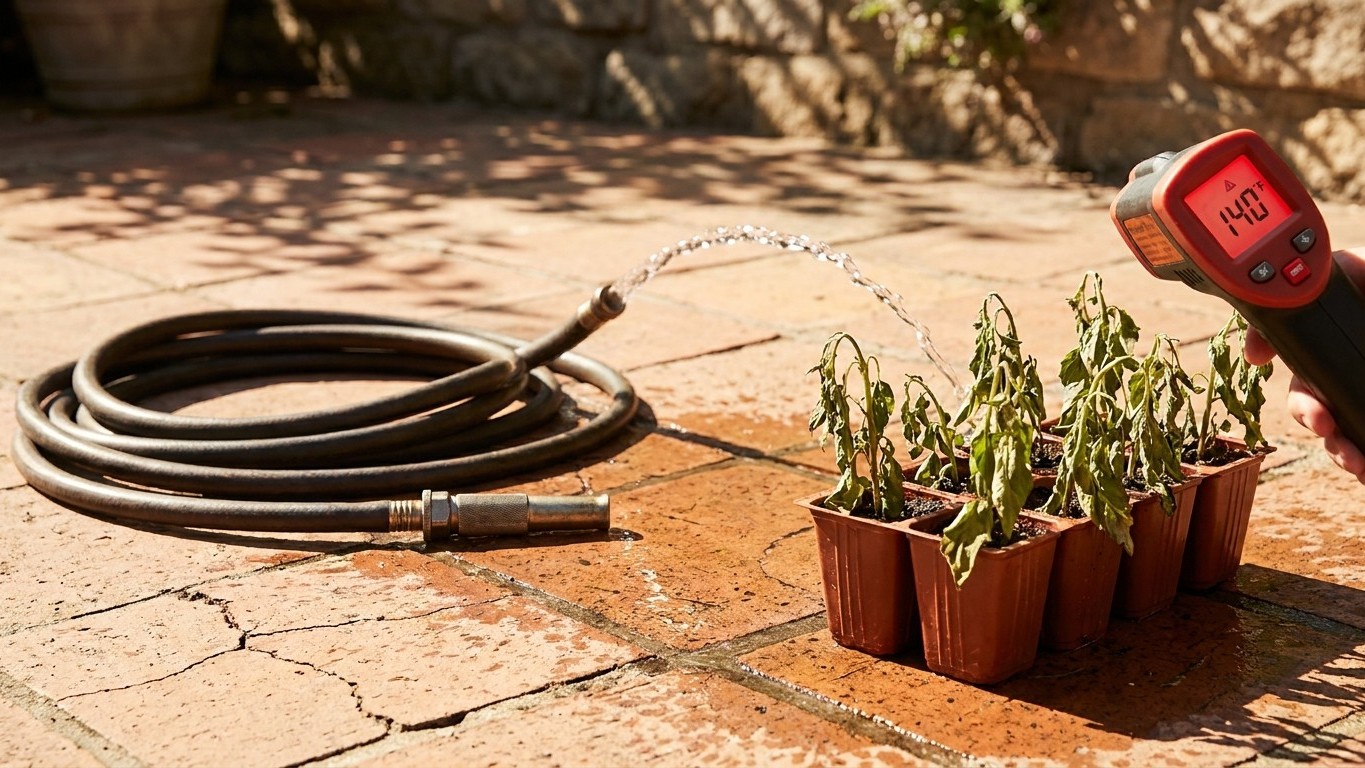
A single watering session. That’s all it took to wipe out three weeks of careful germination work, two dozen tomato seedlings, a flat of basil, and a row of delicate zucchini starts, all cooked from the roots up. The culprit wasn’t overwatering, a fungal disease, or bad seed stock. It was the garden hose sitting coiled in the afternoon sun, loaded with water that had turned scalding while nobody was watching.
When a thermometer gun got pointed at the water streaming out of that hose, the reading was 140°F. For context, that’s the temperature food safety guidelines use to kill bacteria in meat. It’s hotter than most home compost piles ever get. Plant cell membranes begin breaking down somewhere around 104°F, so that first blast of hose water didn’t just stress those seedlings. It destroyed them on contact.
Key takeaways
- A coiled garden hose in direct sun can heat water to 140°F—hot enough to destroy plant cells on contact
- Seedlings die silently, sometimes showing no visible damage for 24-48 hours, making gardeners blame the wrong cause
- A 30-second flush and a light-colored hose can prevent the catastrophe entirely
Why Garden Hoses Become Heat Traps
A standard black rubber or dark vinyl garden hose lying on a sun-baked patio behaves almost exactly like a solar collector. Research from the University of Florida’s environmental health department found that water trapped inside a garden hose exposed to direct sunlight can reach temperatures between 130°F and 150°F within just a few hours on a hot summer afternoon. The darker the hose, the faster it heats. The tighter the coil, the more water stays trapped without circulation.
The physics here are straightforward: the hose absorbs radiant heat from the sun, and the standing water inside has nowhere to go. Unlike a running faucet where cool water continuously flows from the supply line, a closed hose is essentially a sealed vessel. On a 90°F day with full sun exposure, that sealed vessel reaches dangerous temperatures faster than most gardeners would expect, sometimes in under two hours.
What makes this especially deceptive is the first few seconds of watering. The moment you turn on the tap, that superheated water is the first thing to leave the hose. By the time cooler water from the main line arrives, the damage is already done. Seedlings and young transplants, with their shallow root systems and thin cell walls, have zero tolerance for that initial thermal shock.
What Exactly Happens to Plants at High Temperatures
Plants manage heat through a process called transpiration, essentially sweating through their leaf surfaces. But that system has hard limits. When soil temperature spikes suddenly above 95°F to 100°F, root cells begin losing their ability to absorb water and nutrients efficiently. Push past 113°F and you’re looking at protein denaturation inside the plant tissue itself, the same process that turns a raw egg white solid when it hits a hot pan.
Seedlings are disproportionately vulnerable because their root systems haven’t developed the insulating buffer that mature plants have. A six-inch tomato seedling in a small tray has maybe half an inch of growing medium between its roots and whatever hits the surface. Pour 140°F water on that tray and the temperature spike reaches the root zone almost instantly. The plants may not show visible damage for 24 to 48 hours, wilting, yellowing, then collapse, which is why the hose connection often goes unidentified. Gardeners blame the wrong thing.
Interestingly, the same risk exists for established container plants on balconies and patios, especially those in dark plastic pots that have already been absorbing radiant heat all day. Adding scalding hose water to an already heat-stressed root system can push the plant past its recovery threshold.
Simple Fixes That Actually Work
The most reliable solution costs nothing: let the hose run for 30 to 60 seconds before pointing it at anything living. This purges the superheated water from the hose body and replaces it with cooler supply water from underground pipes, which typically sits around 55°F to 65°F even in summer. It feels wasteful, but collect that first flush in a bucket, it’s perfectly fine for watering mature trees, hardscape areas, or topping off a rain barrel.
Hose color and storage position matter more than most people realize. Switching to a lighter-colored hose, tan, gray, or even white, meaningfully reduces heat absorption. A light-colored hose in the same sun conditions typically runs 20 to 30 degrees cooler than a black equivalent. Storing the hose in the shade, wrapped loosely rather than tightly coiled, also reduces how much water sits trapped in the heat zone. Even draping it over a fence rail in partial shade makes a measurable difference.
Watering time is the third variable. Early morning watering, before 9 a.m. in most climates, keeps hose temperatures low because overnight cooling has done its work. Late afternoon watering, roughly between 2 p.m. and 5 p.m., is when hose temperatures peak alongside ambient air temperatures. If your schedule demands late-day watering, running the hose for a full minute before starting is non-negotiable.
For anyone regularly starting seeds or maintaining a nursery bench, an infrared thermometer (the same style used in kitchens to check cooking surfaces) is a genuinely useful garden tool. A quick scan of the hose before watering takes three seconds and removes all guesswork. They cost less than a single tray of quality seedlings.
One detail that rarely gets mentioned: this problem is actually worse with shorter hoses. A 25-foot hose holds less total water than a 75-foot one, which means the superheated portion represents a larger percentage of what comes out before cool water arrives. Compact urban gardens with short hose runs are at greater risk than sprawling suburban plots, the physics favor the longer setup in this particular scenario.