
Rhubarb is one of those plants that rewards the patient and punishes the impatient. For three growing seasons, a gardener in Vermont documented what seemed like an inexplicable decline: vigorous stalks in spring, sluggish regrowth by midsummer, and by late August, a crown that had turned soft, dark, and half-rotted. The culprit wasn’t disease, wasn’t drought, wasn’t a pest. It was a knife.
Cutting rhubarb stalks with a blade, rather than pulling and twisting them free, is one of the most common mistakes home gardeners make, and the consequences play out slowly enough that most people never connect the cause to the effect. By the time the crown shows visible damage, months have passed and the garden journal has moved on to tomato stakes and basil pinching.
Key takeaways
- A knife cut leaves a stub that rots, creating an entry point for fungal pathogens in the vulnerable crown
- Aggressive May harvesting depletes the crown’s energy reserves before it can recover for summer
- By combining cutting wounds with energy depletion, even healthy-looking plants collapse by late August
Why the Cutting Method Actually Matters
The problem with a knife comes down to the wound it leaves. When you slice a stalk, you leave a short stub of stem attached to the crown. That stub doesn’t dry cleanly, it rots. And rhubarb crowns, sitting at or just below soil level, are already in a damp, vulnerable position. A rotting stub becomes an entry point for fungal pathogens, particularly Botrytis and crown rot fungi that thrive in the exact conditions your crown lives in: cool, moist, rich in organic matter.
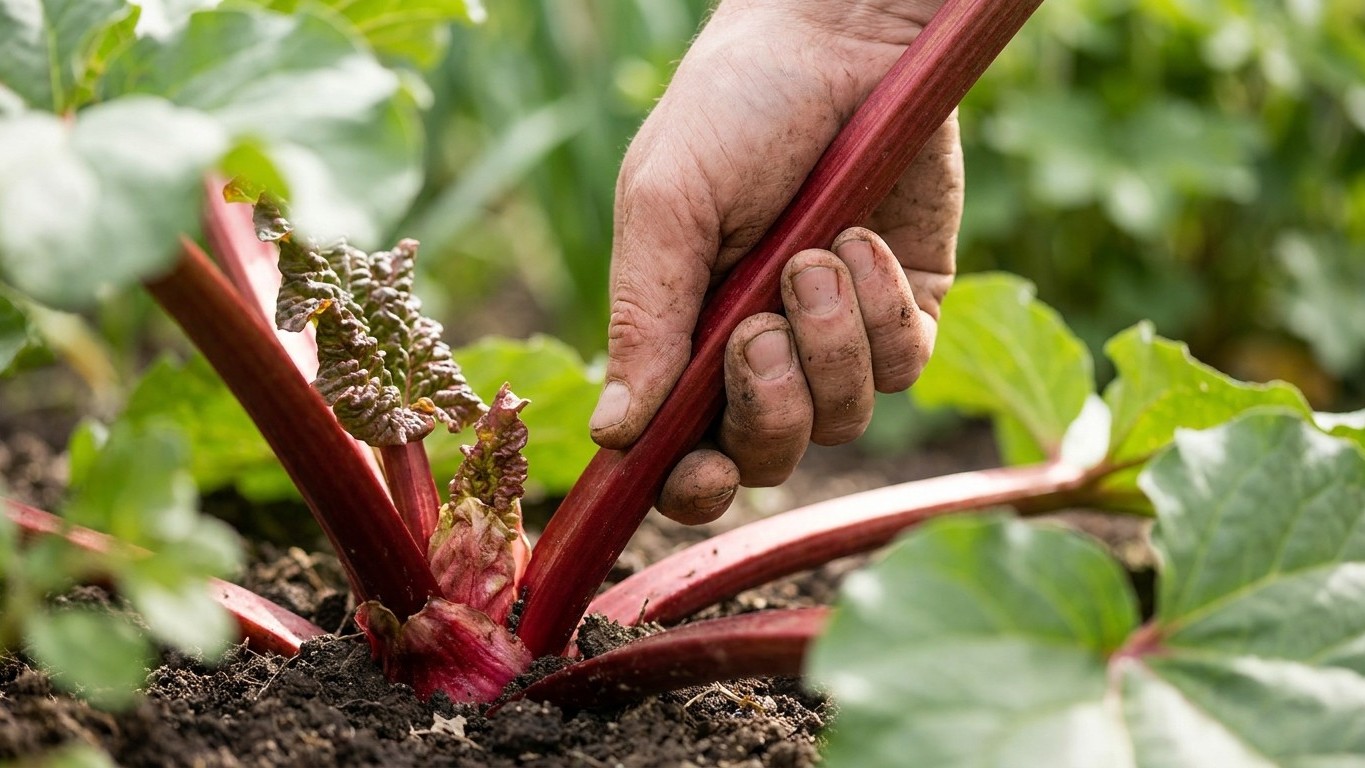
The correct technique is to grasp the stalk low, near the base, and pull with a firm twisting motion, like uncorking a bottle, but downward. Done right, the stalk separates cleanly at its natural attachment point, leaving no stub. The small wound that remains seals over quickly, the way a leaf scar on a tree does. No entry point, no rot, no black mush by August.
This isn’t folk wisdom. The Royal Horticultural Society has long recommended the twist-and-pull method specifically to avoid leaving stubs that decay and compromise the crown. The biological reasoning is straightforward: plants have evolved clean separation points for shedding organs. Fighting that design with a blade creates a problem the plant has no mechanism to solve on its own.
The Timing Trap: When May Harvesting Goes Wrong
May is the month rhubarb harvests feel endless and consequence-free. The plant is at peak production, the stalks are thick and tart, and the crown is flush with stored energy from the previous year. This abundance creates a false sense of security. Gardeners who cut aggressively in May, taking every harvestable stalk, sometimes with repeated cuts over the same plant — deplete the crown before it has had time to rebuild its reserves for summer.
The general rule, supported by extension horticulturalists from the University of Minnesota to Oregon State, is to stop harvesting by mid-June at the latest, and to always leave at least a third of the stalks standing to allow continued photosynthesis. Rhubarb Leaves Are enormous for a reason: they’re the solar panels feeding a root system that needs to store enough carbohydrates to survive winter and push again in spring. Strip those panels too aggressively, too late in the season, and the crown enters summer already running a deficit.
Combine that energy depletion with the stub rot from knife cuts, and you have a crown that is simultaneously starved and infected. By August, the collapse looks sudden. It wasn’t.
Rescuing a Damaged Crown Before It’s Too Late
If your rhubarb crown is showing signs of distress, soft spots, discoloration, a smell that doesn’t belong in a garden — there are steps worth taking before writing the plant off. First, cut away any visibly rotted tissue with a sterilized knife (ironic, yes), removing all darkened material until you reach firm, cream or pale-pink flesh. Dust the exposed area with powdered sulfur or activated charcoal, both of which have antifungal properties and help dry the wound.
Improve drainage around the crown immediately. Crown rot almost always has a drainage component: water pooling at the base, compacted soil, or mulch piled directly against the crown. Pull mulch back at least four inches from the center of the plant. If the site is genuinely waterlogged, the most effective long-term fix is to lift the entire crown in early fall, amend the soil with coarse grit, and replant at a slightly elevated position.
A severely damaged crown can sometimes be divided as a rescue measure. If one section is healthy while another is rotted, separate them cleanly, discard the infected portion, and replant the healthy division in fresh soil. Rhubarb divisions, even stressed ones, are surprisingly resilient when given proper drainage and left unharvested for a full growing season to recover.
The Long Game With Rhubarb
Rhubarb plants can live for twenty years or more when managed well. There are documented cases of crowns outlasting the gardeners who planted them, passed down through families the way cast iron pans are. That kind of longevity requires treating the crown not as a harvest machine but as a perennial investment, something you tend year-round, not just during the six weeks of spring picking.
The knife issue is almost a metaphor for how we approach perennial plants in general: we optimize for immediate yield and underestimate the cumulative cost of small, repeated stresses. A rhubarb crown doesn’t send distress signals. It just quietly weakens until one August morning the whole thing has turned to mush and you’re left wondering what went wrong.
One detail worth keeping in mind as you plan next season: rhubarb planted in full sun with well-draining, deeply amended soil tends to recover from Harvesting errors far better than shade-grown plants. The extra photosynthetic capacity acts as a buffer. It won’t save a plant you’re cutting with a knife all summer, but it buys enough margin that a missed pull here and there won’t cascade into a lost crown.