
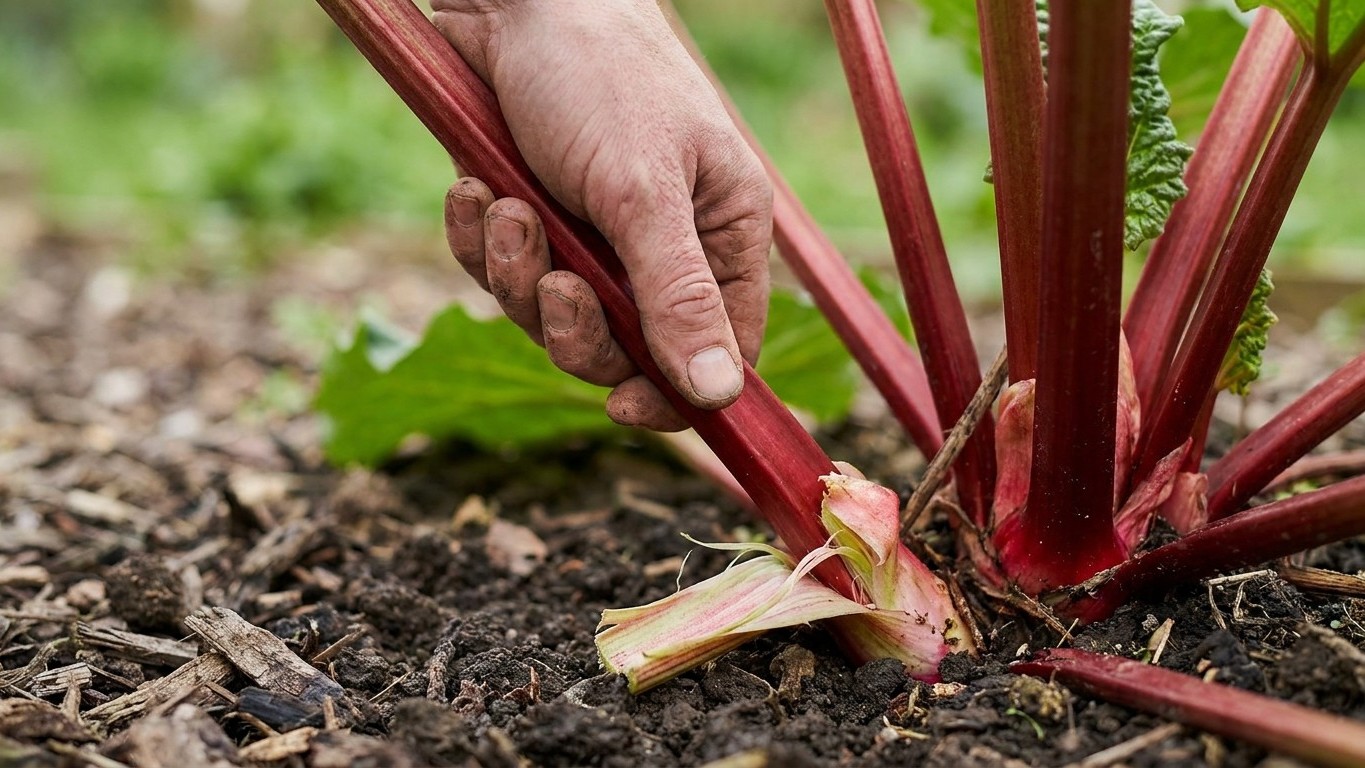
Rhubarb is supposed to be one of the easiest plants to grow. Perennial, low-Maintenance, drought-tolerant once established, the kind of plant that practically takes care of itself. So when a gardener watches their patch slowly decline over two or three seasons, quietly producing thinner and thinner stalks, the instinct is to blame the soil, the weather, or bad luck. The real culprit, more often than not, is a small habit that seems completely harmless: cutting the stalks with a knife.
Key takeaways
- A knife cut leaves behind a stub that rots and invites fungal disease into the crown
- The twist-and-pull method seals the wound naturally, protecting the plant’s core
- Rhubarb crowns can stay productive for decades with proper harvesting technique and basic maintenance
What a knife actually does to rhubarb
A knife leaves a clean horizontal cut at the base of the stalk. Satisfying to look at, precise, tidy. The problem is that this clean cut leaves a stub of stalk behind, a short section that cannot photosynthesize, cannot grow further, and cannot be absorbed back into the plant. It just sits there, exposed, and begins to rot. Over a season or two of repeated harvesting this way, the crown, the central growing hub from which all stalks emerge, accumulates dozens of these small rotting wounds. Fungal disease finds the entry points first. Then the crown itself starts to soften.
When you pull up a crown that has been knife-harvested for several years, the damage is obvious. The base is often dark, mushy in patches, and riddled with what looks like the early stages of crown rot. The stalks that were still coming up were doing so in spite of the crown, not because of it. This is exactly what many gardeners discover the hard way, including anyone who assumed a sharper knife was the solution to thinner harvests.
The right way to harvest: twist and pull
The method recommended by most horticulturalists is deceptively simple. Grip the stalk near its base, twist it slightly to one side, and pull downward with gentle but firm pressure. Done correctly, the stalk separates cleanly at the point where it meets the crown, leaving no stub behind. The plant can then form a natural callus over that point, sealing the surface against moisture and pathogens. No open wound. No rotting stub.
The Royal Horticultural Society has long recommended this pulling technique over cutting, specifically because of the rot risk associated with cut stubs. What makes it feel counterintuitive is that “pulling” sounds rougher than cutting, like you’re tearing the plant. The opposite is true. A clean pull at the natural separation point is far less traumatic for the crown than a blade slicing through tissue that needs to stay intact.
Timing matters here too. Stalks should be pulled when they’re fully developed but before they become woody, generally from April through June in most U.S. growing zones. Earlier in the season, when stalks are young, they separate more easily and the crown recovers faster. Once the plant starts putting energy into flowering (those tall seed stalks that shoot up in midsummer), harvesting should stop entirely to let the crown rebuild its energy reserves for the following year.
Signs your rhubarb crown is already struggling
Thin, spindly stalks where there used to be thick, robust ones are the first indicator. A healthy established rhubarb plant should produce stalks as wide as your thumb, sometimes wider. If yours are starting to resemble celery, the crown is stressed. The cause might be harvesting technique, but a few other factors compound the problem.
Overcrowding is one of the most common. Rhubarb crowns naturally expand and multiply underground, and after five to seven years, a single plant can become so congested that the stalks compete with each other for nutrients and space. Division, digging up the crown, cutting it into sections each with at least one strong bud, and replanting — is the standard fix. Many gardeners avoid it because it looks drastic. But a divided crown almost always outperforms a neglected one within a single growing season.
Nutrient depletion is another factor that accelerates decline when combined with poor harvesting technique. Rhubarb is a heavy feeder, particularly for potassium and nitrogen. A top-dressing of well-rotted compost or aged manure each fall, after the plant dies back, does more for next year’s harvest than almost any other intervention. Some gardeners skip this step for years and then wonder why their crowns look exhausted, which they are.
Rescuing a damaged crown (and knowing when to start over)
If the crown shows soft, discolored tissue but still has firm, healthy sections, rescue is possible. Dig it up in early spring or fall, cut away all the affected tissue with a sterilized blade, and dust the cut surfaces with powdered sulfur or garden lime to discourage further fungal activity. Replant in fresh soil with good drainage, rhubarb sitting in waterlogged ground is a crown rot waiting to happen regardless of harvesting technique.
Some crowns are simply too far gone. If more than half the mass is soft and dark, starting fresh with a new division or a nursery-bought crown is the more realistic path. Rhubarb grows quickly once established, and a healthy new crown planted in fall will often produce a light harvest the following spring, with full production by the second year.
One detail that surprises most people: rhubarb crowns that are regularly pulled (not cut), properly divided every five to seven years, and fed with organic matter each fall can remain productive for decades. There are documented examples of rhubarb plants in old kitchen gardens that have been in the same spot for over 30 years, still throwing up thick stalks every spring. The difference between a short-lived patch and a multigenerational one often comes down to a single habit changed early enough.