
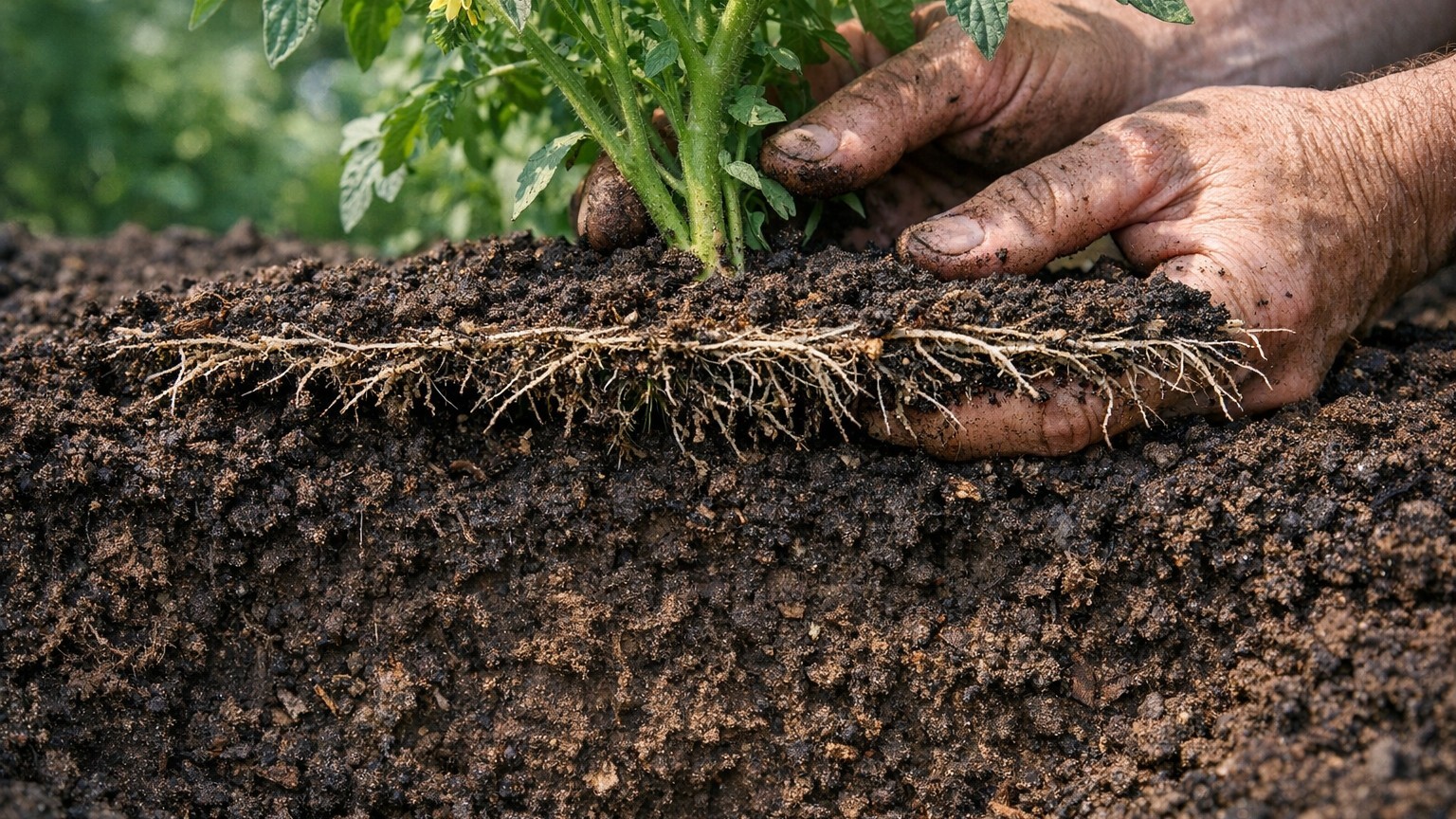
Shallow roots on a tomato plant are almost always a human creation. The plant didn’t fail, the watering schedule did. Every day, a little water hits the top two inches of soil, and every day, the roots follow that moisture upward rather than diving deep where temperatures are stable and nutrients are concentrated. A month of daily watering, and you’ve essentially trained your tomatoes to stay near the surface, fragile and dependent, exactly where they shouldn’t be.
Key takeaways
- Daily shallow watering sends roots a signal to stay near the surface where moisture is—exactly where they shouldn’t be
- A single pulled plant reveals the entire month’s watering history in its root structure
- Deep roots can access moisture long after shallow roots have dried out, creating visibly healthier plants during heat stress
Why the “little and often” rule backfires
The advice to water frequently comes from a reasonable instinct: keep the soil from drying out. The problem is that tomato roots respond to moisture gradients. They grow toward water. When you wet only the top layer of soil every day, you’re sending a signal: stay up here, this is where the food is. The roots oblige. They spread laterally near the surface instead of pushing down 12, 18, even 24 inches, the depths that healthy, drought-resistant tomato roots can reach under the right conditions.
A tomato plant with shallow roots is running a constant deficit. Surface soil heats up dramatically during summer afternoons (sometimes reaching temperatures above 130°F just below the mulch line), dries out within hours of watering, and offers far less mineral content than deeper layers. The plant under this kind of stress produces less fruit, wilts more dramatically on hot days, and becomes far more vulnerable to soil-borne diseases that thrive in warm, moist surface conditions.
That pulled plant, with its tight, horizontal root mat sitting just below the surface — is the physical record of every watering decision made over the previous month. Roots don’t lie about how they’ve been treated.
The deep watering method and what it actually changes
The alternative isn’t complicated, but it requires patience in the short term. Water deeply, infrequently, and then wait. For tomatoes in most climates, that means giving each plant a slow, thorough soak, enough to wet the soil 8 to 12 inches down, and then not watering again until the top 2 to 3 inches have dried out. Depending on your climate and soil type, that might be every 3 days, every 5 days, or even once a week during cooler stretches.
When the surface dries and the roots can’t find moisture there anymore, they go looking. They push down. Within a few weeks of deep, infrequent watering, roots begin colonizing the cooler, more stable lower soil layers. Those deeper roots can access moisture long after the surface has dried out, which is why deeply-rooted tomato plants often look perfectly healthy on days when shallowly-rooted neighbors are visibly wilted by noon.
A slow drip system or soaker hose delivers water gradually enough to penetrate deeply without runoff, the kind of surface flooding that wets the top inch dramatically while letting little reach the subsoil. If you’re hand-watering, count slowly. A five-second splash does almost nothing at depth. A slow, deliberate pour around the base of the plant for 30 to 60 seconds, repeated once or twice, does considerably more.
Soil structure is half the equation
Deep watering only works if the soil allows water to travel downward. Compacted clay, for instance, sheds water sideways rather than absorbing it vertically. This is why soil amendment matters as much as watering technique. Compost worked into the bed breaks up compaction, improves drainage channels, and gives roots something worth growing into. Sandy soils have the opposite problem, water moves through too fast, draining below the root zone before it can be absorbed. Adding organic matter helps here too, slowing drainage and improving water retention at meaningful depths.
Mulch plays a specific and underappreciated role in this system. A 2 to 3 inch layer of straw, wood chips, or shredded leaves over the soil surface dramatically slows surface evaporation. That means the top inch stays moist for longer, but more critically, it gives deep moisture time to establish before surface conditions pull the roots back up. Mulch also moderates soil temperature, keeping that upper zone cooler and less hostile during peak summer heat.
There’s a reasonable counterargument here: in containers, deep watering is harder because root depth is physically limited and drainage is faster. Container tomatoes genuinely do need more frequent attention, though even there, the goal is to water thoroughly each time (until water runs freely from the drainage holes) rather than splashing a little on top daily. The principle holds even when the geometry changes.
Reading your plant instead of following a calendar
The most durable watering habit isn’t tied to a schedule, it’s tied to observation. A wooden skewer or finger pressed 2 to 3 inches into the soil tells you more than any app or calendar. If it comes out damp, wait. If it comes out dry, water thoroughly. That simple feedback loop, repeated consistently, builds a garden-specific routine that accounts for rainfall, humidity, heat waves, and the particular drainage rate of your soil.
Some experienced growers also watch for early-morning leaf behavior. Tomato leaves that are slightly firm and upright at 7 a.m. but drooping by 10 a.m. on a hot day are often perfectly fine, that’s heat stress, not drought stress, and watering won’t fix it. Leaves that are soft and slightly curled inward even in the cool of the morning are genuinely telling you something: the roots aren’t finding enough moisture.
Interestingly, research from the University of California’s vegetable production program has found that tomatoes allowed to experience mild, brief water stress between deep waterings often produce fruit with higher sugar concentration and more intense flavor, the stress triggers the plant to put more resources into seed production, which means more complex, sweeter tomatoes. Giving your plant something to work for, it turns out, pays off on the plate.