
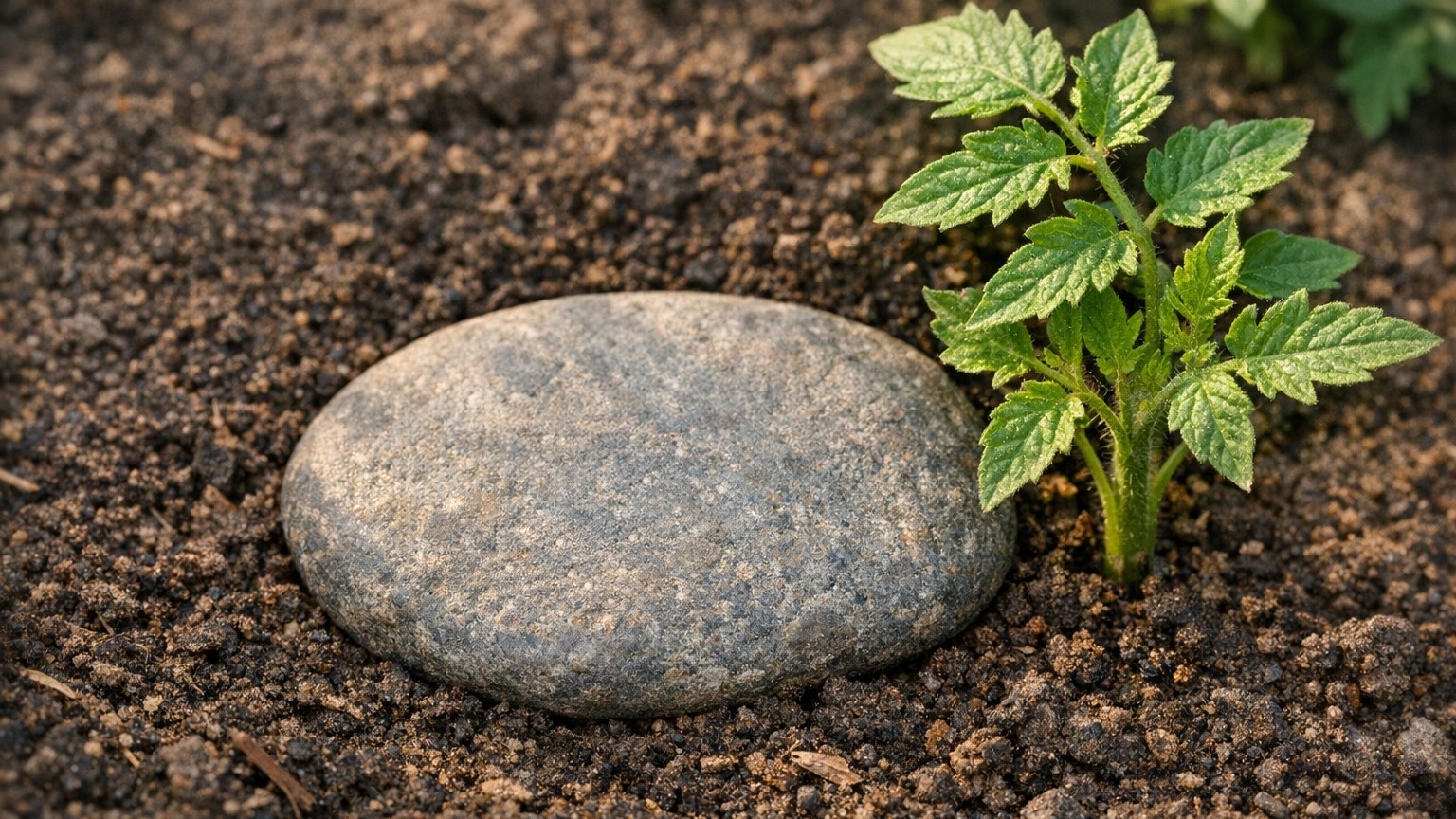
Every summer, my grandfather would kneel down beside each tomato plant he’d just set in the ground and lay a flat stone right next to the stem. Not decorative gravel. Not a border. Just a single, modest, palm-sized rock, flush with the soil. I thought it was the kind of harmless ritual older gardeners develop over decades, endearing, slightly odd, completely unnecessary. Then I started losing tomatoes to blossom end rot and cracked fruit during a brutally dry July, and I finally went looking for the reason behind his habit. He was right. Almost offensively so.
Key takeaways
- A simple flat stone creates a thermal battery that warms soil at night and prevents the temperature swings that damage tomatoes
- Midnight condensation forms under cool stones, delivering free water directly to roots and preventing the moisture chaos that triggers blossom end rot
- One stone per plant works—but a full stone mulch can turn your garden into an oven; placement and timing matter as much as the stone itself
A Stone That Does the Work of Three Tools
The flat stone trick works through a combination of physics and plant biology that most garden guides skip entirely. Stones act as inorganic mulch with significant thermal mass, they absorb the sun’s heat during the day and release it slowly at night, warming the soil beneath. For tomatoes, that matters more than most people realize. Tomatoes are a warm-season crop originating from tropical regions, and how warm or cool the soil itself is has a huge effect on growth rates. A cold night can stall a plant that looked perfectly healthy at noon.
Rocks, stones, and even concrete blocks work as a thermal mass: they warm up during the day and give that heat back at night, which benefits the garden in a cool climate. Think of the stone as a slow-release battery. The sun charges it for eight hours; your tomato roots benefit from it all night. Like Syrah and Cabernet Sauvignon wine grapes, tomatoes benefit considerably from long warm days, supplemented by slow-drip solar heat delivered well into the night courtesy of low-slung stone. Wine growers have known this for centuries. Home gardeners are only now catching up.
The moisture angle is equally compelling. In arid places, folks sometimes plant trees in pits with rocks in the bottom, the rocks stay cool in the shade of the pit and water condenses on the cool surface and drips down to the roots. If you’re not in such an extreme place, the shady side of any pile of rocks ought to do the same thing. A flat stone laid next to a tomato plant works on this exact principle: it shades the soil beneath, slows evaporation, and at night, as the stone cools faster than the ground below it, condensation forms on its underside and seeps directly into the root zone. Free water, every single morning, without turning on the hose.
What Happens When Tomatoes Go Thirsty
Inconsistent soil moisture is the number one silent killer of a tomato harvest. Consistent soil moisture levels will help produce the best quality fruit. When soil moisture levels fluctuate during fruit growth, blossom-end rot can develop. Blossom end rot, that ugly black leathery patch on the bottom of a fruit you’ve been watching for six weeks — is not actually caused by a lack of calcium in the soil. Most garden soils have plenty. The best strategy to reduce blossom end rot is to irrigate properly. The uptake of calcium in the soil by tomato roots depends on the uptake of water. When water delivery becomes erratic, calcium transport shuts down, and the fruit pays the price.
Straw significantly slows surface evaporation, reducing the wet-dry cycles that trigger blossom end rot and fruit cracking. Penn State Extension identifies mulching paired with consistent irrigation as the primary prevention strategy for blossom end rot. A flat stone achieves a version of the same effect, not by covering the whole bed, but by creating a localized moisture buffer right where it counts most: at the base of the plant. When stones are collected on soil, they help in occupying unnecessary air spaces that would give room for evaporation. When temperatures are too high during the day, the heat from the sun tends to heat the water from the soil. Using stones as mulch helps insulate the soil beneath, which reduces water loss to the environment from evaporation.
The Almanac is explicit about this. To help tomatoes through periods of drought, find some flat rocks and place one next to each plant. That sentence, buried in a long guide on growing tomatoes, is essentially a one-line vindication of everything my grandfather did silently, without explanation, for thirty years.
The Nuance Nobody Talks About
Here’s where the stone trick gets more interesting, and where some gardeners get it wrong. A flat stone placed next to a plant is very different from a layer of rocks covering the entire bed. Avoid rock, stone and synthetic mulches as full-bed coverage, they provide no soil value and can retain large amounts of heat in the hot summer sun which can overcook your plants. One well-positioned stone creates a beneficial microclimate. Ten stones blanketing the root zone create an oven.
Your garden will heat up as the sun hits it, reaching its hottest temperature some time in the late afternoon and then cool down at night. The rocks would make their area heat up slower over the day and cool down slower at night, bringing the maximum and minimum temperatures closer together. That buffer is the whole point. Tomatoes aren’t struggling because of cold, they’re struggling because of swings. A stone moderates those swings the same way a cast-iron pan holds temperature more steadily than a thin aluminum one. Same principle, different scale.
Stone choice matters too, though not dramatically. Slate has a significant ability to affect soil moisture and temperature. It has a high thermal mass, meaning it can absorb and retain heat, which can help warm the soil in cooler climates. Additionally, slate can create a moisture barrier, reducing evaporation and helping maintain soil hydration. Dark-colored stones absorb more solar radiation than light-colored ones, making them more effective in cool or short-season climates. But honestly, whatever flat stone you find on a walk works. The geometry matters more than the geology: flat means maximum surface contact with the soil, maximum moisture retention underneath, maximum condensation potential at night.
How to Do It Right
The mechanics are simple. After planting your tomato and watering it in, place a flat stone, roughly the size of your open hand, directly adjacent to the stem, touching or nearly touching the base of the plant. The stone should rest flush on the soil, not propped up. One stone per plant is enough. You’re not building a border; you’re creating a microclimate.
The best time to mulch tomato plants is 3 to 4 weeks after transplanting, once the soil has warmed sufficiently. Applying mulch too early can trap cold moisture in the soil, slowing root development and increasing the risk of disease. The same logic applies to the stone. Lay it down too early in spring and you slow the soil warming your young transplant desperately needs. Wait until your plants are visibly growing, new leaf clusters forming, before placing the stone.
The stone trick pairs well with other techniques rather than replacing them. Mulching the plants 5 weeks after transplanting retains moisture, keeps soil from splashing the lower leaves, and controls weeds. A 2 to 4 inch layer of organic mulch, such as straw, hay, or bark chips around the broader bed complements what the stone does at the immediate root zone. Think of the stone as the localized tool, organic mulch as the wider strategy.
One underappreciated bonus: mulch forms a barrier that prevents soil-borne diseases from splashing onto leaves during rain or irrigation, significantly reducing fungal issues like blight. A flat stone right at the stem’s base does the same job for that critical few inches of lower stem, the area most vulnerable to early blight splash-up during summer storms. My grandfather probably didn’t know the term Alternaria solani. He just knew his tomatoes stayed healthier than his neighbors’.
There’s one more thing worth knowing. Growing grapes and tomatoes in rocky soil is one very celebrated way of capturing and storing solar energy for nighttime release, but stone pavers, stone planters, stone edging, raised planters, buildings, and bulk water containment accomplish the same thing, to varying degrees. The wine regions of Châteauneuf-du-Pape in southern France are famous for their galets — large rounded stones that blanket the vineyard floor, absorbing heat by day and radiating it back through the cool Mediterranean nights. What those French winemakers have been engineering for centuries, my grandfather was quietly replicating in a backyard in the American Midwest with whatever rock happened to be near the garden shed.
Sources : ruralsprout.com | veggieknowledge.com