
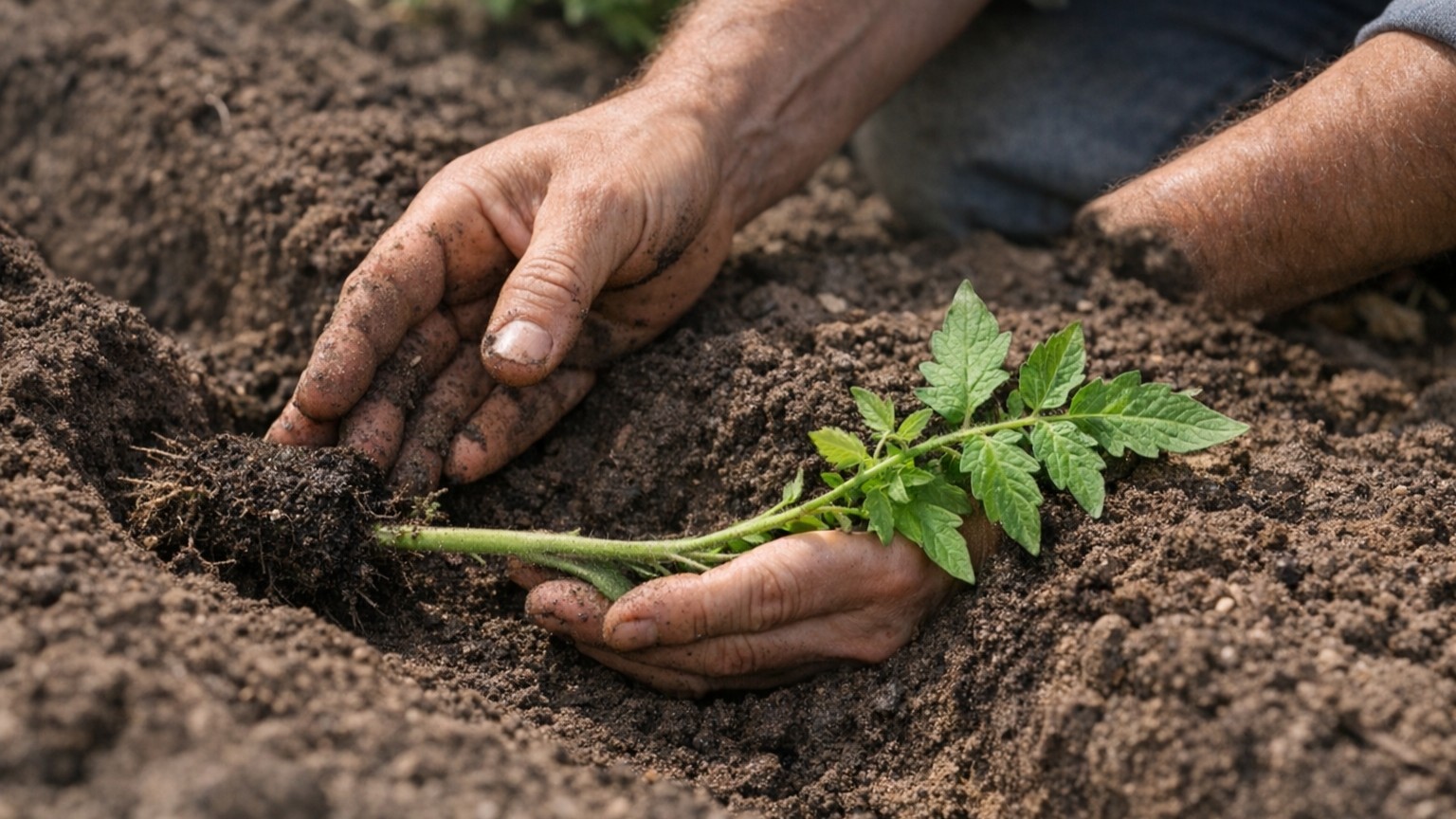
Most gardeners get this wrong on day one. They dig a hole, drop the seedling in straight, pat the soil down, and call it a job well done. Season after season, the plants grow, but the harvest never quite delivers. Not awful, just never great. Then someone lays a tomato plant flat in a shallow ditch and suddenly everything makes sense.
Trench planting isn’t a trendy hack invented by gardening influencers. It’s one of those techniques that experienced growers have passed down quietly for generations, precisely because it works so well and looks so counterintuitive. Watching it done for the first time, your instinct says: that plant is going to die. Three weeks later, it’s thriving harder than anything you planted upright.
Key takeaways
- A simple soil technique used by experienced gardeners produces noticeably bigger tomato harvests than conventional planting
- Tomato plants can do something almost no other vegetable can: grow roots along their buried stems, creating an underground network that changes everything
- The step-by-step method takes less digging effort than deep planting, but the results suggest most gardeners have been planting wrong their entire lives
The biology that makes tomatoes different from every other vegetable
The tomato hails from the Andes Mountains, where it originally grows as a creeping vine. Wherever the stem touches the soil, special cells called parenchyma cells just below the surface of the epidermis begin to divide and grow into new roots. This is not a quirk, it’s a survival mechanism baked into the plant’s DNA over millions of years. And it’s the entire reason trench planting works.
The trenching method takes advantage of a tomato plant’s ability to grow roots along its stem. When part of the stem is buried, it stimulates new root growth wherever the stem is in contact with moisture and soil. While this might sound strange, as most other plants don’t like having their stems buried, tomatoes will produce small, short growths on their stems that first resemble bumps, then become more bristle-like. Those bumps are the beginning of an entirely new root network.
This goes against everything you’ve ever heard about “don’t plant too deep or you’ll kill the plant.” Tomatoes break that rule because they actually have the ability to sprout additional roots along the buried stem. These extra roots strengthen the plant so that it can support more fruit and is better able to survive hot weather. Peppers, cabbages, eggplant, none of them do this. Tomatoes are genuinely exceptional.
What actually happens underground when you plant in a trench
By using the trench method, tomatoes have the benefit of maximum soil-to-stem contact for better root development, plus the warmer soil temperatures found near the surface. That second point matters more than most people realize. Deep vertical planting of tomato seedlings in spring exposes their roots to soil temperatures which may be cooler than those nearer the surface. This can delay the time needed for tomato plants to become established, bloom, and produce fruit. A trench keeps the entire root zone in the warmest band of soil, exactly where a heat-loving plant wants to be.
By burying a significant portion of the stem, either at an angle or laying the root ball almost horizontally in the ground — you stimulate your tomatoes to form new roots along every bit of stem under the soil. This greatly increases the plant’s root surface area. With more roots, your tomatoes can soak up water and nutrients even faster, fueling surprisingly speedy growth. Think of it as trading a single straw for an entire sponge.
A well-rooted tomato plant is more resilient when drought strikes, relying on those deep roots to reach for every drop of moisture lurking below. With a solid underground support system, your tomato’s leafy and fruiting parts above ground will grow and mature more quickly. Tomatoes with a strong, well-developed root system are generally less vulnerable to diseases and tougher against attacks from pests and bugs. One technique, multiple payoffs.
How to actually do it, step by step
The mechanics are simpler than you’d expect. Dig a shallow trench about 4 to 6 inches deep and long enough to accommodate the stem of the seedling. Pinch off the lower leaves of the seedling, and lay it horizontally in the trench, with the top cluster of leaves above the soil line. Fill the trench with soil, covering the stem and leaving the top cluster of leaves exposed. Water the newly planted seedling thoroughly to help it establish.
The benefit to trench planting tall or crooked plants is that it should be less labor intensive. For really tall tomato plants, you would need to dig a super deep hole. In doing so, you may also run into more compacted soil, or clay soil, the deeper you dig. You can save some time and physical effort by trench planting instead. That’s the practical case in a nutshell, less digging, better results.
One detail most guides skip: stake or cage your plants immediately after covering the trench. If you wait until later to stake or cage your trenched plants, you may forget where the stems are buried and risk damaging them. For this reason, it’s best to stake or cage your trench-planted tomatoes right away. The buried stem is doing its root-forming work in the dark, no sense disturbing it a week later with a careless trowel.
Water is concentrated within the trench, reducing waste and maintaining consistent moisture. This is a quiet advantage for anyone gardening through a dry summer. If you live in a cooler climate where the soil takes a while to warm up in spring, trenching your tomatoes can help your plants get going faster. Since most of the root mass will be near the surface, water and fertilizer will also be able to reach the roots more evenly.
The honest tradeoff, and when vertical planting still wins
Trench planting isn’t universally perfect. The problem is most of your new root growth is only a few inches below the soil surface. In regions with long, scorching summers, shallow roots can dry out faster than deep ones. The trench method is best for tall, leggy seedlings and for cooler climates. The vertical method allows you to put the plant’s roots where they can take advantage of a larger reservoir of soil moisture, which is helpful in areas with hot, arid growing seasons. Climate, not habit, should drive the choice.
Science backs the broader principle of deep planting. A study of fall-planted tomatoes in Louisiana showed a benefit of planting to the first true leaf instead of to the top of the root ball in two years at one location. In that study, treatments that lowered the root zone temperature tended to increase yield. The overall trend was for a bit more and a bit larger fruit per plant. Not a revolution, a consistent, reliable improvement.
In loose garden soil, roots commonly reach 18 to 24 inches. Under ideal conditions, tomato roots can go up to 3 feet deep. Most feeder roots stay in the top foot of soil, but deeper roots provide stability and drought tolerance. Whether you trench or go vertical, the goal is the same: give those feeder roots as much prime real estate as possible in that critical top layer of earth.
There’s a reason this knowledge passed from gardener to gardener rather than appearing on the back of a seed packet. It looks wrong. It feels wrong. And yet the plant rewards you precisely because you trusted the biology over the convention. The tomato has been a creeping vine for far longer than it’s been a supermarket staple, sometimes the best gardening advice is just letting it remember what it is.
Sources : gardenbetty.com | canningcrafts.com