
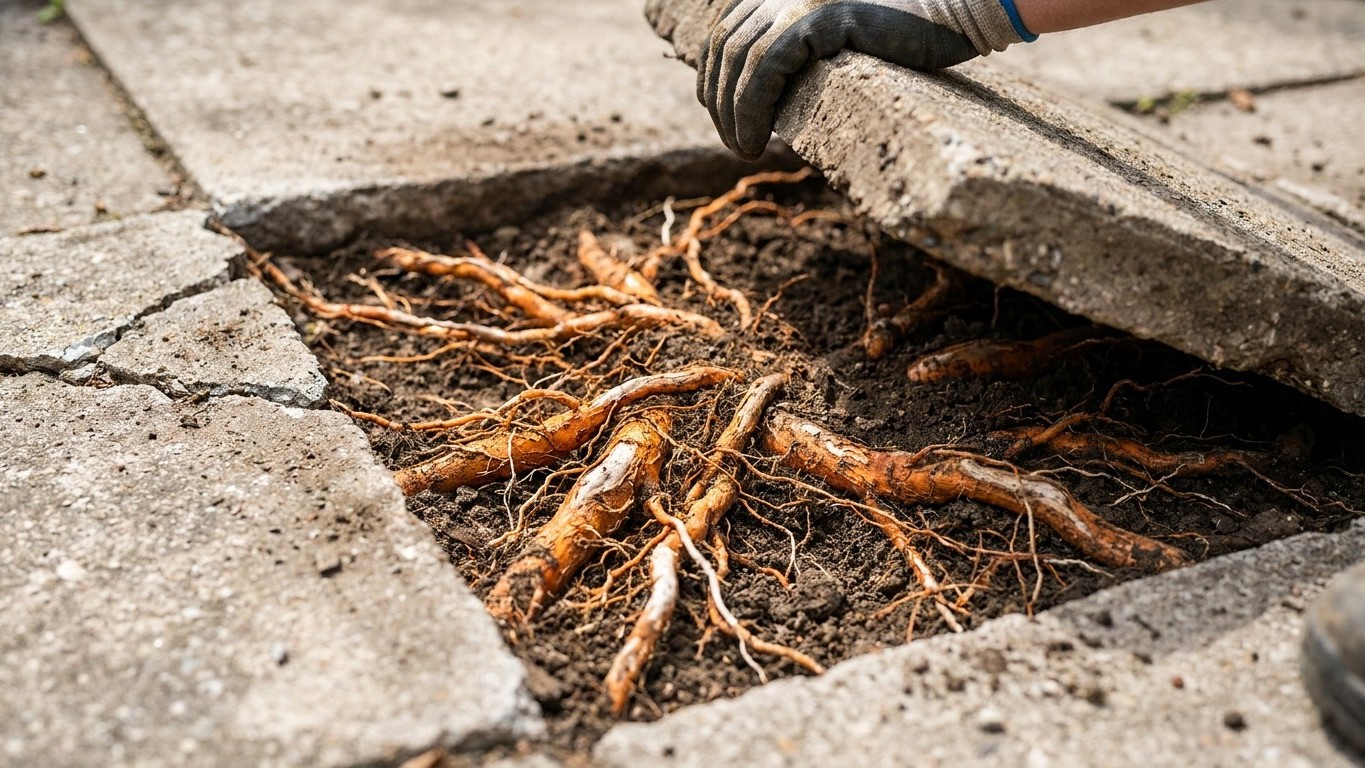
A cracked slab rarely looks like an emergency at first. More often it starts as a hairline. A few seasons pass, the crack widens, and one day you lift the damaged concrete only to find roots, thick, orange, pushing outward in every direction as if the patio never existed. For millions of American homeowners, the culprit was something they planted themselves, feet from their outdoor living space, believing it was harmless greenery.
The problem isn’t the idea of landscaping around your patio. The problem is that plant root behavior underground bears no resemblance to what you see above it. Trees that grow fast above ground grow equally as fast below ground. And many of the most appealing plants sold at garden centers, fast-growing, lush, low-maintenance, happen to be the worst offenders.
Key takeaways
- The plant you innocently placed near your patio may already have roots extending 30+ feet underground
- Trees damage concrete not by punching through it, but by drinking water from soil and causing invisible shifting
- Popular ‘fast-growing’ plants sold at garden centers are often the worst offenders for foundation damage
How Roots Break Concrete (It’s Not What You Think)
Most people picture a root punching straight through solid concrete like a fist through drywall. That’s not quite how it works. A tree’s root system doesn’t usually cause damage to a foundation directly, but it is opportunistic and will invade if it finds a crack. The real mechanism is subtler and, in many ways, more insidious.
Tree roots absorb water from the soil and create voids as they grow, causing the soil to shrink, settle, and move. This shifting puts stress on your foundation, leading to cracks. The soil does the heavy lifting first, then the roots move in. The forces placed on structures by subsiding soil or growing roots are so great that they can cause even a 6-inch thick reinforced driveway to crack. Six inches of reinforced concrete. That number deserves a pause.
There’s a second mechanism that catches homeowners completely off guard. When tree roots absorb water, the soil moisture level is lowered, resulting in shrinkage. This shrinkage causes the movement of underground soil, and the concrete foundation is disturbed. The same happens when water is lost during transpiration, pressure develops under the concrete and causes it to crack. the roots can damage your patio simply by drinking, without ever physically touching the slab.
The Worst Offenders You Might Be Growing Right Now
Silver maple is one of the most popular fast-growing shade trees in American backyards. Silver Maple trees are appreciated for their fast growth and beautiful foliage, but their roots can be a nightmare. They have shallow root systems that spread wide and can easily lift sidewalks or crack driveways, and their rapid growth only exacerbates the problem, as the roots keep expanding year after year.
Bamboo sits in a different category entirely, it’s the plant that fools you with its ornamental appearance. The worst offenders are “running” types, which have large networks of roots and rhizomes (plant stems that grow horizontally underground). These rhizomes are capable of spreading up to 30 feet, and if left unchecked, they invade neighboring gardens and pose a threat to the foundations of houses. Thirty feet. That’s the distance from your patio chair to your neighbor’s fence.
Then there’s Japanese knotweed, a plant so aggressive it has rewritten legal codes in several states. Often mistaken for bamboo due to its hollow, segmented stems, Japanese knotweed is a true nightmare for foundations. Its incredibly strong and deep-reaching rhizome system can exploit tiny cracks in concrete, asphalt, and even solid foundations, causing severe structural damage. The scale is staggering: according to the Environment Agency’s “Knotweed Code of Practice,” Japanese knotweed rhizomes can extend up to seven metres horizontally and three metres vertically from the visible above-ground growth. That means a plant sitting a few feet from your patio edge may already have runners threading beneath every slab. The plant can stay dormant for 20 years until you disturb it, which is why removing it yourself tends to make things worse, not better.
Tree of Heaven (Ailanthus altissima) is another aggressive fast-growing invasive tree whose root system is notorious for exploiting and widening cracks in foundations, sidewalks, and driveways. It self-seeds prolifically and can establish in a single season. You may not have planted it, it may have arrived on its own.
The Rule Nobody Tells You at the Garden Center
A tree’s roots can grow to be wider spread than their canopy. Read that again. The spread you see above ground is actually the minimum indicator of what’s happening below. Tree roots can extend two to three times the height of the tree, so a modest 15-foot ornamental planted at the edge of your patio can have a root system reaching 30 to 45 feet in every direction.
Spacing guidelines exist, but they’re rarely printed on plant tags. Keep medium-sized trees at least six feet from concrete. If you choose larger trees, they should be at least 20 feet away from paths and as far as 50 feet from the house. The practical implication: most suburban patios don’t have that kind of buffer on any side.
Instead of using rigid materials like concrete slabs, flexible pavers installed on sand or gravel bases can shift slightly to accommodate root growth. It’s a design-level solution that prevents the catastrophic slab-lift scenario, and it’s worth considering for any new patio project near existing mature trees.
What You Can Actually Plant Without Regret
The goal isn’t a sterile zone around your patio. It’s informed choices. Good choices for near sidewalks, driveways, and patios include evergreen shrubs like ligustrum and cherry laurel, low-growing shrubs like yew, boxwood, holly, and juniper, and small ornamental trees like dogwood, crepe myrtle, and star magnolia. These species share one trait: relatively contained, non-aggressive root systems that stay close to the plant rather than exploring laterally.
Root barriers add another layer of protection where you want decorative plants closer to hardscaping. Root barriers can be installed between the tree and the foundation or concrete to block roots from spreading toward it. They can be made of various materials, including plastic, metal, or fabric, designed to redirect roots away from vulnerable areas.
For ground covers specifically, shallow-rooted, non-invasive varieties are the answer. The ground cover should be vigorous but not invasive, and dense like a carpet to smother competing weeds. The nuance here: “vigorous” and “invasive” are not synonyms, even though nursery marketing blurs that line regularly. Invasive ground cover plants spread aggressively and refuse to stay where gardeners put them, they grow fast, root wherever they touch soil, and overpower everything around them, including lawns, garden beds, and nearby natural areas.
One fact that rarely surfaces in patio landscaping conversations: even plants removed from your yard can still have active root systems. Cut a bamboo clump down in October and its rhizomes continue working underground through winter, ready to send up new shoots in spring. The above-ground plant disappearing is not the same as the root system dying, a distinction that costs homeowners time and money every year.
Sources : quora.com | a1concrete.com