
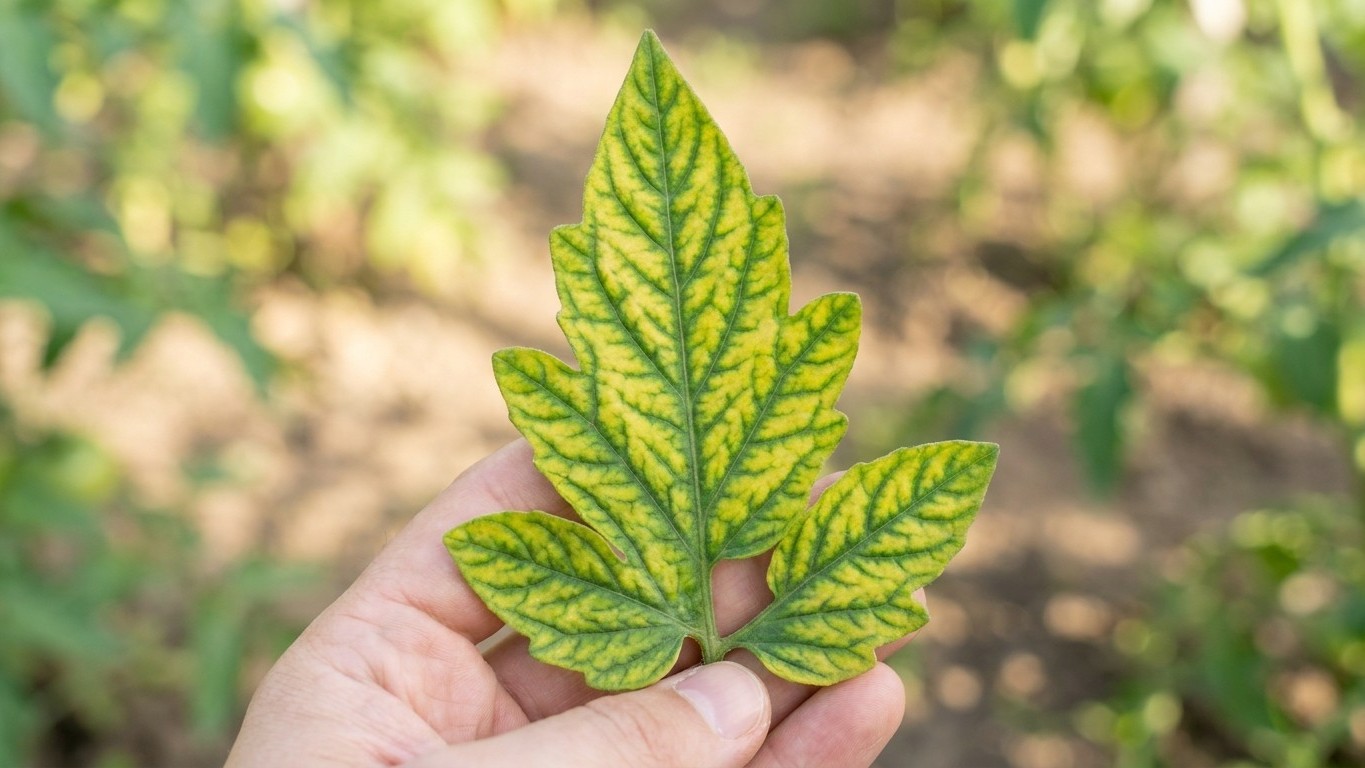
Wood ash looks like the perfect free fertilizer: it’s sitting right there in the fireplace, it’s loaded with minerals, and tossing a shovelful onto the vegetable bed feels like recycling at its finest. But a month after spreading it, when tomato leaves start turning yellow between the veins while the veins themselves stay stubbornly green, something else is going on. That’s not a nutrient deficiency in the soil. It’s a nutrient lockout, and wood ash is often the trigger.
Key takeaways
- A fireplace bucket of ash can shift soil chemistry by a full point in just weeks—with consequences most gardeners never see coming
- The yellowing appears exactly when soil chemistry peaks, which is why the cause gets blamed on everything else
- Iron and manganese are still in your soil; your plants just can’t access them anymore
The Chemistry Behind the Yellowing
Wood ash isn’t a balanced fertilizer. Its main component, often over 25% of its weight, is calcium carbonate, the same active ingredient found in garden lime, which makes it a powerful soil sweetener first and a nutrient source second. That’s the part gardeners forget: ash doesn’t just feed the soil, it fundamentally rewrites its acidity.
When calcium carbonate dissolves in soil moisture, it kicks off a chain reaction. The calcium ions push hydrogen ions, the source of soil acidity, off the soil particles, and this exchange raises the soil pH, making it less acidic. In soil that started out on the acidic side, that shift is genuinely helpful. This pH shift unlocks some nutrients and locks up others: in acidic soil, nutrients like phosphorus, calcium, and magnesium are less available to plants, and raising the pH frees them up.
The trouble starts when the pH climbs past where most vegetables want to live. Vegetables grow best in soil between pH 6.0 and 6.8, slightly acidic and squarely in the range where most plant nutrients become available to roots. Push past 7.0, and the equation flips. As soil pH rises above 6.5, the iron and manganese present in the soil increasingly convert to forms unavailable to plant roots. The minerals are still down there. Test the soil and you’ll find plenty of iron. The plant just can’t reach it anymore, because the chemical form it’s locked into is one roots can’t absorb.
Reading the Leaves: Interveinal Chlorosis Explained
That yellow-with-green-veins pattern has a name: interveinal chlorosis. The chlorosis caused by deficiencies of these nutrients is often referred to as “interveinal chlorosis” since the veins remain green while the rest of the leaf turns lighter green to yellow-green. It shows up because iron and manganese are needed by plants to form the green pigment chlorophyll and to complete photosynthesis. Without them in an absorbable form, chlorophyll production stalls exactly where you’d expect: between the veins, where the youngest tissue depends most on a steady supply.
Timing matters here, and it lines up with a lot of gardeners’ actual experience. Wood ash is not a fast acting liquid fertilizer; it needs a full 4 to 6 weeks after applying ash before soil chemistry reacts and plant changes become visible, because it needs time to dissolve in soil moisture and react with the existing chemistry. That’s almost exactly the one-month window where the yellowing tends to appear, which is why the cause-and-effect connection so often gets missed. Nobody’s watching the fireplace ash bucket a month later when the leaves turn.
It isn’t only about iron and manganese, either. Tomatoes develop blossom-end rot from calcium lockout despite calcium being present in the soil once pH climbs too high, and potatoes are particularly vulnerable, since scab disease becomes more prevalent in high-pH soil and is far less common when pH sits between 5.0 and 5.2. Wood ash spread anywhere near a potato bed is asking for trouble.
Using Ash Without Sabotaging Your Own Garden
None of this means wood ash belongs in the trash. Used with restraint, it’s a legitimate source of potassium and calcium, and it costs nothing. The fix is simple, if unglamorous: test before you spread. Wood ash works best if soil pH is somewhat acidic, below 6.5, and when used at pH levels above 6.5, interference with plant growth may occur as the alkalinity level of the soil increases. A basic soil test kit from a garden center, or a sample sent to a state extension office, tells you in a few days whether your soil is even a candidate.
The recommended pH range for a vegetable garden sits around 6.2 to 6.8, and wood ash should not be added if soil pH already falls within that range. If a test comes back at 6.5 or higher, the ash stays in the bucket. If it comes back acidic, moderation still applies: a light sprinkle, roughly one small handful per square meter, about 70 to 100 grams, is usually enough. Piling it on thicker doesn’t double the benefit; it just accelerates the overshoot.
A few other habits keep ash from becoming a liability. Work it into the top layer of soil rather than leaving it on the surface, since it should be worked into the soil before planting and incorporated into the top 4 to 6 inches with a garden fork so it doesn’t form a surface crust. Keep it away from seedlings and tender stems, since direct contact can cause burn. And source matters as much as quantity: only ash from clean, untreated, unpainted hardwood or softwood belongs in the garden, never ash from charcoal briquettes, cardboard, or treated or painted wood, which can carry lead, arsenic, and other toxins.
If the yellowing has already started, don’t reach for more ash or more fertilizer to compensate. Applying elemental sulfur or organic matter such as compost or pine needles can gently lower pH back down over time. Retest after a few weeks rather than guessing, since the plant’s recovery depends on the soil chemistry actually shifting back, not on adding more nutrients that will just get locked up the same way.
What trips up most home gardeners isn’t wood ash itself. It’s treating it like a neutral, feel-good amendment instead of what it really is: a fast-acting liming agent that can swing soil chemistry by a full point in a matter of weeks. The fireplace bucket is a resource worth using, but it deserves the same respect as a bag of garden lime, measured out after a soil test rather than eyeballed on a whim between raking leaves and stacking firewood.
Sources : lifeandwork.blog | woodworkscience.com