
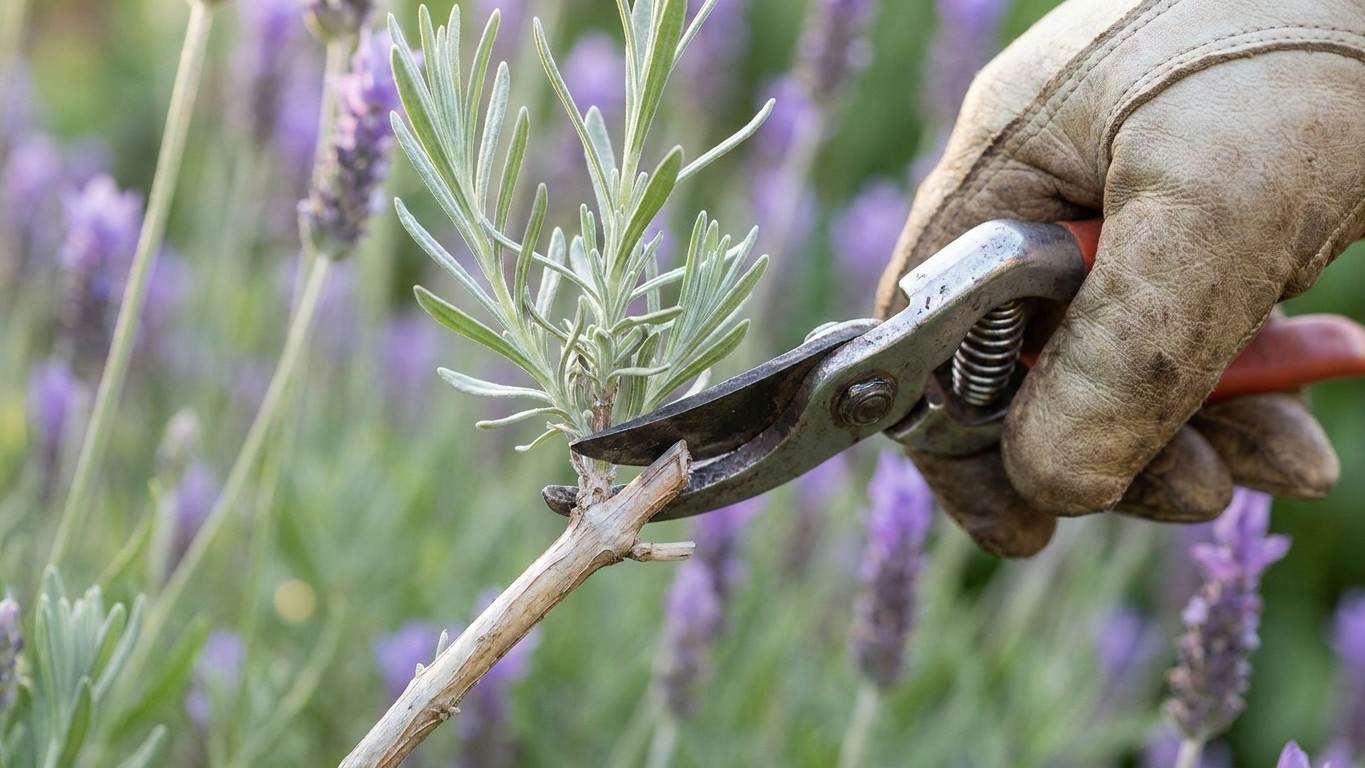
My father’s lavender hedge outlived three lawnmowers, two dogs, and one ill-advised attempt by my mother to turn half the yard into a vegetable patch. Every summer, shears in hand, he’d work down each stalk and stop the exact moment the silvery-green stem turned pale and woody. As a teenager, I thought he was just being overly cautious, leaving the plants shaggy and unfinished. I was wrong, and the reason why has everything to do with how lavender actually grows.
Key takeaways
- A childhood memory of careful pruning becomes a lesson in plant biology and generational wisdom
- Lavender’s growth-initiating cells only exist in green tissue—cut into the woody part and it’s gone forever
- The two-cut system perfected through trial and error turns out to be exactly what horticultural science recommends
Why Lavender Never Forgives a Cut Too Deep
Lavender isn’t a true shrub and it isn’t a soft perennial either. It sits in an awkward middle category gardeners call a semi-shrub: it produces green growth every spring, like all perennials, but older stems become woody as the plant grows older. That distinction Matters More Than most people realize when they pick up a pair of shears.
Here’s the part that surprised me most once I finally looked into the science behind my father’s habit. The growth-initiating cells at leaf nodes that drive new shoots exist only where green tissue remains, and as a stem lignifies, those cells are lost. Cut below that line, into the gray, papery wood, and there’s nothing left to regenerate from. Lavender’s bark also becomes dense as it ages, part of why the plant handles drought so well, but it means dormant buds can’t break through even if any remained, so cutting into bare brown wood removes the only tissue capable of producing new growth. The stem is finished. No amount of water, sun, or apology brings it back.
That’s precisely why nearly every horticultural source lands on the same warning. It’s really important to never cut into the old wood, as this will slow or, in most cases, stop new growth altogether. My father, who never read a single gardening manual in his life as far as I know, had somehow absorbed this rule through pure trial and error. Probably by killing a plant or two before I was old enough to remember.
The Two Cuts My Father Never Skipped
What looked to me like one lazy summer trim was actually the second half of a yearly rhythm. Lavender specialists now describe this as a two-cut system, and it lines up almost perfectly with what I watched him do without ever explaining it. The first pass comes right after the blooms fade, when the structural cut happens after the main bloom finishes, removing the spent flower spikes and shortening the season’s growth back to a compact, rounded mound, which removes weight that would otherwise split the plant and stimulates the remaining green stem nodes to branch and thicken the green zone for next year.
The second pass, lighter and almost fussy by comparison, happens in late winter or early spring. This is the spring tidy, once you can see the first flush of fresh grey-green growth on the stems, a lighter pass where you’re removing only the winter-damaged tips and any growth that’s crept beyond the dome shape. Skip either one, and the plant’s compact silhouette starts to unravel within a couple of seasons.
The general rule of thumb, echoed across nurseries and extension offices, is to take back roughly a third of the plant each time. Cut back the shrub to about one third of its original height but do not cut down to the woody area, as old wood will not generate new green growth, leaving three or four buds above the woody part of a stem as a good rule. My father’s version was less mathematical. He’d just eyeball where the color changed and stop there, every single time, like it was muscle memory.
What Happens When You Ignore the Green Line
I’ve since seen what neglect looks like, because a neighbor two doors down let her lavender go untouched for the better part of a decade. By year six or eight, it had turned into a tangle of bare gray branches with a thin fringe of green clinging to the tips, and hardly any flowers left. That’s a textbook case. Lavender shrubs bear bright, fragrant blossoms and can live for 20 years or more, but after six or eight years, they can begin to look woody, filled with dead wood and bearing fewer of their sweet-smelling flowers. The plant essentially runs out of green real estate to renew itself from.
Even when a plant reaches that state, there’s a narrow, patient path back. The trick is looking for green shoots by carefully examining the base and along the woody stems for any tiny green shoots emerging, particularly near the ground, which is the best indicator of success, and if you see some, it’s a good sign the plant still has life and can potentially regenerate. Some gardeners even use a scratch test, nicking the bark with a fingernail. Gently scratch the surface of a woody stem, and if you see green underneath, that part of the stem is still alive; if it’s brown and dry, it’s likely dead wood. But rejuvenation like this is a gamble spread over multiple years, not a quick fix, and there’s never a guarantee it works.
My father never once let his plants get to that point, which is really the quiet genius of his approach. He wasn’t being timid with those shears. He was protecting the only part of the plant capable of coming back, year after year, without ever needing to explain the biology to a skeptical kid holding a rake. These days I catch myself doing the same thing in my own garden, stopping right where the green fades to gray, and I finally understand it wasn’t hesitation at all. It was the whole secret.
Sources : housedigest.com | gardeningknowhow.com