
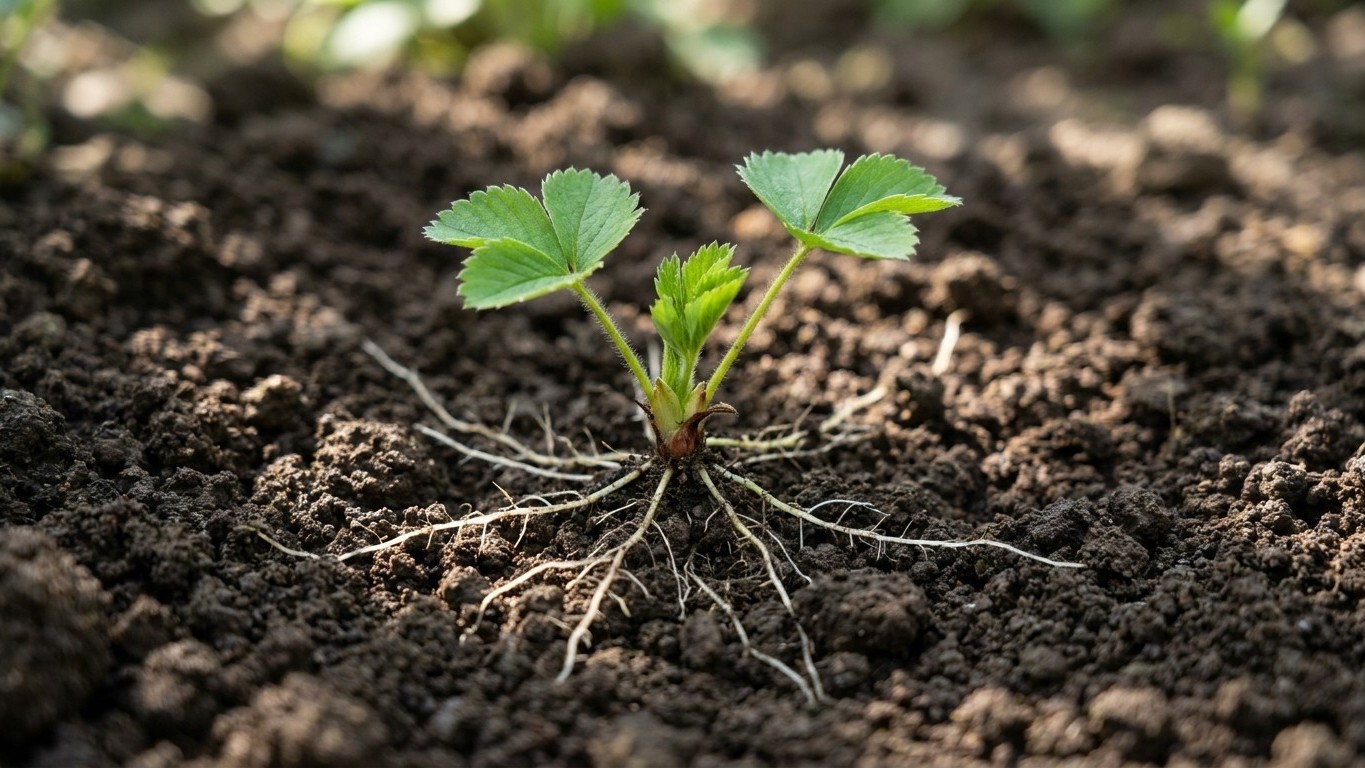
Four rooted plantlets, four hopes for a fuller strawberry patch. The following June, only one of them handed over a single berry. That kind of harvest gap feels like a personal failure, but it’s actually one of the most predictable outcomes in strawberry propagation, and it has almost nothing to do with how carefully those runners were pinned into the soil.
Strawberries put their energy where it counts most for survival, not for your fruit bowl. Young strawberry plants, especially June-bearing varieties, are biologically programmed to spread before they focus on fruiting. A daughter plant that just spent its first weeks growing roots into new soil is, from the plant’s perspective, still in survival mode. Berries are a bonus it hasn’t budgeted for yet.
Key takeaways
- A freshly rooted strawberry runner is biologically in ‘survival mode’—berries are a luxury it hasn’t budgeted for yet
- Timing matters more than most gardeners realize: runners rooted after September won’t accumulate enough crown mass before winter dormancy
- Wild strawberries follow completely different propagation rules than commercial garden varieties, which explains why standard advice fails
Why a freshly rooted runner skips its first harvest
The math behind that one-out-of-four result is almost mechanical. If a runner plant is put in the ground in spring, you generally shouldn’t expect production that year, since flowers are typically pinched off to maximize root establishment and flower bud formation for the following season. Cut a runner too early or too late, and the daughter plant simply doesn’t have the crown mass to push out a real flower cluster before winter dormancy kicks in.
Timing turns out to matter more than gardeners usually admit. Oregon State University Extension has found that runners rooted before September 1 are significantly more productive than late-rooted ones, since late-rooted runners don’t accumulate enough leaf area and crown mass before autumn flower initiation. Miss that window by even a few weeks, and the plant enters winter undersized, which shows up the following June as a sparse, single-berry result instead of a full clump of fruit.
Overcrowding compounds the problem in a way that’s easy to overlook when you’re trying to fill an empty bed. Nurseries that grow strawberries commercially are strict about spacing for a reason: rows are typically filled by allowing just two to four daughters to take root on each side of the mother plant, evenly spaced five to eight inches apart with good soil contact around their roots. Pack in more plantlets than that, and the roots start competing for the same patch of nutrients before any of them are strong enough to compete well.
Wild strawberries play by different rules
Here’s the detail that changes everything about that four-plantlet experiment: true wild strawberries don’t behave like the garden hybrids most propagation advice is written for. Wild strawberry varieties are generally the exception to standard runner propagation, since they must usually be propagated by seed, with horizontal stems that grow from the base of the plants and form nodes. That single sentence explains a lot of disappointing Junes. A rooted runner from a wild strawberry (Fragaria vesca, the small-fruited woodland species) is genetically capable of cloning itself vegetatively, but the species evolved to spread mainly by seed dispersed through birds and small mammals eating the fruit, not by runner networks optimized for fruit production the way modern garden cultivars are.
That distinction matters because most of the propagation guidance circulating online, including tips about fertilizer ratios and rooting hormone, was written with Fragaria x ananassa, the commercial garden strawberry, in mind. Wild strawberry patches naturally colonize an area through runners, but the daughter plants prioritize territorial spread over fruit set in their first bearing attempt. One thriving plantlet out of four isn’t a rooting failure; it’s closer to what the species does on its own in a forest clearing.
What actually predicts whether a daughter plant fruits
Energy allocation inside the plant is the real bottleneck, and it’s finite. Strawberries have finite energy reserves, and every calorie directed toward runner growth is a calorie stolen from berry development. A plantlet that spent its first season anchoring roots, building leaf canopy, and possibly sending out its own baby runners simply hasn’t stored enough carbohydrate reserves in its crown to force out a strong flower truss the next spring. The one plant that fruited in that four-plantlet batch was probably the one that rooted earliest, got the best light, or faced the least competition from its siblings.
Density inside the bed plays a quieter but persistent role too. Plants set too close together suffer from limited airflow, which is a top cause of fungal disease on strawberry foliage and fruit, so good runner management balances filling the bed against overcrowding. University of Minnesota Extension echoes that runner management is one of the most important factors in keeping a strawberry bed productive year after year, according to University of Minnesota Extension, proper runner management is one of the most important factors in maintaining a productive strawberry bed year after year.
Turning a thin harvest into next year’s payoff
The fix isn’t rooting more runners next spring. It’s rooting fewer, earlier, and giving each one room to actually establish before asking anything of it. Cut runners loose from the mother plant by mid to late summer instead of waiting until fall, space daughter plants generously rather than cramming four into the gap where one used to be, and resist the urge to let every single plantlet stay attached and rooting simultaneously.
One quiet fact rarely mentioned in propagation guides: a single vigorous strawberry mother plant can throw off dozens of runners in one season if left unmanaged, which is exactly why patches that look lush in July often disappoint in June. The plant isn’t failing you. It’s just following a survival script written millions of years before anyone cared about jam.
Sources : bloomingexpert.com | thegroundedhomestead.com